A surreal, frenetic portrait of LA’s streets in the ‘70s
- Text by Miss Rosen
- Photography by Gary Krueger

American photographer Gary Krueger attributes his success to luck, chalking it up to an undeniable knack for being at the right place at the right time. After graduating high school in 1963, Krueger hopped in his 1954 Ford and drove west from his native Cleveland, Ohio, to Los Angeles to study graphic design and photography at Chouinard Art Institute, which later became the fabled California Institute of the Arts.
“I was one of four people in the ‘60s who didn’t take drugs that went to art school. I was the casual observer of what was going on,” Krueger says. “I’ve always had a camera, Brownie Starflash, but it was never anything serious. After I got into Chouinard, I made one print in the darkroom and went, ‘This is fucking magic!’ It knocked me out.”
After graduating in 1967, Krueger got a job working at the ‘Imagineering’ division of Disney to photograph the park and its events. “After six months, I decided I’m going to be a photographer,” he remembers.


Krueger quickly struck gold when he landed a cover for West magazine. “I got $250. Well, it might as well have been a million dollars! This is 1967. To give you an idea, gasoline was 11 cents a gallon. My rent was $55 a month.”
Self-employed since March 1968, Krueger has maintained a successful editorial and commercial photography career despite being “very unaggressive about selling my work. I was just glad to work. I’m good but extremely lucky that people call me back.”
And sometimes, they simply call out of the blue. Last autumn, Krueger received a call from gallerist Joseph Bellows asking if he was “the Gary Krueger that Camera magazine out of Switzerland did an article on in 1971.” Indeed, he was. “One thing led to another, and he gave me a show. That’s what I mean about being at the right place at the right time,” Krueger says.


In the new exhibition Gary Krueger’s City of Angeles, 1971-1980, Krueger takes us on a trip back in time, when the photographer was hanging out on Hollywood Boulevard, in downtown LA, attending parades, pageants, and Hollywood parties making pictures for himself.
“I don’t know what got me into street photography. It just happened. I can’t tell you why I take pictures but I can show you why I take pictures. I’m more calculated in my more contemporary work. I’m a graphic designer and this was the complete opposite. Street photos are like chaos. In design, less is more and this is a different story,” he says.
“All my street photos are shot with a 35mm lens on a 35mm camera. I don’t do zoom lens; I don’t get down on the ground and shoot like Elliott Erwitt at a dog. Everything is shot at eye level and they’re all horizontal. I just said to myself, that’s what I’m going to do.”
And so he did. Looking back at the 1970s, Kruger reveals, “I’m 75 and I don’t think the world is ever going to be as good as it was for us. I really think we lived in the Golden Age. It was a different world.”


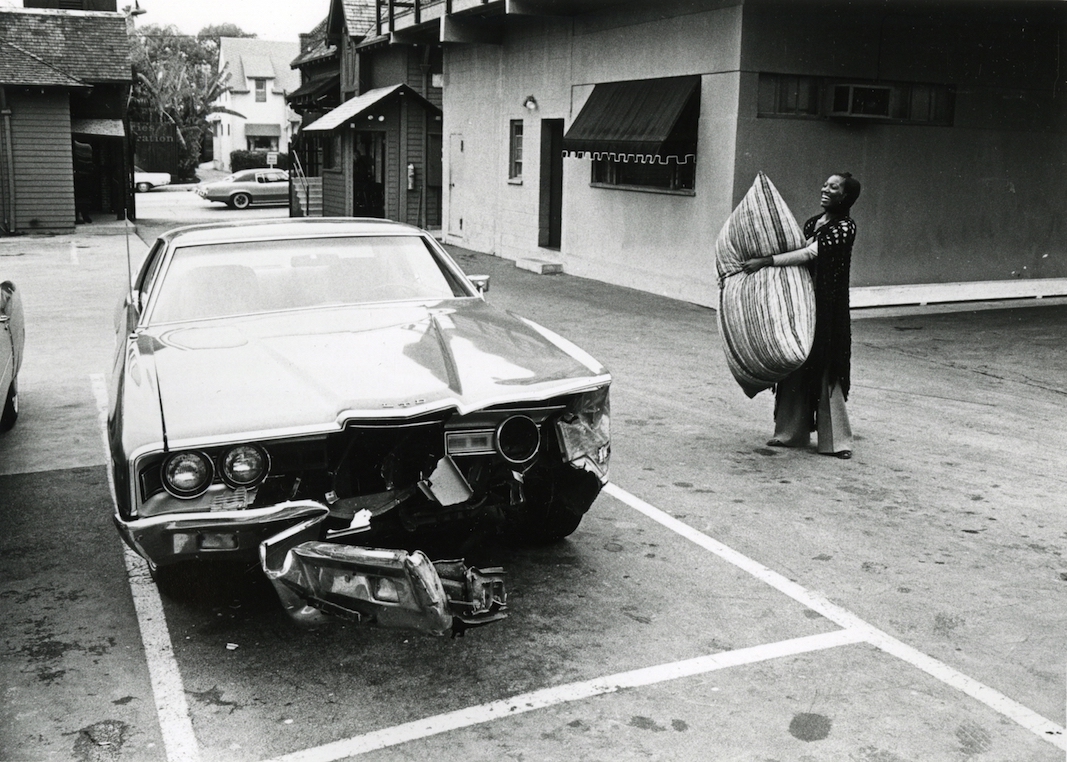
Gary Krueger’s City of Angeles, 1971-1980 is on view at Joseph Bellows Gallery in La Jolla, CA, through March 19, 2021.
Follow Miss Rosen on Twitter.
Enjoyed this article? Like Huck on Facebook or follow us on Twitter.
You might like

On the set of ‘La Bamba’, lost Latino legend Ritchie Valens’s biopic
The overnight rockstar — The Chicano rock & roll star exploded overnight in the late ’50s, but just as quickly he was gone, killed in a plane crash along with Buddy Holly. An ’80s biopic saw him immortalised on the big screen, which photographer Merrick Morton captured behind the scenes.
Written by: Miss Rosen

Louis Theroux’s ‘Manosphere’ shows men aren’t the problem, platforms are
No Ws for Good Men — The journalist’s new documentary sees him dive headfirst into the toxicities and machinations of the male influencer economy. But when young creators are monetarily incentivised to make more and more outrageous content, who really is to blame?
Written by: Emma Garland

In the 1960s, African photographers recaptured their own image
Ideas of Africa — An exhibition at the Museum of Modern Art explores the 20th century’s most important lensers, including Seydou Keïta, Malick Sidibé and Kwame Brathwaite, and their impact on challenging dominant European narratives.
Written by: Miss Rosen

Reynaldo Rivera’s intimate portrait of queer Latino love
Propiedad Privada — Growing up during the AIDS pandemic, the photographer entered a world where his love was not only taboo, but dangerous. His new monograph presents inward-looking shots made over four decades, which reclaim the power of desire.
Written by: Miss Rosen

In photos: The newsagents keeping print alive
Save the stands — With Huck 83 hitting shelves around the world, we met a few people who continue to stock print magazines, defying an enduringly tough climate for physical media and the high street.
Written by: Ella Glossop

Inside Bombay Beach, California’s ‘Rotting Riviera’
Man-made decay — The Salton Sea was created by accident after a failed attempt to divert the Colorado River in the early 20th century. Jack Burke reports from its post-apocalyptic shores, where DIY art and ecological collapse meet.
Written by: Jack Burke


