A visual ode to Hungary’s declining pub culture
- Text by Isaac Muk
- Photography by Zsófia Sivák

In 2011, when Zsófia Sivák was 18, she moved from a small village in eastern Hungary to the country’s capital and biggest city, Budapest. She was to attend the Moholy-Nagy University of Art and Design in order to pursue her dream of becoming a photographer. It should have been an exciting time, studying photography and living in the traditional centre of the country’s arts and culture scenes, as well as having countless young, like-minded people surrounding her.
But what she found, similarly to many others who migrate from rural to urban areas, was that the big city was not so friendly. “It was a really difficult period – turbulent and emotional,” Sívak says. “Because in the university, most people were from a different social class and they were different to people in my hometown.”

Having spent most of her youth thinking about leaving her village and dreaming of the bright lights of the big city, during this time she found herself doing the opposite – yearning for home. Sívak had always used her camera to document her surroundings and understand her identity, and she started being drawn to making pictures of rural Hungarian life.
“It was a therapeutic process for me,” she says. “Circling around my identity, finding out who I really am.”
One aspect of village life Sívak found herself drawn towards was the rural Hungarian pub. As boisterous, social places with flowing beer and loud chatter that her father used to take her to when she was a child, she associated pubs with fun and community. Naturally, she decided to begin a photographic project documenting the taverns and pubs of her home region.
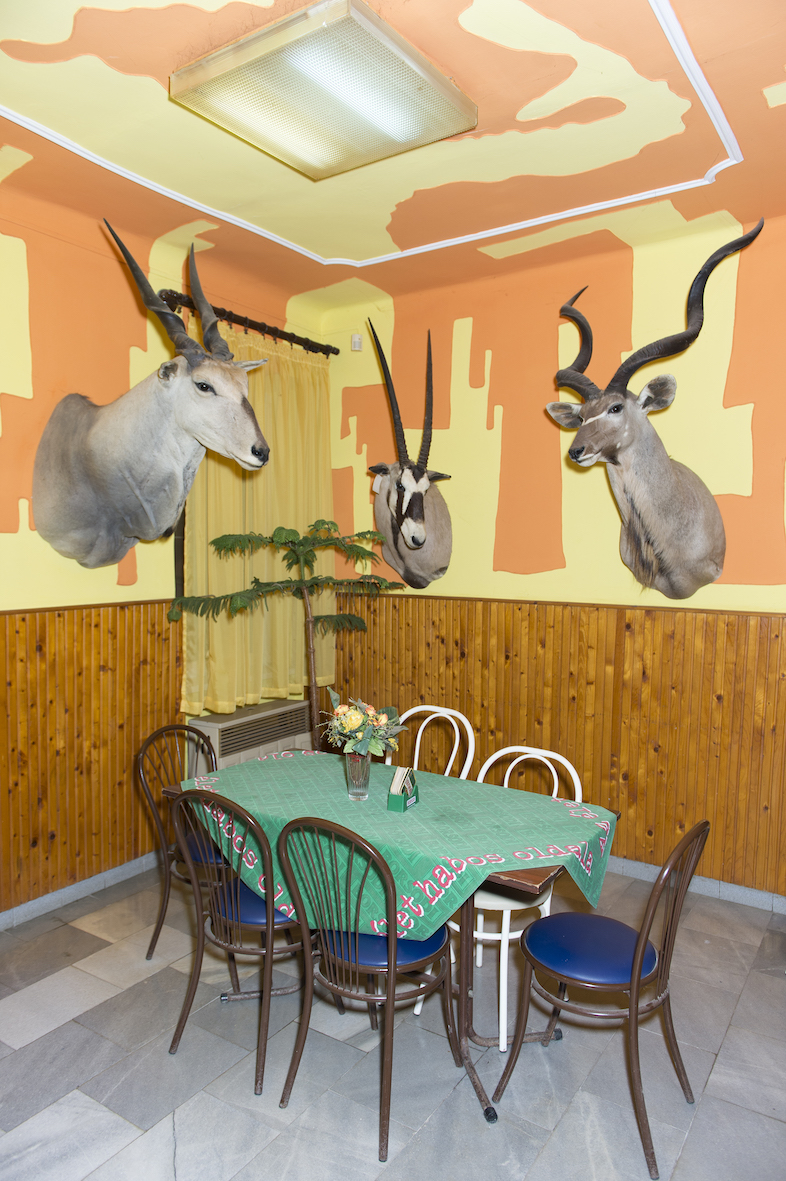

But what she found was a culture in decline, with many pubs struggling to make ends meet. As people struggle financially in rural areas, as well as a large trend towards people leaving for cities, she found taverns closing down or often populated with very few customers. Her ongoing series Our Prices are in Forints documents the fall off of the tavern culture, and the last bastions of the rural Hungarian pub.
“At first I thought pubs were happy places, with people drinking and dancing,” Sívak explains. “But once I started to go, I realised that no one goes to pubs anymore, and just some old people sitting around tables.”
As one of the few places in rural areas people would gather to socialise, the taverns have historically played an important part in Hungarian society. The photographs capture the unique beauty of the establishments, with simple designs and pastel furnishings, as well as the people who keep the tradition and spirit alive – the landlords and few remaining patrons.

Their fall in popularity is a story as much about poverty in the Hungarian countryside as about a decline of a culture. “People have less and less money, even for their basic needs,” Sívak says. “They don’t go to the bar at the end of the month because they don’t have money to pay for the beer, which is shocking because one beer costs around half a Euro.”
The pictures reflect this: a number of the shots are of empty venues, and when people do appear, there are rarely more than one or two subjects. This was despite the fact that Sívak usually only travelled to the rural pubs during the busier periods at the beginning of the month, when people have recently been paid and therefore have more money to spend on beer.

Many landlords she met believed that they would be the last ones of their taverns. “The pub owners are worried about closing,” she says. “These are family business, and young people just don’t want to care for them anymore.”
But on the other side of the bar among customers, Sívak heard a different story. “It seems like they don’t worry that much,” she says. “Because it’s a process in society – these places just dismantle over time and they disappear. It’s not something they can react to, they just accept how these processes happen.
“Rural places are becoming poorer, the money is disappearing” she continues. “It creates more distance between people and the social classes – there will only be an abandonment of these places.”


Follow Zsófia Sivák on Instagram.
Follow Isaac Muk on Twitter.
Enjoyed this article? Follow Huck on Twitter and Instagram.
You might like

Landmark new exhibition is celebrating 50 years of female punk
God Save the Queens – The Museum of Youth Culture is bringing together rare photography, archive material and a one-night-only supergroup featuring members of X-Ray Spex, The Slits and The Raincoats.
Written by: Ella Glossop

Halcyon, end of summer days in ’80s Massachusetts
Bell Pond — Stephen DiRado’s new photobook is a nostalgic look at blissed out moments of young love, family and coming of age at a swimming pond in Worcester, Massachusetts.
Written by: Miss Rosen

Photographing America’s 20th century rebels
Rebels With a Cause — A new monograph looks back at Jean-Pierre Laffont’s extensive archive documenting counterculture, art, activism and more, shaping the country as it is today.
Written by: Isaac Muk

The groundbreaking photography of Gordon Parks
Voices in the Mirror — A new exhibition dives deep into the legendary lensman’s archive, who captured the Civil Rights Movement and Black America like no other.
Written by: Miss Rosen

A chaotic portrait of an ’80s American farming family
Holy Cow! — Melonie Bennett grew up on a farm in Maine in the ’80s, and documented her family’s idiosyncratic daily life. She presents those humorous, everyday memories in a new exhibition and photobook.
Written by: Miss Rosen

Nick Danziger’s striking vision of everyday British life in the ’90s
The British 1994-1999 — The renowned photojournalist returned to his birth country on the cusp of the Millennium, capturing its contradictions with humour and wit.
Written by: Miss Rosen


