Remembering Keith Haring’s final years
- Text by Miss Rosen
- Photography by Keith Haring

As a teen growing up in New Jersey during the 1980s, artist Karey Maurice Counts set his sights on the downtown New York art scene. “I was looking for Andy Warhol, just like everyone else,” he remembers.
Counts began travelling into Manhattan, following the nightclub and art gallery scene through publications like The Village Voice. While taking the subway around town, Keith Haring’s chalk drawings works soon caught his eye. In conjunction with the exhibition Keith Haring at the Tate Liverpool, Counts shares his memories of their first encounter, which would forever change his life.
After learning about Haring’s Pop Shop, Counts headed into the Village to search him out. Bipo, the store manager, tipped Counts off to a photo shoot for a song titled “Crack is Wack”, which was going to be shot in front of the famed Harlem mural on April 22, 1987. He told him to bring some photographs of his paintings to show Haring.
“No one knew if Keith was going to show up because he had been in Europe,” Counts recalls. “We did some Polaroid shots in front of the mural, then the real shots and we took a break. We were drinking beer and this lanky, white guy came riding up on an orange mountain bike, little red hat, and glasses. He asked if he could have some of my beer I said, ‘Sure.’ Then someone said, ‘Hey Keith, where do you think we should set up?’”
Haring ended up reviewing Counts’ work, and invited him to his Soho studio later that day. “That was the most important day of my life in terms of art and artists,” Counts says of his entrée into the downtown scene. He describes the wonder of seeing works by Andy Warhol and Kenny Scharf, as well as Haring’s legendary chair from Vamp and the original art for the Absolut Haring ad.
Soon Haring began to open up, sharing life lessons with the budding artist. “He told me what I needed to do and who I needed to know,” Counts recalls. “I was getting schooled. I kept thinking to myself, ‘No one is going to believe this!’”
That first encounter led to a three-year friendship that continued until Haring’s untimely death. Counts worked at the Pop Shop and became the artist’s personal confidant; remaining close to Haring even when many abandoned him after he fell victim to AIDS.
“Keith was the one person that said to me, ‘You have what it takes,’” Counts remembers. “He saw photos of my paintings and that was all he needed to know. Keith said to me, ‘We met for a reason’ the first day we met.”
“He took me to parties and shows, and we discussed art. It’s all I needed to continue what I am doing. I look at Keith at that time as inspiration. He showed me through sickness you still have to work and produce and give to the world what you intended to do. That’s the key.”

Keith Haring, Safe Sex! 1987. Collection Noirmontartproduction, Paris

Grace being painted by Keith 1986. ARTIST ROOMS Acquired jointly with the National Galleries of Scotland through The d’Offay Donation with assistance from the National Heritage Memorial Fund and the Art Fund 2008

Keith Haring, Ignorance = Fear 1989. Collection Noirmontartproduction, Paris

Keith Haring, Untitled 1980. Collection of the Keith Haring Foundation
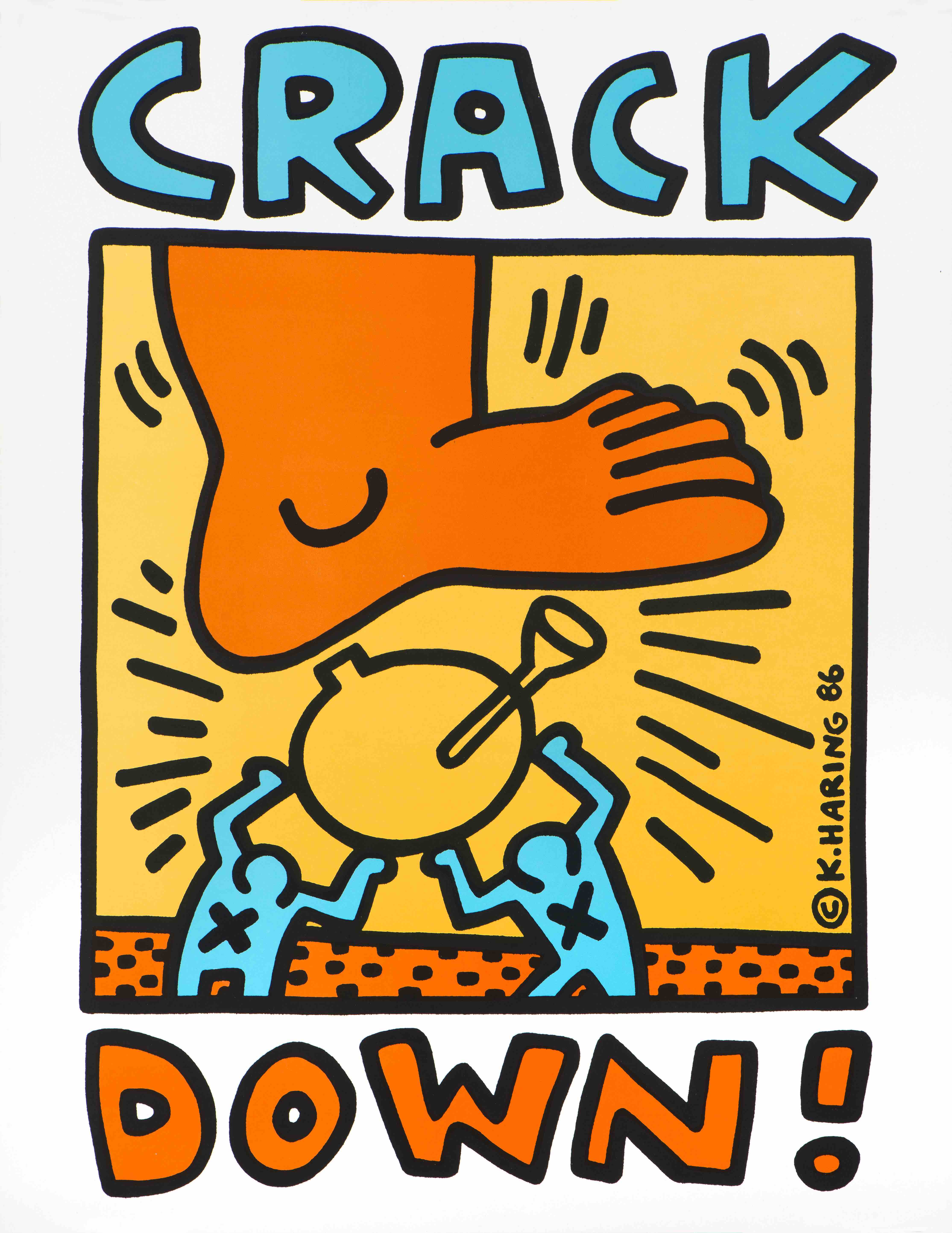
Keith Haring, Crack Down! 1986. Collection Noirmontartproduction, Paris

Keith Haring, Reagan’s Death Cops Hunt Pope 1980. Collection of the Keith Haring Foundation

Karey Maurice Counts
Keith Haring is currently on view at the Tate Liverpool until November 10, 2019.
Follow Miss Rosen on Twitter.
Enjoyed this article? Like Huck on Facebook or follow us on Twitter.
You might like

When David Wojnarowicz became Arthur Rimbaud
Arthur Rimbaud in New York — In 1978, the American artist and his friends donned masks to pay tribute to the French poet, who was born a century before him. Miss Rosen traces the differing yet parallel lives of the queer revolutionaries.
Written by: Miss Rosen

On the set of ‘La Bamba’, lost Latino legend Ritchie Valens’s biopic
The overnight rockstar — The Chicano rock & roll star exploded overnight in the late ’50s, but just as quickly he was gone, killed in a plane crash along with Buddy Holly. An ’80s biopic saw him immortalised on the big screen, which photographer Merrick Morton captured behind the scenes.
Written by: Miss Rosen

DJ AG has redefined DJing. Festivals are next.
From small streams, mighty rivers flow — The London streamer has democratised an art traditionally hidden away in clubs and basements with his easy-to-access, spontaneous, open platform street performances. With AG Fest lined up for the summer, Oliver Keens speaks to him about staying humble, the importance of community, and his dream to open a care home.
Written by: Oliver Keens

Louis Theroux’s ‘Manosphere’ shows men aren’t the problem, platforms are
No Ws for Good Men — The journalist’s new documentary sees him dive headfirst into the toxicities and machinations of the male influencer economy. But when young creators are monetarily incentivised to make more and more outrageous content, who really is to blame?
Written by: Emma Garland

In the 1960s, African photographers recaptured their own image
Ideas of Africa — An exhibition at the Museum of Modern Art explores the 20th century’s most important lensers, including Seydou Keïta, Malick Sidibé and Kwame Brathwaite, and their impact on challenging dominant European narratives.
Written by: Miss Rosen

Reynaldo Rivera’s intimate portrait of queer Latino love
Propiedad Privada — Growing up during the AIDS pandemic, the photographer entered a world where his love was not only taboo, but dangerous. His new monograph presents inward-looking shots made over four decades, which reclaim the power of desire.
Written by: Miss Rosen


