Why you need 35,000 followers to see this artist’s show
- Text by Jonathan Turton
- Photography by Jonathan Turton

“[These] mutts are disrespecting my artistic vision,” wrote New York artist Wizard Skull in a recent Instagram post, referring to critics of his controversial new show, On My Level. The week-long exhibition, which ran at the Lazy Susan Gallery earlier this month, was only accessible to visitors who have at least 35,000 followers on social media.
Wizard Skull – real name Alexander Duke – is no art novice: his work has previously appeared at New York’s MOMA. In recent years, he’s become a ubiquitous face of the city’s art scene, where his freely distributed zines and cartoon-inspired pop art have won him many fans. On My Level, however – which the artist claims started out as somewhat of a joke – has divided audiences, and become a provocative commentary on social media culture.
“I feel the people who are most upset about this show are the people that secretly believe that followers really do reflect your social worth,” he says. “They’re just really angry that they don’t have a high number and can’t get in.”
Wizard Skull’s latest show has something of the Marcel Duchamp about it: like a deliberate attempt to provoke thought and reaction. It’s a ‘happening’ which has triggered a myriad of conversations around exclusivity, and the value that we place on social media numbers. Does Wizard Skull believe that followers equate to worthiness?
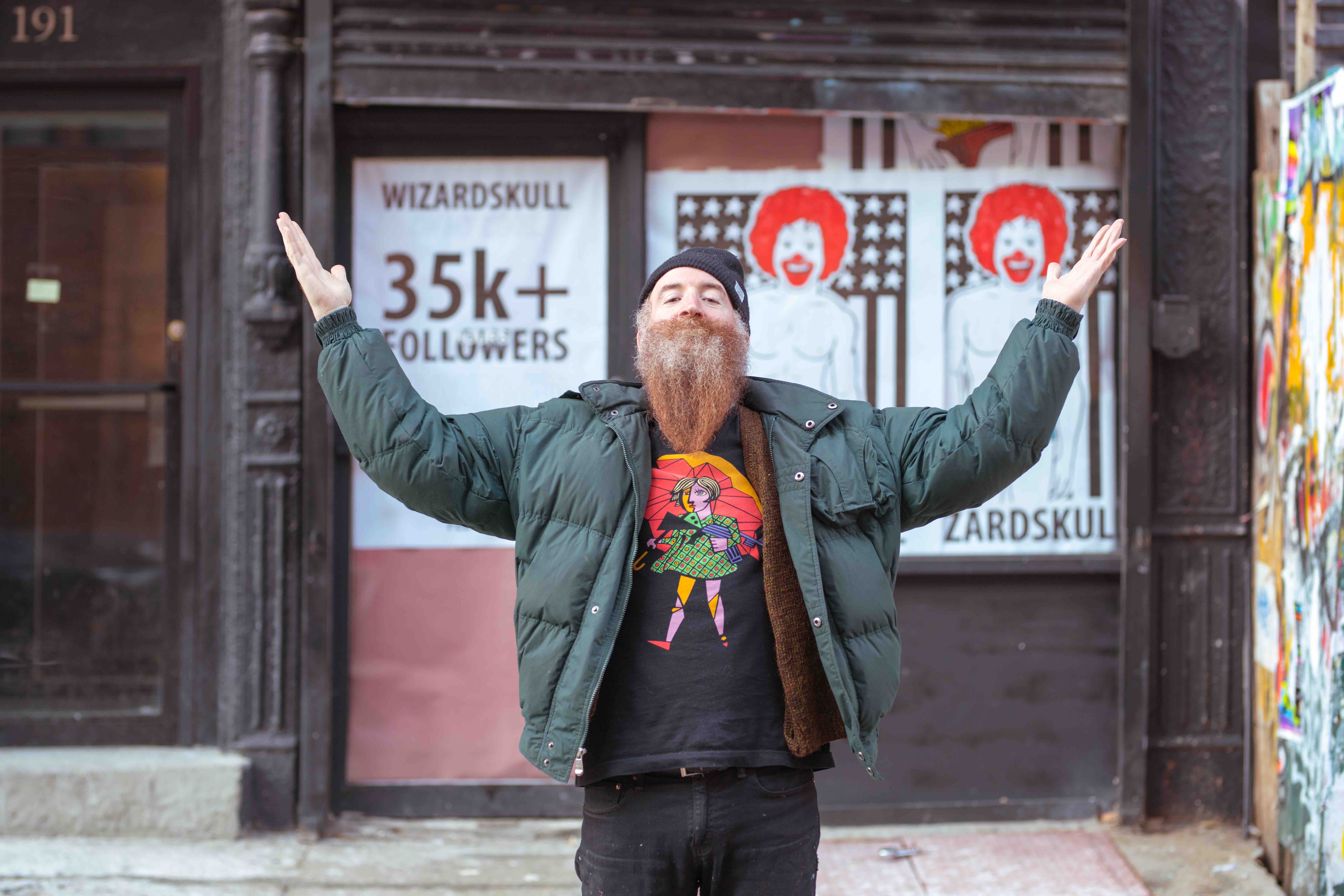
“From the perspective of an artist, social media has real worth,” he explains. “I don’t have to be part of an exclusive art industry, selling to galleries or museums. I can sell myself straight to the public.”
“But then there are amazing artists, who are recognised within the art world, that came up in a different era, who only have maybe a 1000 followers. It’s an interesting situation.”
There’s no doubting that in this brave new world of algorithms and Instastories, having a social media ‘presence’ gives an individual agency. Actors and models are hired every day based on their ‘reach’. For those using social media, we unconsciously make judgements about a person’s leverage on this planet when we discover their numbers – whether it’s a Tinder match or a prospective business partner, a large amount of Instagram followers lends an instant degree of credibility.
“To be viewed as a successful artist, you have to be making art all the time, and to be seen making art all the time. Social media numbers are a measure of that.”
“The people that get my show’s premise, though, and who understand that social media is kind of a joke – even though it really is good for promoting yourself in whatever you do – are laughing at this show.
But it’s not all laughter. The artist admits that he has lost “actual friends” over the exclusive nature of On My Level. Two weeks ago, he was pulled from a street art podcast, which had been courting him for over a year.
“I thought there might be some negative comments, but the exclusivity thing has made people really furious,” he says, with incredulity. “Yet everything in society is based on exclusivity.”
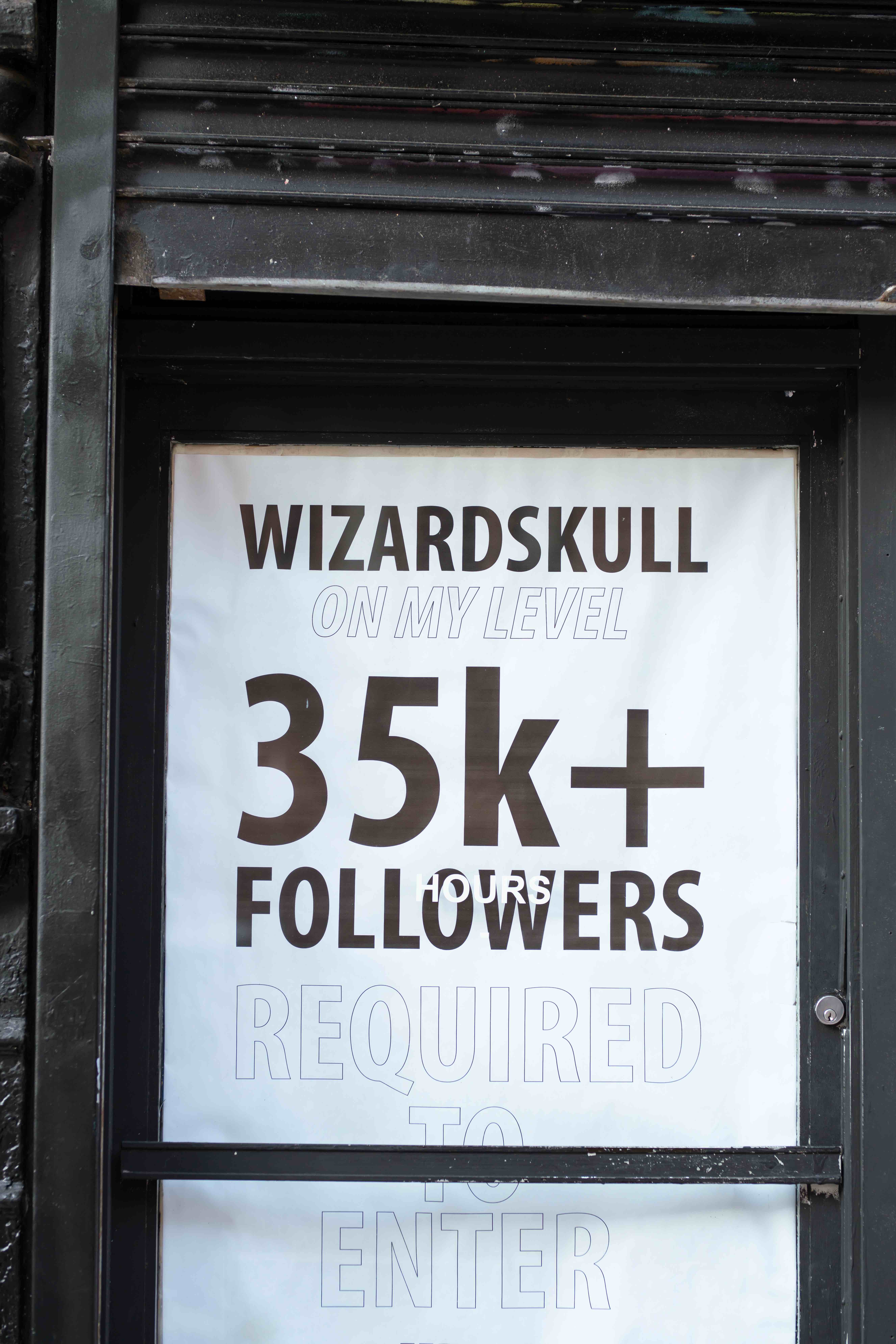
“Money is exclusivity. Access to restaurants, hotels, gym memberships. I feel like maybe everyone has accepted the notion of economic exclusivity, but won’t accept exclusivity when it’s presented like this.”
Originally from Jersey, the New York-based artist is no stranger to controversy. His previous works have seen him put beloved children’s cartoons in twisted sexual situations (in one of his Re-Animator works, The Incredible Hulk humps one of My Little Ponies), and his Ronald McDonald graffiti was largely scoffed at by Bushwick’s street art community. According to Duke, ‘purists’ of the artform felt he wasn’t taking the culture seriously enough. But then he doesn’t appear too fussed about preserving people’s egos or tradition: “as an artist, you have to accept that you’re going to get hated on no matter what. It’s a good sign.”
“When I first got hate comments I was really bummed, but they actually represent that people are feeling something about your stuff. The more people that get angry with this show, the more it inspires me to keep doing it.”
But social media – the platforms that Wizard Skull is critiquing through his show – is simultaneously being used to stir the conversation around it. Perhaps the most intriguing aspect of this entire episode, is deciphering how much of Wizard Skull’s output is art, and how much is the real person behind it?
“I’m real,” says Wizard Skull, quite defensively. “But I actually didn’t realise by saying don’t come to my show, I’d be saying ‘come to my show’ louder than ever.”
Whether authentic or not, Wizard Skull’s recent output has tongues wagging in New York’s art world – and he appears to be revelling in his status as an agent provocateur.
“If you’ve got your numbers up you can come in. It’s as simple as that.”
Follow Jonathan Turton on Instagram and Twitter
Enjoyed this article? Like Huck on Facebook or follow us on Twitter.
You might like

The stripped, DIY experimentalism of SHOOT zine
Zine Scene — Conceived by photographer Paul Mpagi Sepuya in the ’00s, the publication’s photos injected vulnerability into gay portraiture, and provided a window into the characters of the Brooklyn arts scene. A new photobook collates work made across its seven issues.
Written by: Miss Rosen

The rise of anywhere and everywhere radio
Cooking up broadcasts — From a London rickshaw to a shipping container in Ukraine, independent stations are redefining what a studio looks and feels like. Bella Koopman speaks to DIY station founders to find out more.
Written by: Bella Koopman

Defiant photos of New York’s ’80s & ’90s queer activists
Arresting Images — Dona Ann McAdams’ photographs document the AIDS crisis, lesbian organising and civil disobedience from one of the most fraught eras in American LGBTQ+ history. A sale of her archive takes place later this month.
Written by: Sydney Lobe

Joe Bloom’s View From a Bridge
More stories, more human — The artist and creator of the vertical video generation’s most loved storytelling platform explains the process behind creating the show, and the importance of bucking trends.
Written by: Isaac Muk

When David Wojnarowicz became Arthur Rimbaud
Arthur Rimbaud in New York — In 1978, the American artist and his friends donned masks to pay tribute to the French poet, who was born a century before him. Miss Rosen traces the differing yet parallel lives of the queer revolutionaries.
Written by: Miss Rosen

DJ AG has redefined DJing. Festivals are next.
From small streams, mighty rivers flow — The London streamer has democratised an art traditionally hidden away in clubs and basements with his easy-to-access, spontaneous, open platform street performances. With AG Fest lined up for the summer, Oliver Keens speaks to him about staying humble, the importance of community, and his dream to open a care home.
Written by: Oliver Keens


