Capturing 1980s Belfast at the height of the Troubles
- Text by Miss Rosen
- Photography by Judah Passow

The Troubles reached a fever pitch in 1982, as the Irish National Liberation Army (INLA) struck hard, killing more British security forces than ever before. The grievous harm to the innocent was made plain on Thursday, September 16, when the INLA exploded a bomb hidden inside a drain pipe along a balcony in Cullingtree Walk, Divis Tower, Belfast.
Though aimed against a British Army foot patrol, the blast had the unintended effect of killing two local children, Stephen Bennet, 14, and Kevin Valliday, 12, along with soldier Kevin Waller, 20. Three other civilians and one soldier were also injured in the explosion.
It just so happened that earlier that year, Israeli photojournalist Judah Passow spent a couple of weeks documenting Divis Flats for the Observer magazine to create a portrait of a people and a place. These photographs have been published in Divis Flats Belfast 1982 (Café Royal Books).

The story came about one Saturday evening in January, when Passow read a report by the European Union that named Divis Flats as the worst public housing in Europe.
He remembers, “This story had all the ingredients for a remarkable essay: appalling housing conditions, teenage car-jacking gangs, elderly residents abandoned by a dysfunctional sectarian municipal welfare system, lethal rivalry between paramilitary organisations, British soldiers patrolling the neighbourhood – and, lousy weather.”
Passow, who had been covering the Soviet invasion of Afghanistan, the Israeli invasion of Lebanon, and the Palestinian uprising in Gaza and on the West Bank, came to Divis with an open mind. “I had no particular political or sectarian agenda,” he says.
“I was drawn to Divis by the need to understand why people have a seemingly limitless capacity for inflicting pain on each other. All kinds of pain – physical, emotional, spiritual, psychological. During my time there, I came to see Divis as a sort of metaphor, as a smaller, local version of the larger, disturbing world, as a war zone, as a place of material poverty and social deprivation.”
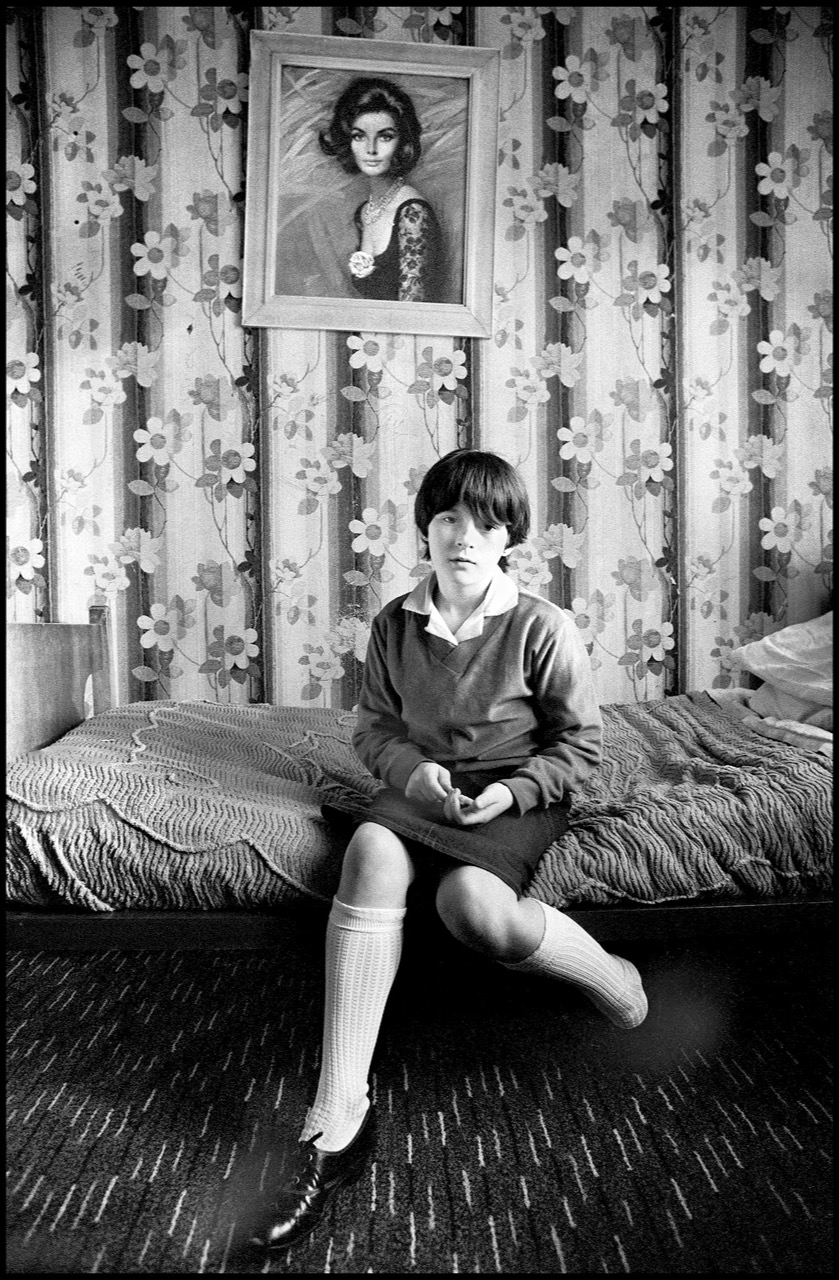
Passow took great care to create mutual empathy and earn the respect of his subjects. “Once that trust has been established, people take you into their confidence and into their lives.”
The photographer learned how residents fought back against a public housing system that only exacerbated their problems. His photographs bear witness to their striving to maintain dignity, sanity, and humanity amidst poverty and strife.
“The biggest problem I faced was trying to show the IRA’s relationship to a story about urban deprivation. I needed to earn enough trust by the paramilitary ranks living in the flats to move beyond the access they gave me to their family life, and on to their role as foot soldiers in a grim political battle,” he says.
“It took a while, but when that moment arrived, I felt that the story would now be able to tell itself with journalistic substance and authority. Taking pictures in these fraught situations demands that a photographer bring passion and commitment to using the camera as a tool for asking uncomfortable questions in the search for truth.”


Divis Flats Belfast 1982 is out now on Café Royal Books.
Follow Miss Rosen on Twitter.
Enjoyed this article? Like Huck on Facebook or follow us on Twitter.
You might like

Behind the curtain at Alternative Miss World 1981
Olympia glamour — Running a subversive take on the traditional beauty pageant, the Andrew Logan organised event prioritised underground creativity and invention. Photographer David Corio went behind the scenes at its biggest edition.
Written by: Miss Rosen

New exhibition highlights British radical living over 200 years
Earthly Paradise — Taking place at the William Morris Gallery, it explores the homes and lives of artists, writers, musicians and more, as well as the conditions that allowed them to thrive.
Written by: Isaac Muk

What life on the Strait of Hormuz is really like
Southern Winds — Bandar Abbas based photographer Morteza Niknahad has been capturing the diverse communities and stories of his local region since he first picked up a camera. His new series highlights the human impact of war.
Written by: Isaac Muk

Nick Haymes’s intimate portrait of his family’s life
Chronograph — Over 25 years, the photographer documented his son’s lives as they grew into adults. The resulting photobook is an exploration of the passage of time, as well as the optimism of youth.
Written by: Miss Rosen

Kristina Rozhkova’s scatty, confronting portrait of captivity
Gut Feeling — The Russian artist’s 2024 arrest and subsequent detention opened her eye towards the omnipresent dynamics of power and control. Her new photobook is a stark exploration of being trapped.
Written by: Isaac Muk

UK’s first ever Latino film festival is coming to London
LoLaFF — Taking place between October 2-6, it will feature 55 filmmakers from Latin America, with an opening night at the Barbican.
Written by: Isaac Muk


