
Detroit’s defiant underground activists of the ‘60s and ‘70s

In 1959, Leni Sinclair, then 19, fled her native East Germany for the United States, settling in Detroit to study at Wayne State University where she became interested in politics. She joined Students for a Democratic Society very early on, becoming one of two members citywide participating in the New Left movement that would soon take the nation by storm.
In 1964, she met poet and jazz critic John Sinclair, who would become her husband and collaborator in the creation of the Detroit Artists Workshop – a network of communal houses, print shop, and performance space, where Leni photographed jazz legends like John Coltrane, Miles Davis, and Thelonious Monk, as well as proto-punk band MC5.
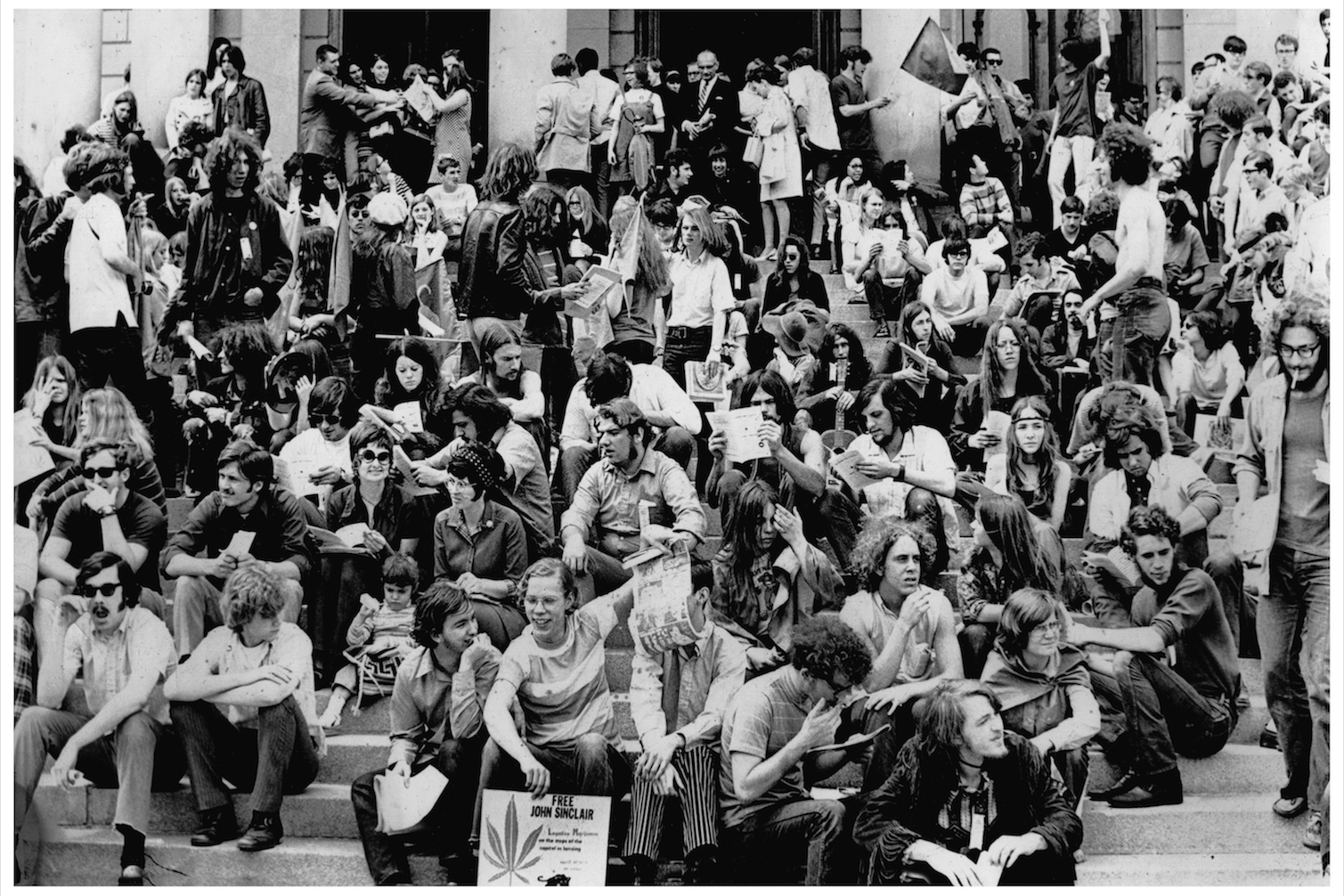
Members of the White Panther Party in Lansing, Michigan, 1970
“We were living outside the system, starting to create something for ourselves, and not the predominant culture, which was too stiff,” Sinclair says with a laugh. “We wanted to have a place without restrictions. That to me was more radical than anything I had experienced in my life.”
But paradise wouldn’t last. Police raided the Detroit Artists Workshop in 1965, arresting John Sinclair on marijuana charges. “While he was in jail, the whole country changed. All of a sudden there was this big phenomenon called the hippies,” Sinclair recalls.
“At first, we thought the ‘hippies’ was a put-down, a name for wannabe hipsters into jazz and weed that didn’t make it, so we didn’t really embrace ourselves as being hippies. But the police labelled my husband as the ‘King of the Hippies,’ making me the ‘Queen of the Hippies.’”
Sinclair laughs fondly at the memory then says, “Hippies were a force. They were not overtly political like SDS but they sure were influencers. They opened up society not to be so provincial.”
In the new exhibition and book, Motor City Underground, Sinclair revisits her photographs documenting Detroit’s radical artist/activist scene of the 1960s and ‘70s. “It was a fun time, until 1967 and the urban rebellion in Detroit,” Sinclair says of the four-day uprising that devastated the city that July.

Two boys at Detroit’s state fairground

Portrait, interior with map and poster, ‘National Heroes and Martyrs of A People’s Revolution’
“People who looked like hippies would be stopped and searched just like Black people have been forever. [Police would say] ‘What are you doing in this neighbourhood? Who are you?’ All those kinds of things,” Sinclair says.
“Our living quarters were firebombed and we couldn’t live there anymore. We had to flee overnight to save our lives and we moved to Ann Arbor. But there was a lot of resistance when we arrived because no matter how progressive the university was, the citizens were a conservative lot. They had a demonstration against us carrying signs like, ‘Sin, Like in Sinclair.’”
While living in Ann Arbor, the Sinclairs created the White Panther Party in November 1968 to support the work of the Black Panther Party. Although they won a landmark U.S. Supreme Court decision in 1972 against the government for illegal surveillance, their name created misunderstandings and was later changed to the Rainbow People’s Party.
Reflecting on her experiences, Sinclair says, “Everybody has to do what their heart dictates. Be yourself, do what you need to do, and document it.”

Protestors at anti-war march

Crowd in Ann Arbor, Michigan, 1970

Wayne Kramer in Ann Arbor, Michigan photograph, 1969

Members of the White Panther Party and the Weathermen at The Fifth Estate, 1970

Public display of poem by Medgar Evers
Leni Sinclair: Motor City Underground is on view at the Museum of Contemporary Art in Detroit through April 18, 2021.
Follow Miss Rosen on Twitter.
Enjoyed this article? Like Huck on Facebook or follow us on Twitter.
You might like

The sharp rise of video game photography
Point, shoot — As the entertainment medium’s fidelity levels increase and developers build more powerful tools, a growing community of gamers are pushing the boundaries of image making in virtual worlds. Vicky Jessop meets people at the forefront of the emerging artform.

Joyous photos from the heart of the UK’s radical free festival movement
Common Grounds — The photographer has been capturing British counterculture for the past half century. A new exhibition looks at his archive sitting at the intersection of music, community and grassroots protest.

The lasting community legacy of a legendary Californian boxing gym
Moretón — Since opening in the ’80s, the Coachella Valley Boxing Club has trained multiple world champions, while providing a vital hub for local youth. In his new photobook, Darren Vargas documents its tight-knit, Chicano-led community, while also weaving a deeply personal story.

Inside the grunge golden age with Hole’s former bassist
My ’90s Rock Photographs — Melissa Auf der Maur’s new photobook is a sprawling visual memoir of her time at the heart of the US scene, from Tinker to The Smashing Pumpkins.

Introducing ‘The Chaos Isles’, a new photozine by Huck and Yushy
Normal Island — From unlicensed raves to the solstice at Stonehenge, furries to giant vegetable growers, Yushy is one of the UK’s best lensmen of its wild side. ‘The Chaos Isles’ will be sent out exclusively to Club Huck+ members.

Join Club Huck+ to get the most from Huck
Dispatches from the sharp edge of culture — Members get our print magazine, special photozines, The Huck Long Read newsletter, discounts from our friends and partners, digital versions of back issues and priority access to events.


