
Five reasons Kenneth Anger is the most influential director in underground filmmaking

Just how close was Kenneth Anger to the occult? By all accounts, Anger had a good deal of bizarre run-ins and astral coincidences. With a career starting in the 1940s, the surrealist’s filmmaking spans from surf vids, to art-house porn, dark spiritual odysseys and quiet, thoughtful documentaries.
It wouldn’t be an exaggeration to say that Kenneth Anger made underground cinema what it is today. The LA director is the cult filmmaker for cult filmmakers. He’s had a significant influence on directors like David Lynch, Martin Scorsese, and Stan Brakhage. As Anger enters his 89th year, let’s take some time to remember just how absolutely weird this guy is, and how integral he was to the way movies are made today.
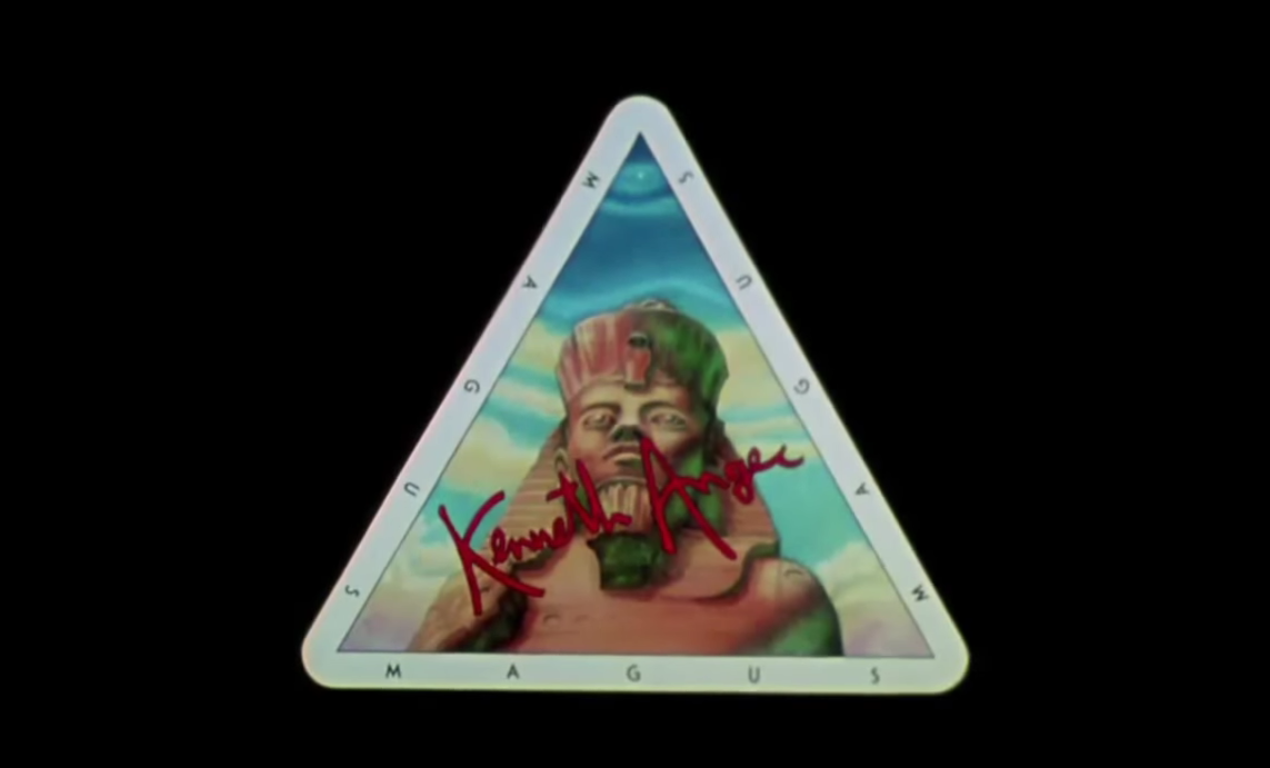
1. He pioneered the modern music video
Anger has played a huge part in the formation of the modern music video. As a filmmaker, he’s always stuck with the classic silent film format. His films never have dialogue, but an enormous amount of thought is put into the soundtrack, making them unique audio-visual experiences. One of his more recent films, Elliott’s Suicide, is about the death of singer-songwriter Eliott Smith, who was a friend of Anger’s.
Lucifer Rising is another interesting part of Anger’s back catalogue – at one time it was slated to have a score by Jimmy Page, but Anger and the Led Zeppelin guitarist had a falling out before the film was released. There was another soundtrack recorded by guitarist Bobby Beausoleil, who also starred in the film – but that relationship was fraught as well. Beausoleil eventually became a follower of Charles Manson, stealing most of the footage from his performance in Anger’s film, and burying it in Death Valley. Beausoleil is now serving life in prison for a murder he committed while he was living with the Manson “Family.”
2. He was a pagan and practicing magician
Anger was good friends with Aleister Crowley, and the occultist had a strong influence on him. Crowley was a founder of a “religion” called Thelema, which involves a lot of sex magick. Overall, sex magick is about as weird and ritualistic as you’d imagine. Crowley was a self-professed magician, as was Anger. The two of them were also pretty close to Anton LeVey, who started the Church of Satan. All of this seeps into Anger’s films, and it gets freaky.
One of the key films to watch here is Invocation of My Demon Brother, scored by Mick Jagger. In 1967, Anger had a manic episode, bought a full page ad in The Village Voice announcing his death, and then moved to the UK, where he met Jagger and other counterculture figures. The Rolling Stones frontman had just bought a Moog synthesizer when Anger was working on the film, so he volunteered to improvise something for it.
3. Anger was one of the first openly gay filmmakers in Hollywood
Anger has an important place in the history of queer filmmaking. Not only was Anger one of the first openly gay filmmakers, his films were some of the first to address homosexuality head-on. His symbol-heavy films were repeatedly censored and Anger himself was charged with obscenity several times. The sexologist Alfred Kinsey, father of the “Kinsey Scale” was close to Anger, who participated in some of Kinsey’s influential research.
Anger was intensely private though, preferring to channel his desires on to the screen. His 1963 flick Scorpio Rising, is about a group of Brooklyn motorcycle enthusiasts. Full of Nazi imagery, heavy leather, and early rock and roll, it is interspersed with clips from a Sunday School video accidentally mis-sent to Anger. Scorpio Rising was also protested by the American Nazi Party, who – get this – found it to be too offensive.
4. He relied on “dream logic”
Dreams were a backbone for Anger’s filmmaking, and they are also a huge reason why his films are strangely calming. The visual language of his films – ancient objects, snippets of the unconscious, and religious icons – all look towards what Anger has called a “dream logic.” Inauguration of the Pleasure Dome features the writer Anaïs Nin and is a sort of culmination of Anger’s wild visual experiments, synthesising esotericism and surrealist visual style.
5. He was vehemently anti-hollywood
Kenneth Anger is a relic of ‘Old Hollywood’, while he also also harboured a pretty strong hatred against it. Part of his resistance to the industry has to do with McCarthyism and the Red Scare that was strangling the American Film industry. But Anger is known to cast a lot of curses against Hollywood types, including journalists. He grew up in LA, and has always shown a fascination with the decline of Hollywood stars – obsessed with urban myths, sexual perversions, and the violent demise of young stars. He’s talked about collecting stories and gossip about the film industry as he grew up, and he published two books.
But as much as he’s denied the Hollywood mythology, he has slowly become a part of it. He has a plot in the Hollywood Forever Cemetery, paid for in advance by filmmaker Vincent Gallo. Anger claims to have been a child actor playing the changeling in a 1935 version of A Midsummer’s Night Dream, an early big studio film by Warner Brothers. Its dreamy plastic set served partially as inspiration for his own avant-garde piece Rabbit’s Moon, which is filled with symbols and surrealist imagery.
Enjoyed this article? Like Huck on Facebook or follow us on Twitter.
You might like

Exploring girlhood and land ancestry in Sudan’s cotton fields
Cotton Queen – A new feature debut from filmmaker Suzannah Mirghani explores the legacy of colonialism and the fight for self-determination through the tender eyes of a teenage girl.

Pink Floyd’s Roger Waters joins team of new Palestinian resistance documentary
Freedom Theatre — Directed by Rishi Pelham, the film spotlights a theatre operating in the Jenin refugee camp.

UK’s first ever Latino film festival is coming to London
LoLaFF — Taking place between October 2-6, it will feature 55 filmmakers from Latin America, with an opening night at the Barbican.

Youthful joy & end-of-era poignancy at a London school prom
Leavers — For several years, Lewis Khan documented young people as they celebrated the last of their school days and the completion of their exams. The series is now collated in a new self-published photobook and short film.

A major Nan Goldin exhibition is coming to London
You Never Did Anything Wrong — Opening at the Hayward Gallery in November, the show will debut a new film from the artist and activist, alongside a slate of recent work.

Rab’s adventures on film at Love Trails Festival
Adventure Film Night — Taking place between July 2-6, Rab are screening six documentaries at the festival that explore the remarkable world of the adventure sport community.


