Inside the ghostly hotel that symbolises South Africa's past
- Text by Cian Traynor
- Photography by Yvonne Mueller and Leif Bennett

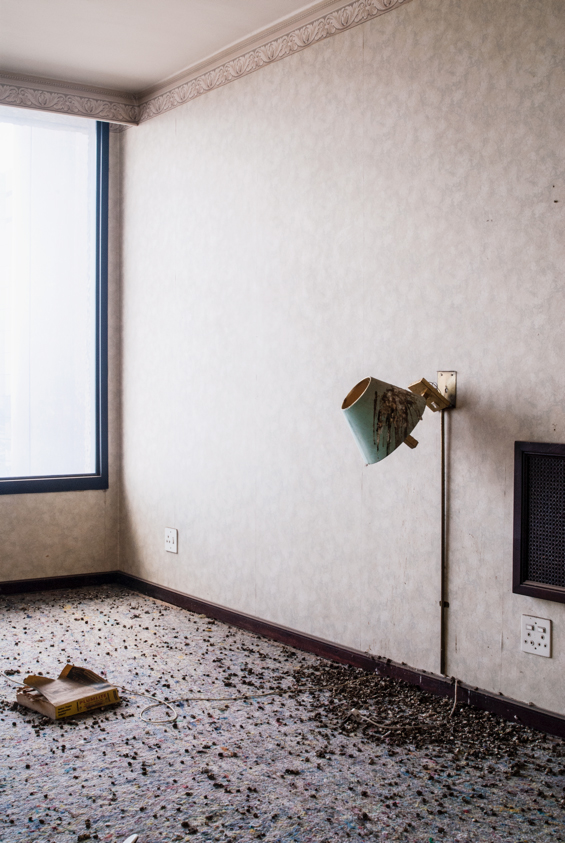
Yvonne Mueller and Leif Bennett were taking a tour through downtown Johannesburg, guided by a local artist, when they noticed a building that didn’t look quite right: a 30-floor hotel that’s been closed for 20 years but guarded around the clock.
The Carlton is a former 5-star complex with an imposing history. It has witnessed landmark political moments, entertained celebrities and even been home to a murder. But before Yvonne and Leif had heard the stories, all they wanted to do was get inside.


“We felt a bit lost, really,” says Yvonne about sneaking in. “It was quite scary, especially being all alone on one of the higher floors. The lower floors had almost no light and we needed a flashlight, but it was an adventure because you would never know what to find next.”
It didn’t take long for the pair to come up with an idea: a photo project documenting a ghostly space that “managed to encapsulate so much of the history of a country we ourselves did not know very well yet.”
Yvonne and Leif are an artistic couple from Switzerland with interweaving backgrounds. Leif’s father was a photographer, so he grew up in Schaffhausen with black-and-white prints strewn across the house and bookshelves teeming with histories of the medium.
The 43-year-old inherited his dad’s analogue gear but is largely self-taught as an artist, placing huge emphasis on the value of experimentation. Yvonne, meanwhile, grew up in Bern and worked in finance before pursuing her real passion by studying art in Basel and earning scholarships at studios in Paris and South Africa.
They met at a communal studio space, had a daughter together and found ways to spark each other’s creativity. “Unfortunately we cannot work together very well,” says Yvonne, who’s 44. “We tend to end up in long discussions and even fights! Sometimes we have a vastly different outlook on things and it can be difficult to find a compromise. But we are most at ease travelling together.”


In Johannesburg, the pair were astonished by the Carlton’s empty shell and began to research its history. Past guests included Henry Kissinger, Hillary Clinton, Margaret Thatcher, Whitney Houston and Mick Jagger; there were strikes, protests, bomb threats and high-profile banquets.
Leif and Yvonne established that Nelson Mandela lived in the hotel’s presidential suite during South Africa’s transition from white-minority rule. He held his 75th birthday celebration in its ballroom and, in 1994, gave a victory speech there announcing that he would be South Africa’s next president.
But within just a few years, the Central Business District it was located in deteriorated rapidly and its 670 rooms became impossible to fill.


In 1997, two hotel employees murdered one of their managers after he found them drinking on duty. The Carlton was closed within five months, having lost $4m that year alone, and its contents were gradually sold off.
When Leif and Yvonne found an old video interview with Mandela recorded in the hotel, they tracked down the exact spot it was taken in – plants now growing out of the floor, its decorative wall laid bare. Outside, security guards were patrolling its various back entrances to fend off vandalism and illegal occupation.
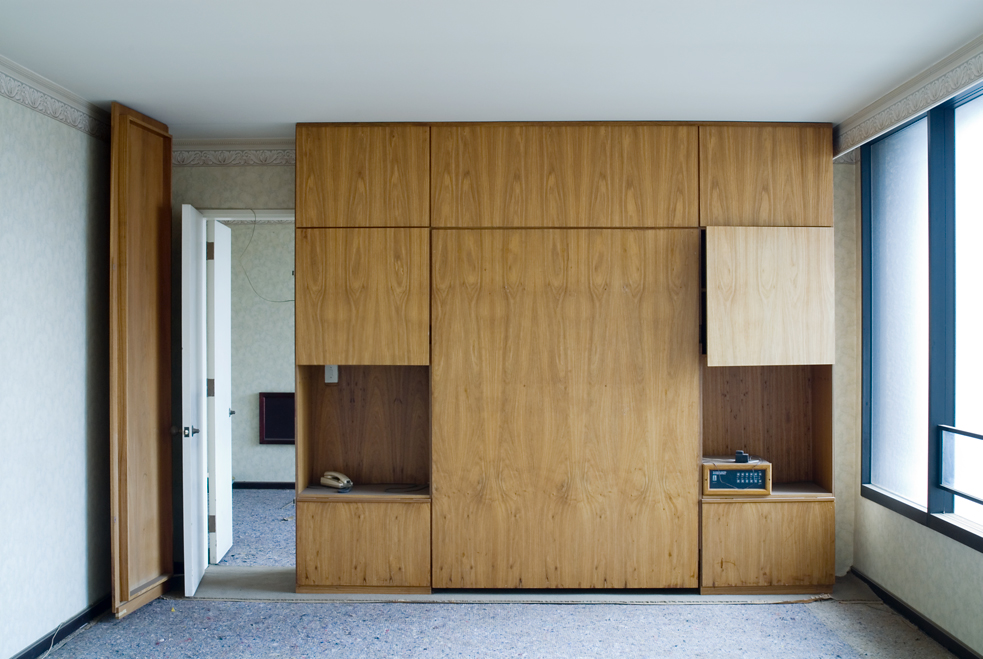
Capturing such contrasts seemed to provide a profound reflection, not just on what was once the southern hemisphere’s best hotel, but a symbol of of South Africa’s complex history.
“At its completion in the 1970s, the Carlton Hotel was deemed a liberal hub where petty apartheid laws managed to be eroded,” says Yvonne.
“On the other hand, it stands as a monument of financial gains made on the backs of the disenfranchised… It remains a stark reminder of international collusion to uphold, or turn a blind eye, to a broken system.

“South African society will likely have to live with this monument, as it looks expensive to topple, and so perhaps it will once again become symbolic when it has an opportunity to be transformed into something new.”
Inside the Carlton Hotel Johannesburg is published by Kehrer Verlag.
Enjoyed this article? Like Huck on Facebook or follow us on Twitter.
You might like

Landmark new exhibition is celebrating 50 years of female punk
God Save the Queens – The Museum of Youth Culture is bringing together rare photography, archive material and a one-night-only supergroup featuring members of X-Ray Spex, The Slits and The Raincoats.
Written by: Ella Glossop

Halcyon, end of summer days in ’80s Massachusetts
Bell Pond — Stephen DiRado’s new photobook is a nostalgic look at blissed out moments of young love, family and coming of age at a swimming pond in Worcester, Massachusetts.
Written by: Miss Rosen

Photographing America’s 20th century rebels
Rebels With a Cause — A new monograph looks back at Jean-Pierre Laffont’s extensive archive documenting counterculture, art, activism and more, shaping the country as it is today.
Written by: Isaac Muk

The groundbreaking photography of Gordon Parks
Voices in the Mirror — A new exhibition dives deep into the legendary lensman’s archive, who captured the Civil Rights Movement and Black America like no other.
Written by: Miss Rosen

A chaotic portrait of an ’80s American farming family
Holy Cow! — Melonie Bennett grew up on a farm in Maine in the ’80s, and documented her family’s idiosyncratic daily life. She presents those humorous, everyday memories in a new exhibition and photobook.
Written by: Miss Rosen

Nick Danziger’s striking vision of everyday British life in the ’90s
The British 1994-1999 — The renowned photojournalist returned to his birth country on the cusp of the Millennium, capturing its contradictions with humour and wit.
Written by: Miss Rosen


