Bleak and beautiful: a visual history of Leeds
- Text by Zoe Whitfield
- Photography by Peter Mitchell

“They’re not really nostalgia and they’re not really charming,” says Peter Mitchell, assessing his images of Leeds, a city he’s been photographing for over 40 years. “But people do identify with them.”
Arriving in 1972 from London where he studied at Hornsey College of Art – he’s originally from Manchester – the photographer got “stuck” in Leeds while visiting friends in the city. He quickly found a flat in Chapeltown, where he still resides today.
Working various jobs, it was a stint driving trucks that first led him to explore the city’s landscape and establish his distinct visual perspective. Initially taking on photography as a vehicle for silk screen printing, in 1979 he exhibited his pictures at Bradford’s Impressions Gallery. The show, titled A New Refutation of the Space Viking 4 Mission, was the first exhibition of colour photography at a British photographic gallery by a British photographer, and was lauded by his contemporary Martin Parr.
“It coincided, just about, with Britain starting to appreciate photography,” Mitchell says today. “It’s always been backward – nothing like America or Europe – but the arts council started taking an interest in photography. They actually set up a staff and handed out bursaries.”

Queens Road LS6, Hartwell terrace
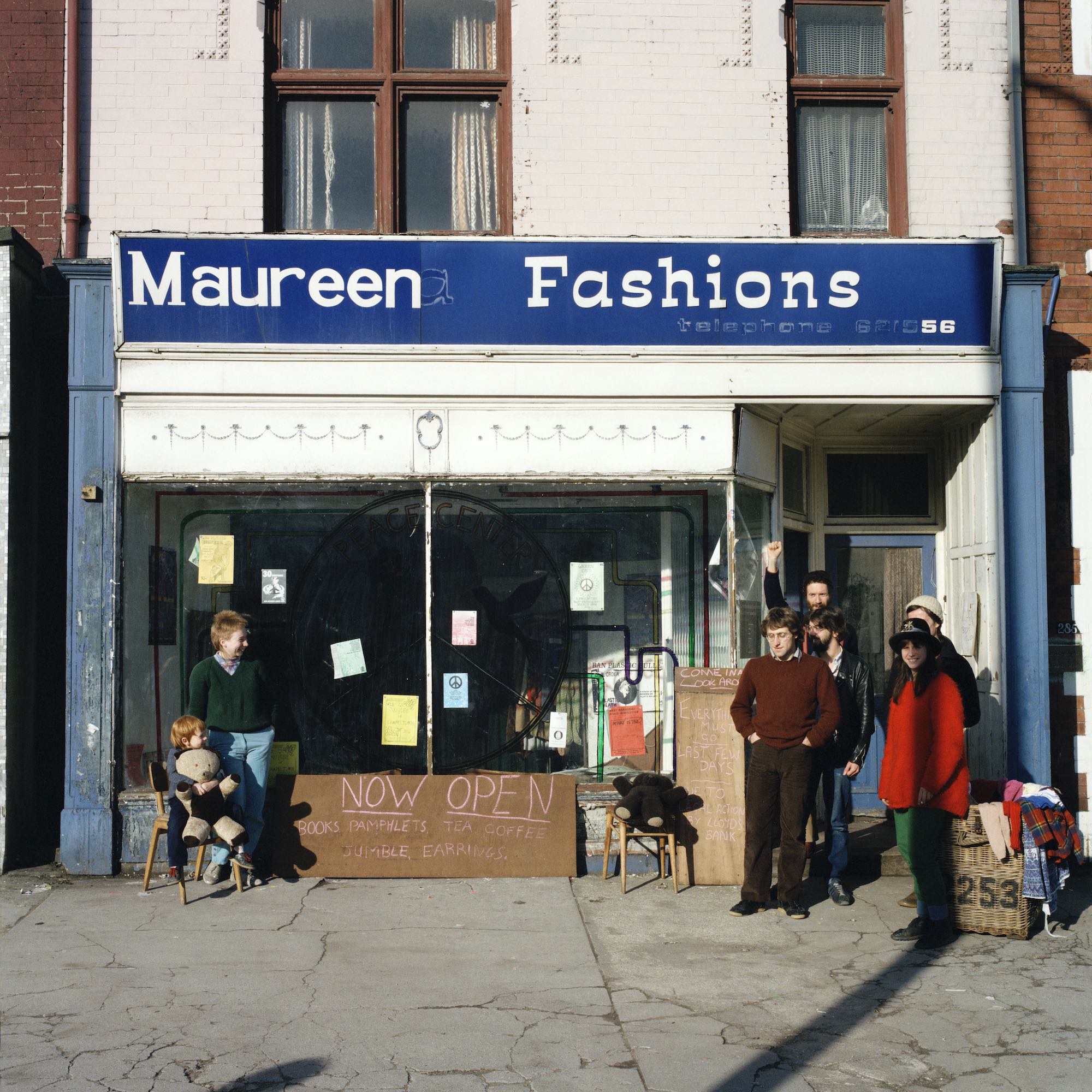
Roundhay Road
His practice has continued in much the same vein over the last four decades, studying the city and shooting buildings of interest (frequently rundown and close to destruction), alongside other work. Released this month, new book Early Sunday Morning is perhaps the biggest Peter Mitchell volume to date, and highlights the personal framing of his observations of the city.
Named by his co-editor John Myers in reference to the Edward Hopper painting of New York in 1930, the book is a considered portrait of the city featuring close to 100 images in full colour. “The colour of Leeds used to be black because it was so industrial,” he says. “They didn’t start cleaning it up until halfway through the ’70s, and it didn’t look right somehow.” In his images, any bleakness is softened with bright skies and pops of colour courtesy of painted window frames.
“It was fast, there were whole terraces demolished in a day,” he explains of how the images, shot during the ’70s and ’80s, took form. “I made a note of things because I would think, ‘that looks incredible but it would look great if the windows were smashed’. They were sort of spontaneous, but I did a lot of waiting, going there morning and afternoon. I suppose one of the universal things I saw about them, was all these places were vulnerable, they weren’t going to be there for much longer.”

Cloth Hill street

Hyde Park Corner

Alea Stony Rock Westlock terrace

Union Cross between Stocks Hill and Crab Lane

Meanwood road off Cliffdale road

Burley Road

Chapeltown Road
Early Sunday Morning is out now on RRB books.
Enjoyed this article? Like Huck on Facebook or follow us on Twitter.
You might like

Nick Haymes’s intimate portrait of his family’s life
Chronograph — Over 25 years, the photographer documented his son’s lives as they grew into adults. The resulting photobook is an exploration of the passage of time, as well as the optimism of youth.
Written by: Miss Rosen

Kristina Rozhkova’s scatty, confronting portrait of captivity
Gut Feeling — The Russian artist’s 2024 arrest and subsequent detention opened her eye towards the omnipresent dynamics of power and control. Her new photobook is a stark exploration of being trapped.
Written by: Isaac Muk

UK’s first ever Latino film festival is coming to London
LoLaFF — Taking place between October 2-6, it will feature 55 filmmakers from Latin America, with an opening night at the Barbican.
Written by: Isaac Muk

Shawn Walker’s layered, psychedelic vision of Harlem’s streets
From BeBop to Illusion — Using glass as a means to illuminate the city’s different layers, the longtime photographer and filmmaker is publishing his first monograph at the age of 86.
Written by: Miss Rosen

In photos: The enduring resistance of Notting Hill Carnival
Carnival of Resistance — A new photobook by Wayne Campbell and Wayne Crichlow reflects on the protest beginnings of Europe’s biggest street festival, along with the traditions keeping its original spirit alive today.
Written by: Isaac Muk

Washing strangers’ feet at Houghton Festival
Pedilavium — As part of artist Henry Krokatsis’s performance piece at the weekender, we sat down with over 30 others to clean the dusty digits of passersby, while reflecting on the power of collective ritual and human connection.
Written by: Isaac Muk


