Inside the American town burning since 1962
- Text by Miss Rosen
- Photography by Renée Jacobs

A version of this story appears in Huck Issue 77. Get your copy now, or subscribe to make sure you never miss another issue.
On 27 May, 1962, a long, shrill whistle swept through Centralia, sounding the alarm. An abandoned coal mine, now an unofficial trash dump, was on fire. Volunteer firefighters and borough workers moved quickly to extinguish the flames. But unto their knowledge the fire continued to blaze. 300 feet below ground, the flames made their way to a coal seam, before spreading through mine tunnels running beneath the small Appalachian town.
It was soon clear the fire hadn’t stopped. That July, town officials met with government representatives to discuss solutions — none of which worked. Instead, as the years passed, the situation only worsened. Carbon monoxide began to rise out of the mines, poisoning the air. Inside homes, black boxes monitored gas levels with a relentless ticking – only to issue an explosive scream when they reached dangerous heights. Warning signs began to litter the landscape, highlighting places it was unsafe for children to play. Some 1,800 boreholes were dug into the ground, releasing smoke from the slow-burning fire into the atmosphere.
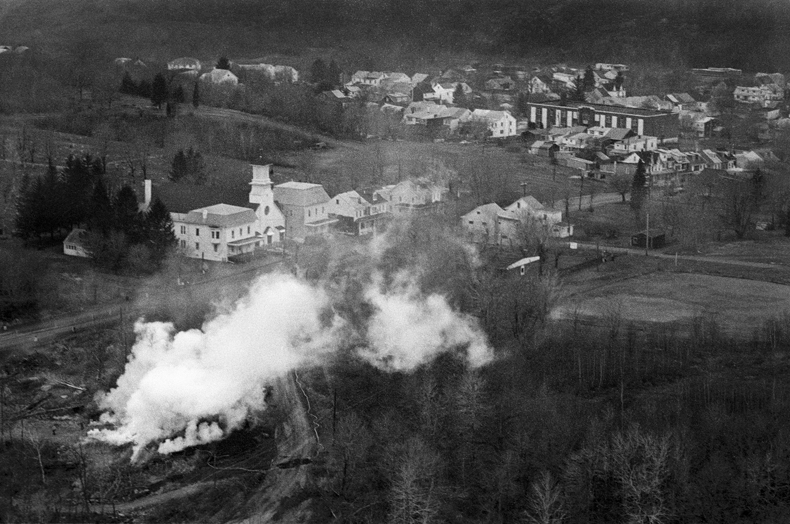
In 1980, the US Bureau of Mines (USBM) released the Red Book, a report on the Centralia fire that concluded all efforts to extinguish it were futile. Three years later, a second report announced the fire was now burning on three, possibly four fronts, and would continue to spread to lands under neighbouring towns. After Centralia residents voted to take a federal government buyout on 11 August, 1983, blood-red numbers appeared on houses sold and slated for demolition.
That same year, photographer Renée Jacobs, then 21, decided to visit Centralia while working as photo editor at The Daily Collegian, the student newspaper of Penn State University. “It was really eerie,” she says, describing her first impressions of a town that was so small, she was able to cross it by foot in 30 minutes. “I didn’t know anyone, so I just walked around and people were hanging out on their front stoops. They were very open and friendly, and very savvy about trying to use the media to get their agenda across. Everyone was eager to share their views with me.”


What started as a weekend trip soon became a chronicle of the town’s final years. To get a better understanding of the issues at play, Jacobs moved into a house right on top of the impact zone, owned by local couple Catharene and Leon Jurgill. She lived there for six months, documenting the lives of townspeople on both sides of the divide.
“There was skepticism about whether the mine fire posed a danger and families like the Jurgills were split on opposite sides. Catharene became a very vocal proponent for leaving the town. I was able to live in their house because they moved out when the problems first began,” says Jacobs, who published her work in the 1986 book, Slow Burn: A Photodocument of Centralia, Pennsylvania.

As time went on, Jacobs became increasingly aligned with people who wanted the government buyout. “Being there day to day, you could see it and smell it,” says Jacobs.
There were unseen dangers, too. On Valentine’s Day, 1981, a 12-year-old Todd Domboski was playing in his grandmother’s backyard when the earth gave way under his feet. As the boy began to fall into a 300-degree pit, he grabbed hold of tree roots exposed in the loose earth, narrowly escaping death when his cousin pulled him to safety.
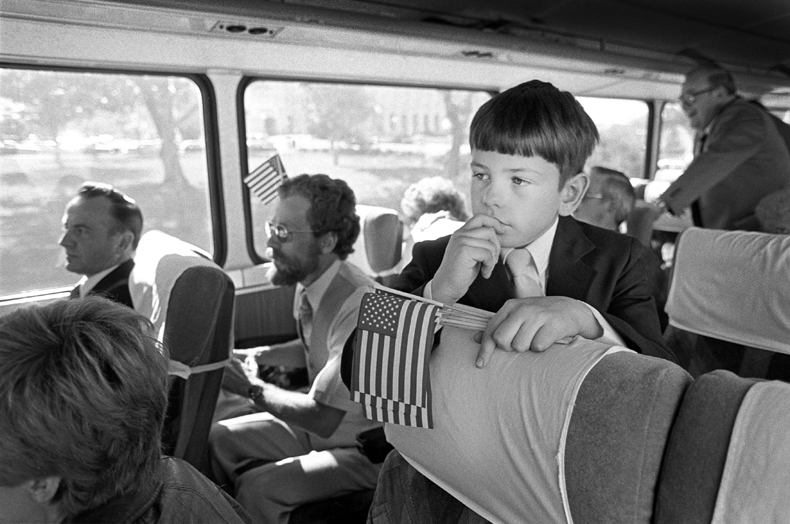

On December 14, 1984, the federal government finally began to raze the tiny town. Today, just five people continue to live in Centralia while the fire continues to burn below them — just one of the thousands of mine fires blazing all around the world.
Centralia remains one of the most prevalent in the US, due to the media attention it received. Over the past 60 years, the fire has covered an eight-mile stretch of 3,700 acres. At its current rate, it could continue to burn for over 250 years. For Jacobs, it serves as an ominous warning. “We have to make progress,” she says. “And move away from fossil fuels that leave us vulnerable to planetary destruction.”
Get your copy of Huck 77 now, or subscribe to make sure you never miss another issue.
Renée Jacobs’ complete archive of Centralia is in the collection of the Archive of Documentary Arts at Duke University.
Follow Miss Rosen on Twitter.
Enjoyed this article? Follow Huck on Twitter and Instagram.
You might like

Portraits of gay bears through a rooftop hatch
Big Boys On My Roof™ — Growing up, Anthony Stockdale struggled with his love for bigger men. His new photo series celebrates the bear community.
Written by: Anthony Stockdale

In photos: Lives of solitude at the world’s edge
Coirón — Pie Aerts’s new photobook documents years spent in close quarters with puesteros in Patagonia – a group of aging gauchos who live almost completely isolated existences.
Written by: Isaac Muk

The raw, fledgling intimacy of Peter Hujar’s contact sheets
Hujar:Contact — A new photobook highlights the process of the legendary queer photographer, and his process of growing into the artist he ultimately became.
Written by: Miss Rosen

Jesse Glazzard’s messy portrait of queer friends, lovers and chosen family
The Sound of Dirt and Beauty — The photographer’s debut monograph explores tender, unpolished moments shaped by the people who he surrounds himself with, while offering a window into the UK’s working-class LGBTQ+ community.
Written by: Sunny Sunday

Behind the curtain at Alternative Miss World 1981
Olympia glamour — Running a subversive take on the traditional beauty pageant, the Andrew Logan organised event prioritised underground creativity and invention. Photographer David Corio went behind the scenes at its biggest edition.
Written by: Miss Rosen

New exhibition highlights British radical living over 200 years
Earthly Paradise — Taking place at the William Morris Gallery, it explores the homes and lives of artists, writers, musicians and more, as well as the conditions that allowed them to thrive.
Written by: Isaac Muk


