An eerie tour of Georgia’s forgotten Soviet bus stops
- Text by Eva Clifford
- Photography by Nanuka Zaalishvili

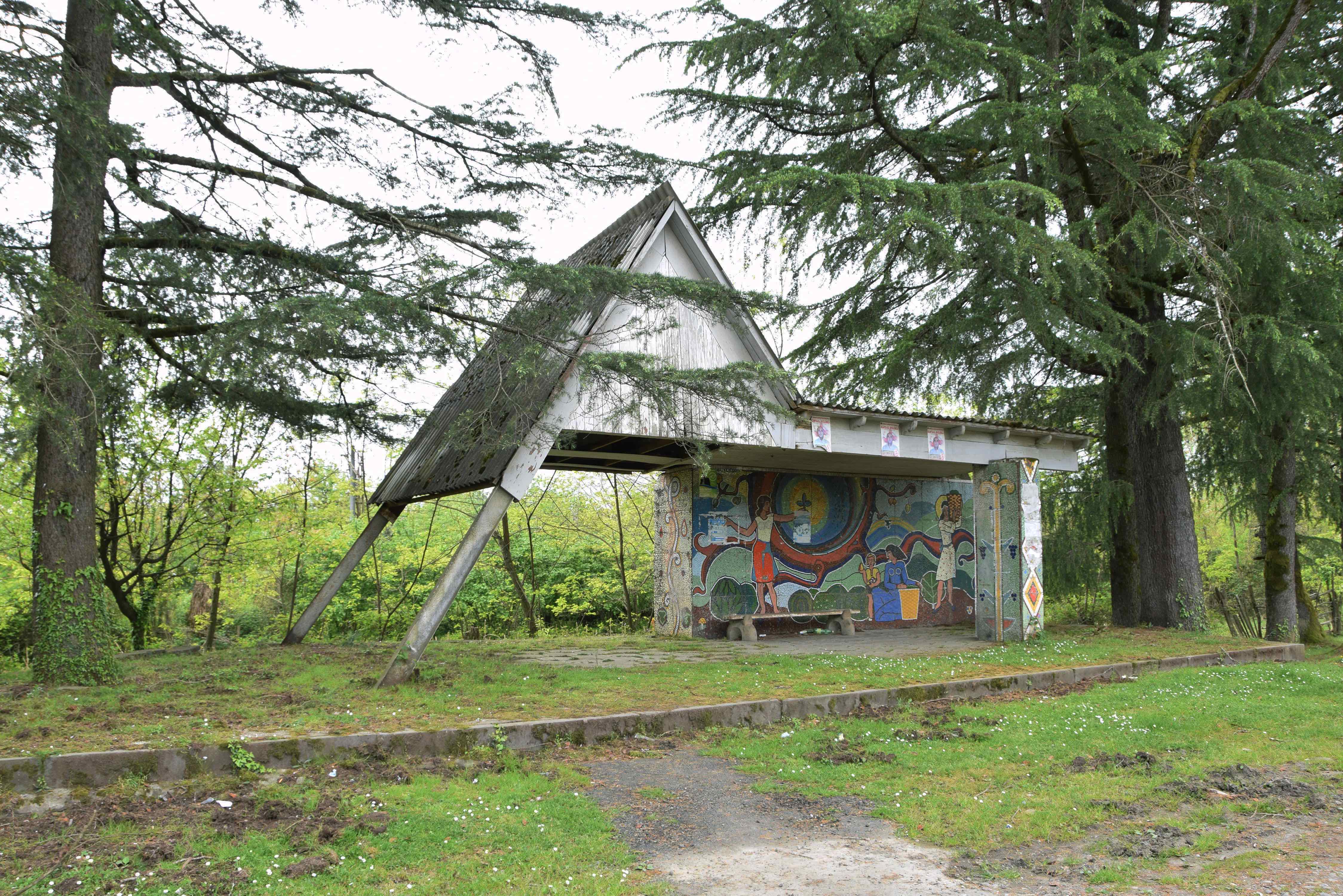
Ever since she was a child, Nanuka Zaalishvili remembers seeing the strange shapes of Soviet bus stops along the roadsides of her native country, Georgia.
After growing up and qualifying as an architect, Zaalishvili came into photography unexpectedly when curiosity led her to return and document these forgotten constructions.
“For me, being an architect does not only mean sitting in a studio designing buildings or interiors,” she says. “It’s more about exploring the world around me and things that surround us in daily life.”

Natakhtari
Zaalishvili makes clear from the outset that she is not a photographer. “I had no idea how to use a camera, so the first pictures I took are not professional photos,” she says. Yet, a couple of years into the project she decided to make the pictures public, and they soon sparked an interest.
To find the bus stops, Zaalishvili scoured the country by car. Setting out from the Georgian capital Tbilisi, she drove with a different route in mind each time. While some were easy to find, others were set back a long distance from the main road – and, in some cases, new bus stops had been built in front of the original Soviet ones.
“Some of them are still functioning, but the majority are not,” explains Zaalishvili. “Nowadays, public transport will stop wherever you wave your hand, so nobody uses the bus stops.”
Kakhuri
In Soviet times it was a different story, because independent travel was discouraged and people relied heavily on public transport to get them from A to B.
As the pictures illustrate, no one bus stop is the same. Some are decorated with vibrant mosaics specific to that region – for example, grapes will signify a famous wine region – while others look like they’ve just landed from outer-space. Zaalishvili hopes that in documenting their diversity, others will also appreciate their value and see them as an important heritage of Soviet-era Georgian architecture.

Chalaubani

Goderdzi Pass

Rustavi

Manglisi

Borjomi

Patara Chailuri

Patara Kanda

Kobuleti
Zaalishvili’s book Soviet Bus Stops in Georgia is available now. Zaalishvili runs an architectural studio, as well as a site dedicated to all things architecture-related.
Zaalishvili was one of the exhibiting photographers at Kolga Tbilisi Photo Week, which takes place each May in the Georgian capital.
Enjoyed this article? Like Huck on Facebook or follow us on Twitter.
You might like

New exhibition highlights British radical living over 200 years
Earthly Paradise — Taking place at the William Morris Gallery, it explores the homes and lives of artists, writers, musicians and more, as well as the conditions that allowed them to thrive.
Written by: Isaac Muk

What life on the Strait of Hormuz is really like
Southern Winds — Bandar Abbas based photographer Morteza Niknahad has been capturing the diverse communities and stories of his local region since he first picked up a camera. His new series highlights the human impact of war.
Written by: Isaac Muk

Nick Haymes’s intimate portrait of his family’s life
Chronograph — Over 25 years, the photographer documented his son’s lives as they grew into adults. The resulting photobook is an exploration of the passage of time, as well as the optimism of youth.
Written by: Miss Rosen

Kristina Rozhkova’s scatty, confronting portrait of captivity
Gut Feeling — The Russian artist’s 2024 arrest and subsequent detention opened her eye towards the omnipresent dynamics of power and control. Her new photobook is a stark exploration of being trapped.
Written by: Isaac Muk

UK’s first ever Latino film festival is coming to London
LoLaFF — Taking place between October 2-6, it will feature 55 filmmakers from Latin America, with an opening night at the Barbican.
Written by: Isaac Muk

Shawn Walker’s layered, psychedelic vision of Harlem’s streets
From BeBop to Illusion — Using glass as a means to illuminate the city’s different layers, the longtime photographer and filmmaker is publishing his first monograph at the age of 86.
Written by: Miss Rosen


