How growing up in a Calcutta brothel gave photographer Avijit Halder a unique way of seeing the world

“I was born and raised in Sonagachi, Calcutta’s red-light district. My grandfather had two shops that sold groceries and stationary, but they both closed in the 1990s and he started selling alcohol from the house. People who came for the women would come to our place for a drink and as a kid I would serve them alcohol. When I was about two years old my father started doing heroin and that’s when everything went really downhill. Until I was nine years old my mum really took care of me, she always told me, ‘You live here because you have to, but you have to get out of here. There is a world beyond this.’
“Growing up I was very scared of my mother and in a way I hated her because she was so strict with me, but when she passed away I missed her immensely. Growing up in a brothel one of the things you definitely have is freedom; I was seeking that freedom when my mum died. I could have gone in a whole different direction where I didn’t do anything with my life but Zana Briski came and changed everything.
“During summer vacation, an NGO would come and teach kids from the brothels for two or three hours, but they would also feed them. I would always go because they had good food. Zana came there as a volunteer because she wanted to teach the kids from the brothels how to use a camera. Zana and I had a weird connection; we didn’t speak the same language – I didn’t speak any English back then – but we clicked.

“I was nine years old, and having a camera was super exciting. I was already doing watercolours at the time so for me it was a new medium. I wanted to take unconventional photographs. I remember with my first roll of film I shot some dogs and garbage; everyone else took photos of their family but I was too embarrassed. Zana asked why I photographed garbage and shutters and wires – I found a certain beauty in things being different.
“Zana would give us home assignments. We’d come back and critique each other’s work. It wasn’t professional; it wasn’t like we had photo knowledge. It was the honest opinions of kids and it helped us grow together. It matured us as people. We were talking about photographs, but whatever we said we had a voice and someone listening to us. We had something to talk about and working together as a group empowered us. We became this group – a group with a voice – and people started looking up to us.
“The thing I love and respect about Zana is she sees everyone, regardless of age or race, as friends. In the British school system in India you’re scared of your teachers. You don’t even ask questions if you’re confused – you don’t want to speak up. With Zana it was the first time I’d felt liberated to learn. She’d tell me what she thought, not that I’m right or wrong.

“By 2002, they were done with shooting. Zana put me into a boarding school and I lost touch with her for three years. I didn’t know if she was ever coming back. When Zana did come back years later she told us they’d made a movie – Born into Brothels, which won Sundance and an Academy Award in 2004. But at the time we didn’t know they were making a documentary. They were just guests and they had cameras, we thought they were doing it for their memories. Zana explained that the film had raised a bit of money [the children’s photos were sold at Sotheby’s], and if we wanted to study abroad we could. Everything changed for me; I went to prep school in New Hampshire, and today I live in New York City where I work as a cinematographer. I’m also writing a film about Sonagachi.
“I’ve always been a big street photography fan. I love photographers like Sebastiāo Salgado and Alex Webb. Salgado’s compositions are almost of a painting-like nature. One of the biggest criticisms of his work is that it is too beautiful, but I like that aspect of it because you can do street photography and make it beautiful. It doesn’t have to be gritty. For me an image has to haunt you, it has to stay with you, only then is it an image. Somehow the image has to remain in your system.”
This article originally appeared in Huck 52 – The Documentary Photography Special III.
Grab it in the Huck Shop now or Subscribe today to make sure you never miss another issue.
Interview: Alex Moore
You might like

Cruising on the West Side Piers, New York’s wild side
West Side Highway — In the late 20th century, the area was an if-you-know-you-know hotspot for the city’s gay scene. William Howell’s new photobook immortalises it.

Ahilya Bamroo is Gen Z India’s authentic ambassador
Reel relatable — The influencer turned actor speaks about trolls, beauty standards and youth activism.

What went down at Huck’s 20th birthday party
84 issues and counting — We took over east London’s Jaguar Shoes with friends old and new to celebrate two decades and our new issue, with Tony Bontana taking the decks for a special set.

Photos of friends, lovers and afters in Berlin’s party scene
Dreams and How to Keep Them – Vincent Wechselberger’s new monograph documents a decade of hedonism in the German capital, and the people he met along the way.

Inside the Los Angeles scene kid revival
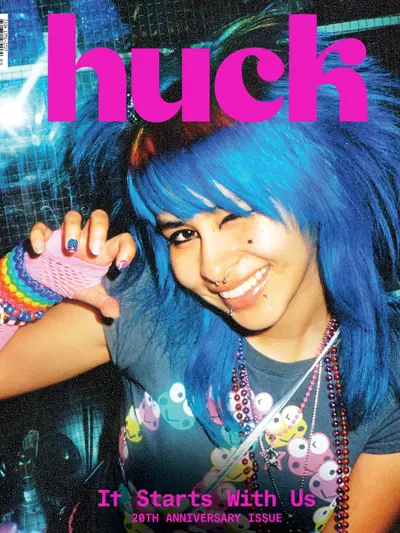
The Rawring ’20s — For the cover of Huck 84, photographer Alexis Gross and writer Anna Zanes meet the latest faces of scene, who are finding freedom to express themselves through its technicolour, unafraid aesthetic.

Introducing our new issue of Huck Magazine: It Starts With Us
Huck 84 — For our second 20th anniversary issue, we spotlight 20 people and groups providing the world with a hopeful future.


