
Intimate photos of love and loneliness in rural Russia

“It’s a bad translation of a Russian saying,” says Nadia Sablin, clarifying the title of her new monograph, Years Like Water. “I don’t really like the way it sounds in Russian, but it feels like a poetic representation of what I was looking at – not just photographing people or a place, but photographing time.”
Born in Saint Petersburg 11 years before the dissolution of the Soviet Union, aged 12 the photographer’s family emigrated to Cleveland, Ohio, where she developed a new way of engaging with the world. “I had dreamed about America as a magical place, but of course any dream is very different to reality. Cleveland isn’t a very big city compared to Saint Petersburg, so it was a huge cultural shift, from being close to people and involved in life in a physical way to being isolated and separated. That put me into the role of the observer early on, and it kind of stuck.”

Alyona Savelyeva, 2019.

Alyosha Savelyev, 2018.
Later moving to New York, where she still lives today, it would be 16 years before Sablin returned to Russia, following a stint with the Peace Corps in Ukraine in the early 00s. “I saw a lot of things that reminded me of my childhood there – same smells, same roots and same words,” she says. Initially trained in commercial photography, while in Ukraine she adopted a more intimate approach, documenting the people and landscapes she encountered as a tool of curiosity and connection. This same perspective informed her work in Alekhovshchina, the northwestern village where Years Like Water unfolds, and where her late grandfather’s house anchored her, by then occupied by her two paternal aunts, whom she photographed for 2015’s Aunties: The Seven Summers of Alevtina and Ludmila.
The new book foregrounds the young people she met on her annual summer visits to Alekhovshchina, beginning in 2008. “It was a roundabout way of going back to Russia – for a long time I didn’t know if I could or what our citizenship status was,” she explains, recalling that initial prompt. “The second I walked into that old house, my childhood just rushed back – so little had changed there, as opposed to the rest of the country. I left the Soviet Union, I came back to Russia. At that point, there was a lot of hope for democracy and westernisation. Technology, advertising, all that had been missing in my childhood suddenly was everywhere in the big cities, but the village was the same.”

New Year pig, 2018.

Seryozha and Zhenya Maymistovy, 2014.

Former School House, 2017.

Nastya at Vysotskiye house, 2014.
“There was a mutual curiosity,” she continues, reflecting on those early interactions with the kids she photographed. “They wanted to know what it was like for a former Russian person to become an American. It’s hard to judge another country through the media, especially Russian propaganda media.” The product of many short trips made over an 11-year period, as well as a year-long stay in 2018 – the result of a Guggenheim grant, which allowed her to “experience the other rhythms of life rather than just summers” – Years Like Water distinguishes itself against media portrayals of the country, from both Western and Eastern outlets, instead honing in on a specific narrative shaped by poverty, trauma, community and hope, as well as nature, which underscores much of Sablin’s work. “At that point I didn’t go anywhere without a camera, so my intent was always to photograph, though I don’t know if I had a purpose necessarily. It was mostly just an act of appreciation,” she adds.
Shot in public and private spaces, Sablin recognises that the village, the children, and later their parents, do ultimately serve as a sort of stand-in for Russia, though nuance and detail is chief amongst her objectives. “On the one hand yes, it is kind of a synecdoche for Russia, but Russians aren’t monolithic. Every person in my photographs has a different opinion about politics, their life and their connection to the world,” she asserts. “I’m less interested in representing than I am interested in understanding. To me, this village has been a kind of insider look. If you travel through Russia there’s so much repetition because there isn’t much variety [in what’s available]. There are vast differences as well, but there is a certain connectivity that allows me to look at a village in the Leningrad region and imagine what it might be like in Vladivostok.”

Teenagers on post office porch, 2009.

Vysotskiye family on NewYears Eve, 2018.

Ferns, 2018.

Dance for Over 40s, House of Culture, 2017.
Wrapping the project in 2019, Sablin has returned to Alekhovshchina just once since, when Covid allowed in 2021. Faced with the conclusion of such an engrossing project – and with the added context of the war in Ukraine – she has mixed emotions about it today. “There’s a feeling of loss of innocence, or maybe my perception of the country and the children. As well as my own growth – I came in looking at this fairy tale, romanticising what I was seeing because of the beauty of the nature and the people, and I came out aware of how hopeless poverty is,” she notes.
While she’s kept in touch with people on birthdays and such like, she has no interest currently in knowing their stance on the war. “Honestly, I’m afraid to go back, afraid it will drive us apart. So I’m leaving it in a limbo for now, because I can’t reconcile the people that I know in Russia with this movement of support for the war, the belief in propaganda. It’s so senseless and scary, I have stopped trying to pretend I understand anything about Russia, its people or history, as much as I have tried.”

Seryozha Maymistov, 2012.
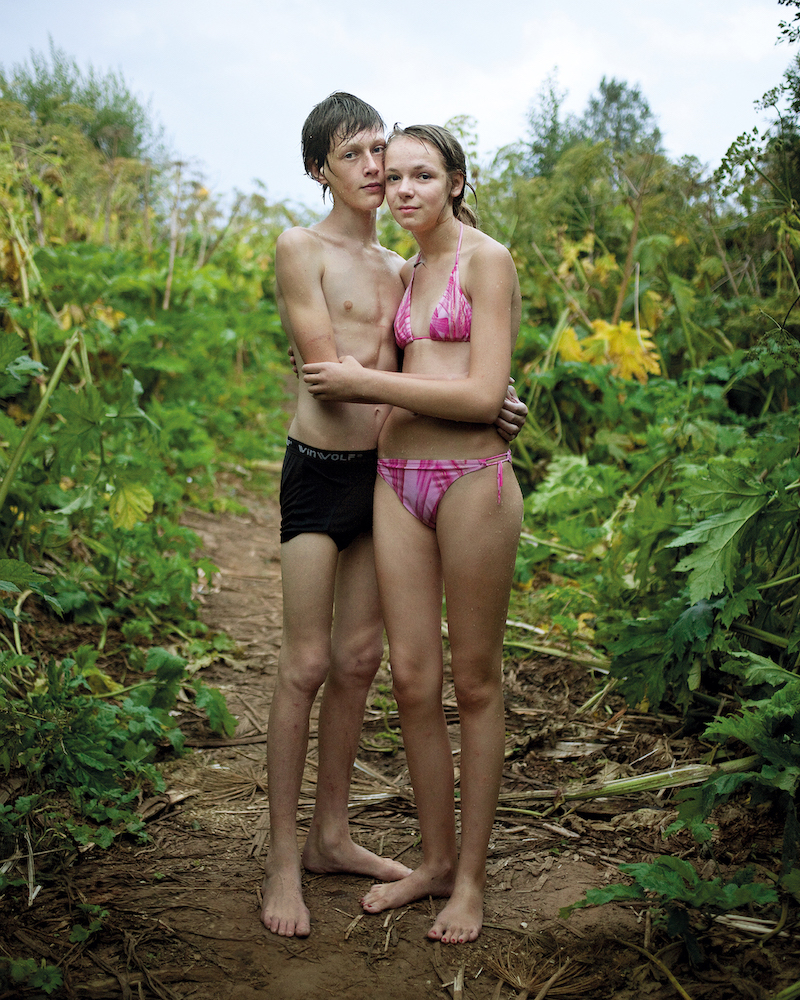
Vitya, Alyona, 2010.
By contrast in an earlier project, 2014’s Rosegarden, Sablin sought to find a grasp on Russia’s invasion of Crimea, travelling to Western Ukraine to meet people and gain some internal comprehension. “I went to try to understand what was going on and how the people were reacting to this terrifying thing. When I did the Peace Corps it was such a magical place, but of course with a huge undercurrent of danger and evil. In 2014 the undercurrent became a visible reality that you could feel and see, observe and describe,” she recalls. Today, as the war marks its first anniversary and she wrestles with what that means, Sablin is trying to make new work at home in the States. “But I’ve never been comfortable photographing here. I don’t have the same understanding of this land, the same history or relationship to the people. I feel very adult and competent here, and that prevents me from wandering blindly.”

Petya and Andriusha Vysotskiye, 2014.

Vika Ivanova, 2009.
Follow Zoe on Twitter.
Enjoyed this article? Like Huck on Facebook or follow us on Twitter.
You might like

The sharp rise of video game photography
Point, shoot — As the entertainment medium’s fidelity levels increase and developers build more powerful tools, a growing community of gamers are pushing the boundaries of image making in virtual worlds. Vicky Jessop meets people at the forefront of the emerging artform.

Joyous photos from the heart of the UK’s radical free festival movement
Common Grounds — The photographer has been capturing British counterculture for the past half century. A new exhibition looks at his archive sitting at the intersection of music, community and grassroots protest.

The lasting community legacy of a legendary Californian boxing gym
Moretón — Since opening in the ’80s, the Coachella Valley Boxing Club has trained multiple world champions, while providing a vital hub for local youth. In his new photobook, Darren Vargas documents its tight-knit, Chicano-led community, while also weaving a deeply personal story.

Inside the grunge golden age with Hole’s former bassist
My ’90s Rock Photographs — Melissa Auf der Maur’s new photobook is a sprawling visual memoir of her time at the heart of the US scene, from Tinker to The Smashing Pumpkins.

Introducing ‘The Chaos Isles’, a new photozine by Huck and Yushy
Normal Island — From unlicensed raves to the solstice at Stonehenge, furries to giant vegetable growers, Yushy is one of the UK’s best lensmen of its wild side. ‘The Chaos Isles’ will be sent out exclusively to Club Huck+ members.

Join Club Huck+ to get the most from Huck
Dispatches from the sharp edge of culture — Members get our print magazine, special photozines, The Huck Long Read newsletter, discounts from our friends and partners, digital versions of back issues and priority access to events.


