
Photos that capture the red lights of ’70s Paris

Pigalle is a place of discretion. By design, its network of streets allows for anonymity, but it’s also possible to lose yourself. Historically, the red light district was created to fence-in Parisian society’s less ‘civilised’ activities, yet within its parameters, those who escaped traditional gender roles found a type of caged freedom. For the heavily stigmatised trans community of the ’70s, there was little else to turn.
Jane Evelyn Atwood devoted her early career to capturing those who fall into this category. Often, her subjects were groups discarded by society, who because of their vulnerable position were unable to protect themselves against injustices. Her latest book, Pigalle People (1978 – 79), published 40 years in retrospect, followed the lives of the trans-sex-workers as they navigated the crepuscular world of Pigalle, a dense maze of erotic cabarets, go-go bars and neon-lit strip joints.
Pigalle People introduces a number of colourful characters who brawl with troublemakers, shoot-up, solicit much shorter clients, and link arms walking down cobbled streets, smiling as multiple kisses are bestowed.
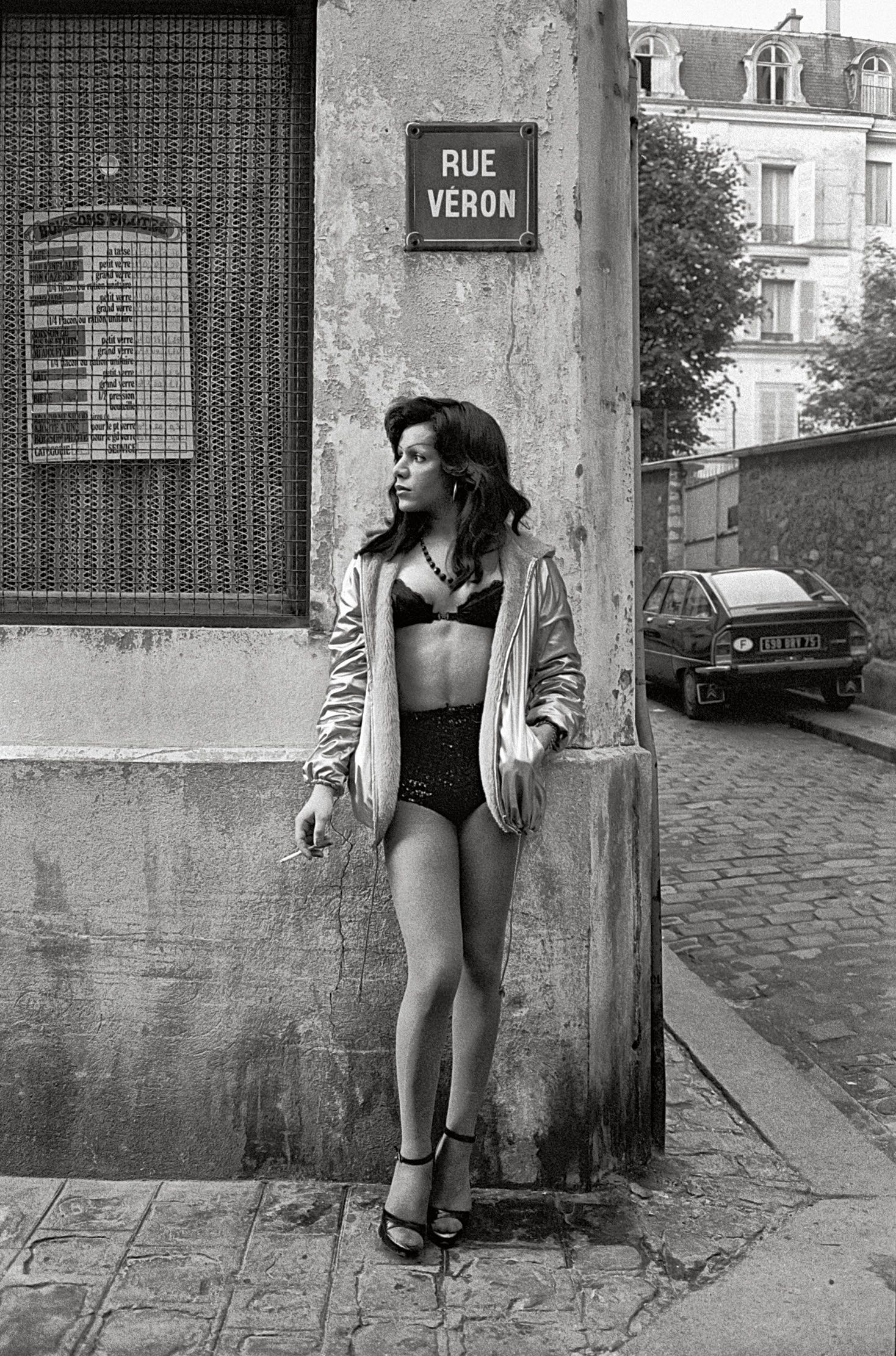
Atwood was introduced to this tight-knit circle by Blondine, a sex-worker with whom she was close. “I never thought I would photograph Pigalle, but I had been given that entrée,” she remembers. “It’s a paradox that photography allows you to know people better… I need to know how they do things, how they get up in the morning.”
While Atwood’s documentation couldn’t ignore the unvarnished painful reality of the women’s lives, the photographs depict their defiance and resistance. Dreams and personal histories are all made visible. An approach typical of the photographer, whose reverence and consideration of her subjects, becomes palpable throughout each turn of the page.

Pigalle has always invited tourism. The endless gawking and documentation would often be a source of discomfort for the women soliciting. Although with time, Atwood proved herself trustworthy. “You can’t just barge in and start taking pictures,” she recalls. “It’s not my world, I will always be just a visitor. As a visitor, I had to respect and behave a certain way.”
When AIDS hit Pigalle later, many of those Atwood photographed lost their lives; if not blotted out before, due to drugs or violence.
“It’s really a witnessing,” she explains. “I loved them and I felt privileged to have been allowed in their world. By publishing the book, I’m giving it to other people and saying this is what I lived, this is what it was like. People can draw their own conclusions.”


Pigalle People is available now.
Follow Ellie Howard on Twitter.
Enjoyed this article? Like Huck on Facebook or follow us on Twitter.
You might like

Inside the grunge golden age with Hole’s former bassist
My ’90s Rock Photographs — Melissa Auf der Maur’s new photobook is a sprawling visual memoir of her time at the heart of the US scene, from Tinker to The Smashing Pumpkins.

Introducing ‘The Chaos Isles’, a new photozine by Huck and Yushy
Normal Island — From unlicensed raves to the solstice at Stonehenge, furries to giant vegetable growers, Yushy is one of the UK’s best lensmen of its wild side. ‘The Chaos Isles’ will be sent out exclusively to Club Huck+ members.

Join Club Huck+ to get the most from Huck
Dispatches from the sharp edge of culture — Members get our print magazine, special photozines, The Huck Long Read newsletter, discounts from our friends and partners, digital versions of back issues and priority access to events.

Signs of solidarity as London marks three years of genocide in Palestine
Never forget — 250,000 people gathered on Saturday as Israeli attacks have continued in Gaza and the West Bank. Daisy Schofield photographed the diverse people and placards in attendance.

Landmark new exhibition is celebrating 50 years of female punk
God Save the Queens — The Museum of Youth Culture is bringing together rare photography, archive material and a one-night-only supergroup featuring members of X-Ray Spex, The Slits and The Raincoats.

Halcyon, end of summer days in ’80s Massachusetts
Bell Pond — Stephen DiRado’s new photobook is a nostalgic look at blissed out moments of young love, family and coming of age at a swimming pond in Worcester, Massachusetts.


