Remembering the life and work of Philip Jones Griffiths

On the 10-year anniversary of his death, a new exhibition is showcasing two of Philip Jones Griffiths’ most significant bodies of work: photos shot amid the conflict of the Vietnam War, and his pictures of Britain taken between 1950 – 1970.
Titled PJGX, the exhibition – presented by TJ Boulting and Trolley Books, in conjunction with Magnum Photos and the Philip Jones Griffiths Foundation – showcases the two works alongside one another, conveying an all-encompassing legacy of one of history’s finest photojournalists.

Mowing the Lawn, Northern Ireland, 1973 © Philip Jones Griffiths / Magnum Photos

South Vietnam, 1970 © Philip Jones Griffiths / Magnum Photos
“When starting to think about a show like this, any curator would be spoilt for choice,” says Fanny Ferrato, daughter of Philip and co-trustee of the foundation, along with her sister, Katherine Holden.
“Philip will always be known for his Vietnam work, however he hated being thought of as a war photographer. By showing the British work alongside Vietnam, it not only gives you a more rounded view of his life’s work, but also presents an interesting comparison, as most of the photographs in the show were taken in the same time period.”
His photos of Vietnamese conflict, first published in the acclaimed Vietnam INC (1971), were credited with helping shift public perception of the Vietnam war – particularly in the US. Speaking of the work years later, Noam Chomsky said: “If anybody in Washington had read that book, we wouldn’t have had these wars in Iraq or Afghanistan.”
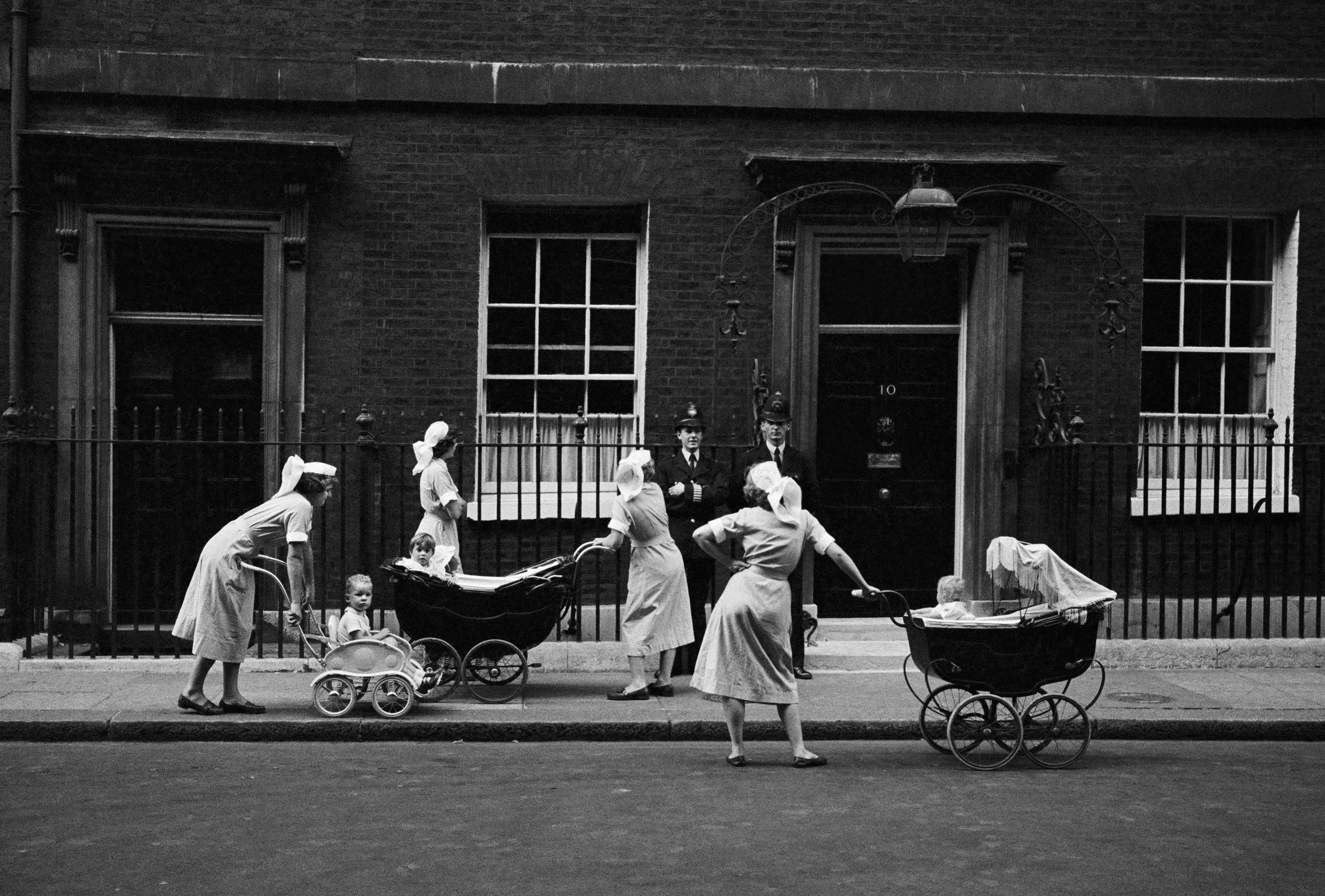
Nannies Outside No.10, 1959 © Philip Jones Griffiths / Magnum Photos

Refugee from U.S. Bombing, Saigon, 1968 © Philip Jones Griffiths / Magnum Photos
Similarly, his shots of Britain – drawn from 2008 publication Recollections – demonstrate Griffiths’ unparalleled ability as a poignant documenter of place and time. While the two works displayed in PJGX are contrasting in their subject matter, they remain united through his unique curiosity in people and a belief in the power of visual storytelling.
“It has been said that in order to tell a great story you have to concentrate on the 5 ‘W’s: who, what, where, when and why. To Philip the first four were perfunctory and it’s the last one that really counted,” adds Holden.
“This focus and ability to get into the ‘why’ of certain situations certainly helps distinguish Philip as a unique storyteller. As well as this, he had a real empathy with his subjects – whether it be a child in Vietnam suffering the effects of Agent Orange, or an old lady trying to do her shopping in Northern Ireland among the soldiers and sandbags.”

U.S. Marine Sharing Cigarettes, 1967 © Philip Jones Griffiths / Magnum Photos

Oxford Street, London 1960 © Philip Jones Griffiths / Magnum Photos

Soldier with Bullet-proof Shield, Northern Ireland, 1973 © Philip Jones Griffiths / Magnum
Photos

The Beatles, 1963 © Philip Jones Griffiths / Magnum Photos

Saigon, South Vietnam, 1967 © Philip Jones Griffiths / Magnum Photos
PJGX: Philip Jones Griffiths – Ten Year Anniversary Exhibition is showing 19 March – 21 April, 2018 at London’s TJ Boulting Gallery. Philip Jones Griffiths: Icons is showing 5 June – 27 July, 2018 at Magnum Print Room.
Enjoyed this article? Like Huck on Facebook or follow us on Twitter.
You might like

What went down at Huck’s 20th birthday party
84 issues and counting — We took over east London’s Jaguar Shoes with friends old and new to celebrate two decades and our new issue, with Tony Bontana taking the decks for a special set.

Photos of friends, lovers and afters in Berlin’s party scene
Dreams and How to Keep Them – Vincent Wechselberger’s new monograph documents a decade of hedonism in the German capital, and the people he met along the way.

Inside the Los Angeles scene kid revival
The Rawring ’20s — For the cover of Huck 84, photographer Alexis Gross and writer Anna Zanes meet the latest faces of scene, who are finding freedom to express themselves through its technicolour, unafraid aesthetic.

Introducing our new issue of Huck Magazine: It Starts With Us
Huck 84 — For our second 20th anniversary issue, we spotlight 20 people and groups providing the world with a hopeful future.

The sharp rise of video game photography
Point, shoot — As the entertainment medium’s fidelity levels increase and developers build more powerful tools, a growing community of gamers are pushing the boundaries of image making in virtual worlds. Vicky Jessop meets people at the forefront of the emerging artform.

Joyous photos from the heart of the UK’s radical free festival movement
Common Grounds — The photographer has been capturing British counterculture for the past half century. A new exhibition looks at his archive sitting at the intersection of music, community and grassroots protest.


