The passion of West Virginia's last snake-handling church
- Text by Miss Rosen
- Photography by Robert LeBlanc

Nestled deep in the Appalachian Mountains of West Virginia lies Squire, an unincorporated community in McDowell County that takes its name from a local law enforcement officer. Although the coal industry shapes the area’s blue-collar conservative politics, McDowell County is one of the poorest in the nation.
“The land has made many people rich, but most don’t live in that region,” says photographer Robert LeBlanc. Once the natural resources have been extracted, companies ship out and abandon the communities they built, creating a virulent mix of environmental destruction and rural poverty. As is often the case when these forces collide, religion fills the void.


“Once you turn off the freeway, you begin to see churches pop up everywhere,” says LeBlanc. “As you get deeper into the mountains, the small towns you pass through are no longer than a mile long [with] no more than 100 to 150 people living in them. I remember thinking, how do they fill all these churches?”
LeBlanc would discover the answer for himself. He’s spent the past five years with pastor Chris Wolford and his family, who run the notorious House of the Lord Jesus – said to be the last serpent-handling church in West Virginia.
One of few remaining churches in the Pentecostal Signs denomination, the House of the Lord Jesus take the King James version of the Bible literally, following the Gospel of Mark 16:17-18, which extols believers to cast out devils, speak with new tongues, and take up deadly serpents for protection and healing. Snake handling is a centuries-old ritual, often involving drinking poison as a demonstration of the strength of their faith.
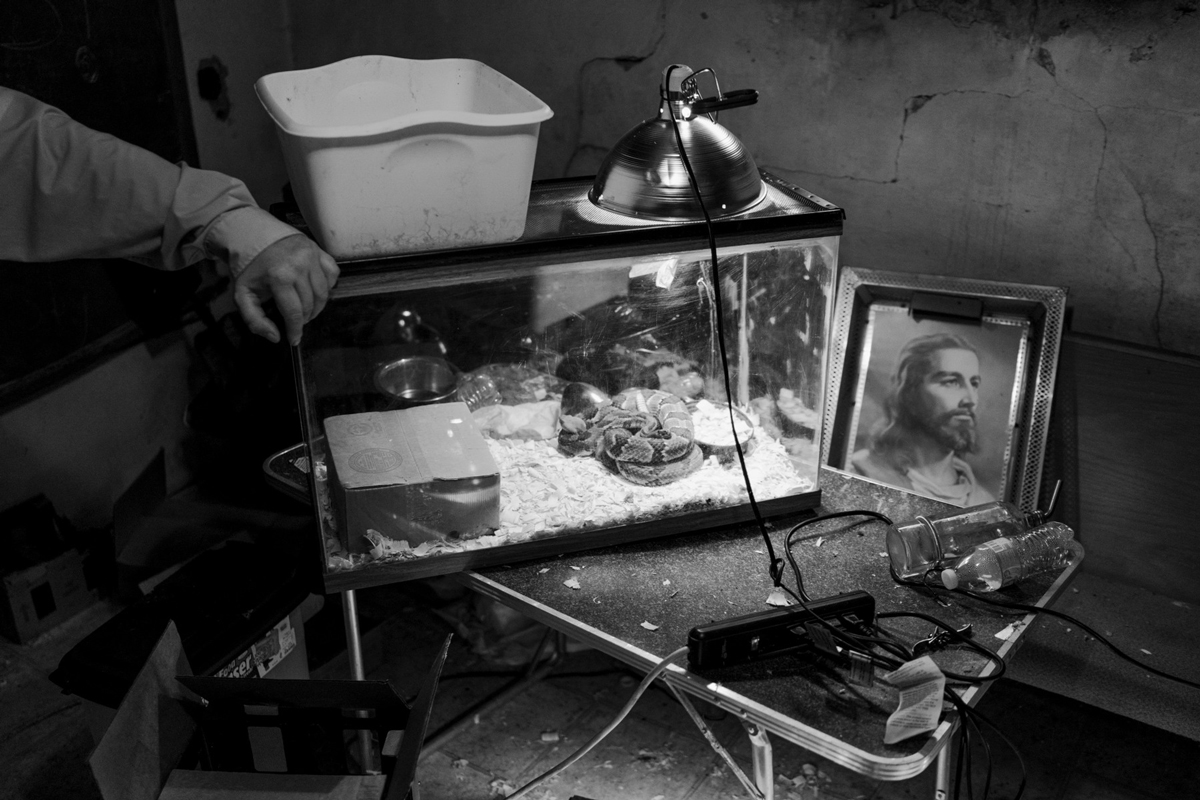


LeBlanc’s new book and exhibition, Gloryland, takes us inside this fabled sect. The project began as he traveled through the South, exploring a moment in American history where old beliefs and traditions are falling away under the relentless onslaught of late capitalism. On his journey, he connected with Wolford and spoke with the preacher for two months before attending his first service among the entire congregation.
“I witnessed something extraordinary that probably wouldn’t be around in another 10 or 15 years,” says LeBlanc of the services, which include music he describes as “a clash of Southern gospel, Delta blues, and folk,” as well as the legendary snake-handling rituals. LeBlanc ultimately came to feel a sense of kinship with the Wolfords despite their ideological differences, and observes their displays of devotion with reverence. “They have taught me a lot about love, family, and believing in something so profoundly that they are willing to risk their lives twice a week for what they believe,” he says.
For LeBlanc, the idea behind Gloryland is about the search for something greater than oneself – and the arrival at one’s destination after the struggle is won. “Seeing their ability to still hold onto their faith against the odds is admirable,” he says. “They have been turned into a spectacle by almost every major media outlet and online bashing never stops, but they keep their heads up. As a congregation, they are bulletproof.
“West Virginians fight all odds as a community and help each other,” he adds. “Even though the world has forgotten about them.”


Find more of Robert LeBlanc’s work on Instagram.
Enjoyed this article? Like Huck on Facebook or follow us on Twitter.
You might like

Photographing America’s 20th century rebels
Rebels With a Cause — A new monograph looks back at Jean-Pierre Laffont’s extensive archive documenting counterculture, art, activism and more, shaping the country as it is today.
Written by: Isaac Muk

A chaotic portrait of an ’80s American farming family
Holy Cow! — Melonie Bennett grew up on a farm in Maine in the ’80s, and documented her family’s idiosyncratic daily life. She presents those humorous, everyday memories in a new exhibition and photobook.
Written by: Miss Rosen

Exploring girlhood and land ancestry in Sudan’s cotton fields
Cotton Queen – A new feature debut from filmmaker Suzannah Mirghani explores the legacy of colonialism and the fight for self-determination through the tender eyes of a teenage girl.
Written by: Roxana Diba

Portraits of gay bears through a rooftop hatch
Big Boys On My Roof™ — Growing up, Anthony Stockdale struggled with his love for bigger men. His new photo series celebrates the bear community.
Written by: Anthony Stockdale

In photos: Lives of solitude at the world’s edge
Coirón — Pie Aerts’s new photobook documents years spent in close quarters with puesteros in Patagonia – a group of aging gauchos who live almost completely isolated existences.
Written by: Isaac Muk

The raw, fledgling intimacy of Peter Hujar’s contact sheets
Hujar:Contact — A new photobook highlights the process of the legendary queer photographer, and his process of growing into the artist he ultimately became.
Written by: Miss Rosen


