Roberta Bayley, the queen of punk, on New York’s raw years
- Text by Miss Rosen
- Photography by Roberta Bayley

After living in London in the early ’70s, California native Roberta Bayley arrived in New York in 1974 because it was the only return ticket she could afford back to the States.
Serendipity served Bayley well. She soon met a young musician by the name of Richard Hell and was asked to work the door when his band Television played at CBGB, a new club on the Bowery. Bayley fell in love with the emerging punk scene of the Lower East Side and began working at CBGB five nights a week.
In 1975, Bayley bought a camera and adopted the punk attitude to making art: sheer nerve. As chief photographer for Punk magazine, she would amass a singular archive of artists like Iggy Pop, Debbie Harry and Blondie, the Sex Pistols, the Damned, the Clash, the New York Dolls, X-Ray Spex and the Dead Boys, among others.
“Photography is more the eye than the technique,” Bayley says in Beth Lasch’s new documentary short, Roberta Bayley: She Just Takes Pictures. The film provides a whirlwind view of her 10-year career, kicking things off with her iconic black and white photograph of the Heartbreakers, which later appeared on the cover of the seminal punk oral history, Please Kill Me.
“That was right at the beginning: it was the fourth roll of film through my camera,” Bayley recalls. “Photography is pretty easy, you just push that button. I just went with it. I never learned to do any of that [technical] stuff. I learned to use a flash but basically I quit before I learned anything deep about photography.”

The Heartbreakers 1975. This was my first photo session, the 4th and 5th rolls through my new (used) Pentax Spotmatic.

This was the first attempt to get all the living New York Dolls reunited outside Gem Spa in 1977. Unfortunately, Jerry didn’t show up! We re-shot a few days later, the last photo of them together.
Going on instinct, Bayley knew she needed total freedom to create her work. She didn’t want to work in a studio; she wanted to be with the band, not just as a photographer but as friends. As an insider, Bayley got close to her subjects in a way few others could.
“I travelled with Blondie a few times,” she says. “We were the same age, the same level of success – not much. At a certain point, you’re just invisible if you’re always hanging around. ‘It’s just Roberta, what’s the big deal?’”
“That was definitely true at the Ramones session. If I had shown up with all these lights and a makeup person, it would have been a completely different situation. It was like, ‘It’s just Punk magazine – let’s get this over with.’ Sometimes that’s a good thing.”
From the very start of her career, Bayley’s talents were immediately recognised. Her Heartbreakers photos became a poster, her Ramones photo became an album cover, and her portrait of Richard Hell for Blank Generation was chosen by Lester Bangs as the worst album cover of all time in the Rolling Stone Book of Lists. “I thought that was great,” she says with a laugh. “It’s always good to be number one even if it’s the worst.”

Polly Styrene of X-Ray Spex 1978. Taken in a short lived Punk store on the Bowery near CBGB.
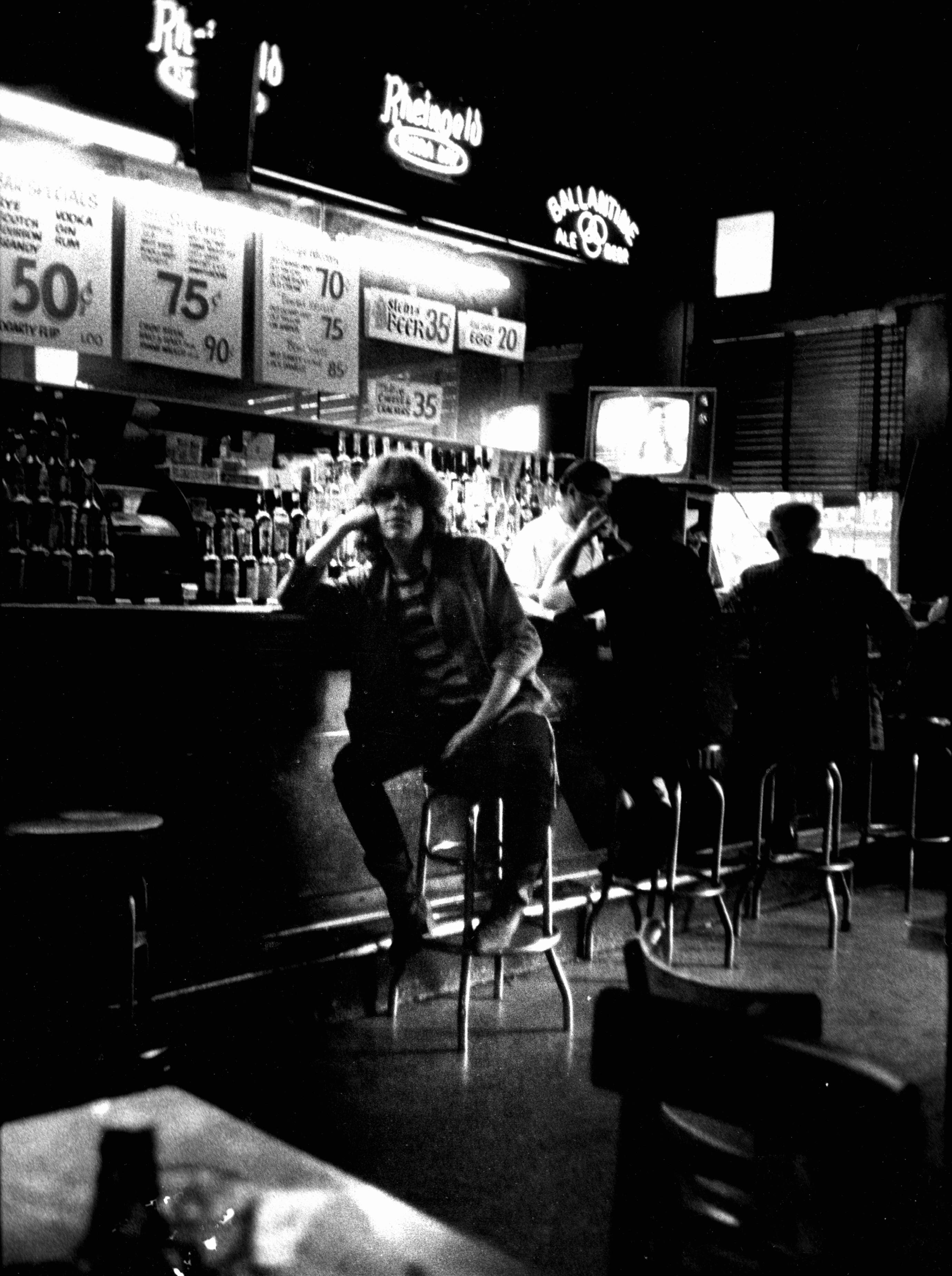
David Johansen Canal Center Bar in Chinatown 1978. David was rehearsing his first solo album in a nearby studio on Mercer Street

Joey Ramone in an outtake from Punk magazine’s “Mutant Monster Beach Party” 1977

Richard Hell in his apartment for the “Destiny Street” album cover session 1980

Debbie Harry and Chris Stein at an early appearance on cable TV about Punk.

The Dead Boys outside CBGB 1976. When they came back to New York they all had short hair!

Iggy Pop at the Ramones loft on E. 2nd Street at a shoot for Punk magazine. A few days later, Iggy would leave for Berlin with David Bowie.

The Ramones 1976

Joe Strummer rolling a spliff (on a copy of Creem magazine!) 1980
Roberta Bayley: She Just Takes Pictures is out now.
Follow Miss Rosen on Twitter.
Enjoyed this article? Like Huck on Facebook or follow us on Twitter.
You might like

How Japan revolutionised art & photography in the ’60s and ’70s
From Angura to Provoke — A new photobook chronicles the radical avant-garde scene of the postwar period, whose subversion of the medium of image making remains shocking and groundbreaking to this day.
Written by: Miss Rosen

In west London, Subbuteo is alive and flicking
London Subbuteo Club — The tabletop football game sees players imitate vintage teams with tactics and tiny painted replica kits. Ryan Loftus takes a trip to Fulham to meet a dedicated community and witness a titanic Brazil vs Coventry City showdown.
Written by: Ryan Loftus

Artifaxing: “We’ve become so addicted to these supercomputers in our hands”
Framing the future — Predominantly publishing on Instagram and X, the account is one of social media’s most prominent archiving pages. We caught up with the mysterious figure behind it to chat about the internet’s past, present and future, finding inspiration and art in the age of AI.
Written by: Isaac Muk

The lacerating catharsis of body suspension in Hong Kong
Self-Ferrying — In one of the world’s most densely packed cities, an underground group of young people are piercing their skin and hanging their bodies with hooks in a shocking exploration of pain and pleasure. Sophie Liu goes to a session to understand why they partake in the extreme underground practice.
Written by: Sophie Liu

What we’re excited for at SXSW 2026
Austin 40 — For the festival’s 40th anniversary edition, we are heading to Texas to join one of the biggest global meetups of the year. We’ve selected a few things to highlight on your schedules.
Written by: Huck

Wu-Tang Clan forever, and ever
The Final Chamber — RZA, the spiritual leader of one of the most important hip hop groups of all time explains why they won’t rest until their legacy is secured.
Written by: Yoh Phillips


