The man who taught America how to grow weed
- Text by Miss Rosen
- Photography by Mel Frank, courtesy of Benrubi Gallery

The year was 1967, the city: New York. At the age of 23, Mel Frank had completed four years of service in the Navy before settling into an apartment on the Upper West Side (a room formerly occupied by Nico of the Velvet Underground).
“It had beautiful eastern light,” Frank recalls. “Not having much money, I filled it with plants. I built a stereo cabinet and within that, I put up fluorescent lights and grew smaller plants.”
He started smoking marijuana and purchasing nickel bags on the street. “In those days, Mexican or Colombian marijuana came packed with seeds – it didn’t take me long to start growing it.”
“The only thing I knew was the plant was field crop so I could treat it like corn. I had a small room and put down plastic, made a big box, filled it with sand and manure, and hung fluorescents over it, then eventually moved to pots, which made it easier to control the light intensity on top of the plants.”

Sativa Landraces, Sierra Nevada Foothills CA 1978
In 1971, while looking for work, a journalist suggested Frank write an article to make ends meet. He wrote about what he knew: how to grow marijuana. It was later published as a two-part story in the New York Flyer, an insert found in local copies of Rolling Stone. Once this seed was planted, a new world began to bloom.
“At the exact same time, Ed Rosenthal was trying to sell an article to Rolling Stone – except his was a promotion for his company that would set up planters in your home,” Frank says. “The publisher put him in touch with me, and within five minutes of meeting me, he said we should write a book together. I didn’t really want to write a book with him but he was very persistent. Within a year, I relented.”
Their first effort was a 94-page book with what Frank describes as “an incredibly long name,” published in 1974. “When it came out I was studying biology at City College and I realised the little guide was embarrassing,” he remembers.
Inspired to do better, Frank moved to California and spent two years researching marijuana in botanical libraries where he made five cent photocopies of more than 300 scientific papers. The result was the 1978 publication of Marijuana Grower’s Guide Deluxe, which was unexpectedly given a glowing review by The New York Times.

Afghani Congolese backcrossed Afghani NY 1982
“Suddenly everyone was reviewing the book and all the stores were carrying it,” Frank shares. “The book set out the basics for how to grow indoor or outdoor. It put into the heads of the general public that they could grow their own. The book really started a revolution.”
In order to illustrate the book, Frank taught himself photomicrography. He also documented the guerilla growers who went out into remote areas to farm, creating a phenomenal archive of work now on view in Mel Frank: When We Were Criminals. (“Mel Frank” is a pseudonym, used in order to publish his work without placing himself in danger of persecution from the law prior to the 2016 passage of the Adult Use of Marijuana Act in California.)
“To me, it’s really criminal what the government has done for the last 80 years, which is lie about all of this,” Frank says. “If you see the posters for movies like Reefer Madness, they were serious. This is what they told you it was. They completely tried to erase the entire history of cannabis in this country.”
“All of the government funding that goes into cannabis is to find something wrong with it.”

Seeded Colombian Landrace Backyard Oakland CA 1979

Afghani Landrace, Sonoma County CA 1979

Cazadero Sonoma County CA 1977

South Indian Landrace, Oakland CA 1980

Mokelumne Hill Calaveras County, CA 1978
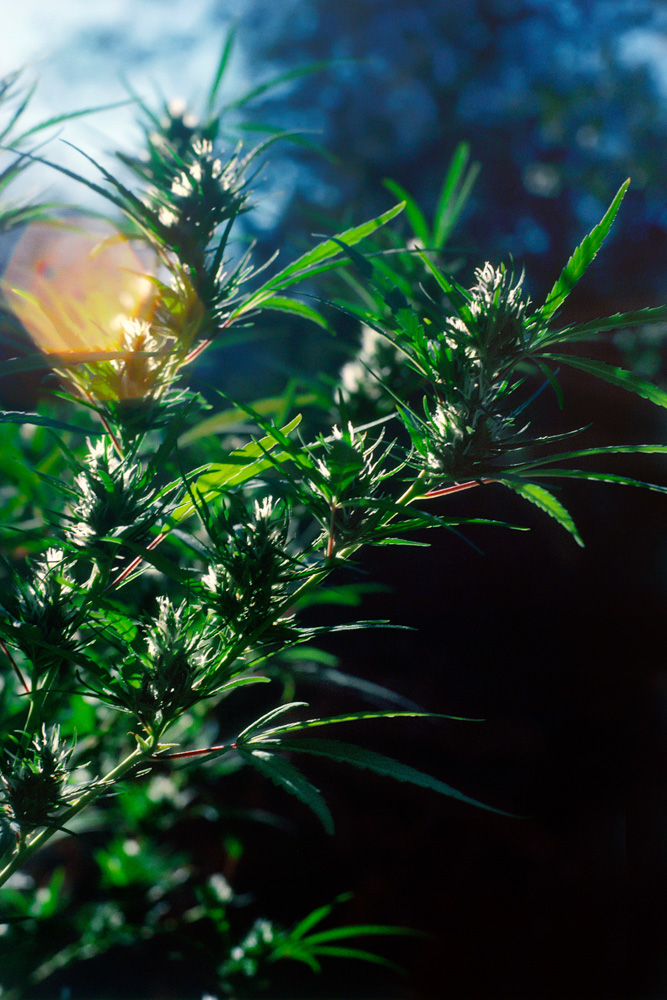
Backyard Berkeley CA 1977

Nigerian Landrace Greenhouse, Oakland CA 1979
Mel Frank: When We Were Criminals is on view at Benrubi Gallery, New York, through November 20, 2018.
Follow Miss Rosen on Twitter.
Enjoyed this article? Like Huck on Facebook or follow us on Twitter.
You might like

Louis Theroux’s ‘Manosphere’ shows men aren’t the problem, platforms are
No Ws for Good Men — The journalist’s new documentary sees him dive headfirst into the toxicities and machinations of the male influencer economy. But when young creators are monetarily incentivised to make more and more outrageous content, who really is to blame?
Written by: Emma Garland

In the 1960s, African photographers recaptured their own image
Ideas of Africa — An exhibition at the Museum of Modern Art explores the 20th century’s most important lensers, including Seydou Keïta, Malick Sidibé and Kwame Brathwaite, and their impact on challenging dominant European narratives.
Written by: Miss Rosen

Reynaldo Rivera’s intimate portrait of queer Latino love
Propiedad Privada — Growing up during the AIDS pandemic, the photographer entered a world where his love was not only taboo, but dangerous. His new monograph presents inward-looking shots made over four decades, which reclaim the power of desire.
Written by: Miss Rosen

In photos: The newsagents keeping print alive
Save the stands — With Huck 83 hitting shelves around the world, we met a few people who continue to stock print magazines, defying an enduringly tough climate for physical media and the high street.
Written by: Ella Glossop

Inside Bombay Beach, California’s ‘Rotting Riviera’
Man-made decay — The Salton Sea was created by accident after a failed attempt to divert the Colorado River in the early 20th century. Jack Burke reports from its post-apocalyptic shores, where DIY art and ecological collapse meet.
Written by: Jack Burke

The quiet, introspective delight of Finland’s car cruising scene
Pilluralli — In the country’s small towns and rural areas, young people meet up to drive and hang out with their friends. Jussi Puikkonen spent five years photographing its idiosyncratic pace.
Written by: Josh Jones


