The rise and fall of Sheffield’s brutalist post-war utopia
- Text by Hannah Clugston
- Photography by Bill Stephenson

“I have always been interested in documenting communities,” explains photographer Bill Stephenson. “Particularly communities on the edge of existence.”
This statement couldn’t be more readily applied to the photographs Stephenson shot on a Sheffield housing estate in 1988, when he captured a community that was literally about to be blown apart by the City Council.
Although Hyde Park was only 22 years old and housed over 4,000 people, by the end of the ’80s Sheffield council had their finger on the demolition button. But before the 18-storey brutalist wonder could be raised to the ground, Stephenson nipped in there with his Hasselblad ready to capture the final residents, and document the end of an era.

Bill Stephenson, young couple by a service lift. Hyde Park Flats, Sheffield, 1988
Hyde Park and its next-door neighbour Park Hill started life as a post-war utopian dream, and were the biggest social housing projects outside of London in Britain. Designed by Jack Lynn and Ivor Smith, the concrete fortresses were inspired by Le Corbusier’s Unité d’Habitation and his belief that the post-war housing crisis could be solved by building high-rise tower blocks that had all the amenities of a typical street. The Sheffield-based spin-off garnered the catchy nickname “streets in the sky” and was even furnished with a large deck that allowed the local milkmen to manoeuvre milk floats around the building.
Documentary photographs of Park Hill by Roger Mayne in 1961 depict lively playgrounds, a close-knit community and cutting-edge architecture. Stephenson recalls that Hyde Park was referred to as “the citadel” or “the castle.” And yet within 30 years, the council had decided the scheme was a failure, and embarked on a plan to blow the whole thing up.

Roger Mayne, Park Hill Estate, Sheffield, 1961 © Roger Mayne Archive / Mary Evans Picture Library
“I think the people who described it as ‘failed’ had never lived there,” argues Stephenson. “I didn’t meet anybody that hated living there – they liked living there and they liked its prominent position over Sheffield. If I’d met people that hated living there, my pictures would have reflected that.”
On the contrary, his captivating photographs uncover a community at ease with their home, rushing to play at the nearby canal basin or relaxing with friends at the estate’s café. Even now, the Facebook page that reconnects old residents includes comments like: “Best years of my life. Love the place.”
For Stephenson to create these intimate portraits he had to get well acquainted with his subjects. So, he popped his camera in the bottom of a carrier bag and started making friends, attending meetings, going to the shops, and visiting the pop-in centre. “Maybe you can tell from the photographs that those people knew me… Wandering around Hyde Park people used to shout things like: ‘Hey, Bill! Have you taken my sister’s picture yet?’ I wasn’t like a spy. I never felt uncomfortable and the people I photographed didn’t feel uncomfortable either.”

Bill Stephenson, Sue the popular owner of Sue’s Shop. Hyde Park Flats, Sheffield, 1988
Although Hyde Park’s lively residents take centre stage in Stephenson’s photographs, the gloomy, crumbling concrete in the background tells a different story – as does the “unemployed club” sign at the local youth club and the short-term loan offer at Sue’s corner shop.
“When I first came to Sheffield in 1979 as a student, I used to go to sleep listening to the sound of drop hammers working through the night,” he remembers. “If I drove out, I could see the glow from the steelworks. Sheffield was an industrial city, and then in a very short space of time, everything shut down. It was devastating.”
Unemployment is often cited as the main culprit in the demise of these idealistic superstructures. Once residents were unable to pay their rent, the council were unable to pay for much-needed repairs, making the cheapest option a stick of dynamite. Of course, Margaret Thatcher’s reign over the ’80s didn’t help either; particularly her belief that “there’s no such thing as society,” and her campaign to shift social responsibility from the state onto the individual.
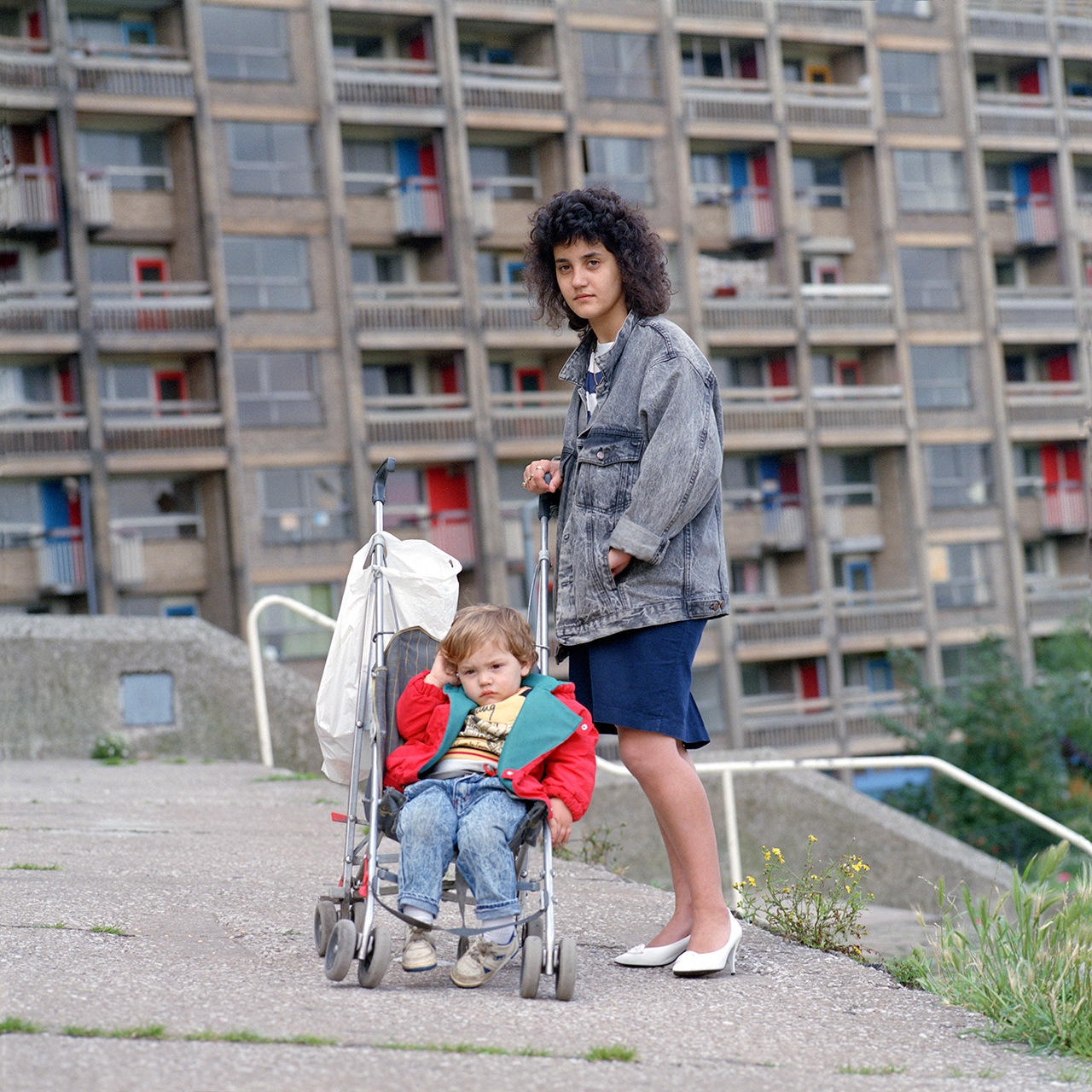
Bill Stephenson, Janet Casey age 18 and baby son Liam Kyle Perkins. Hyde Park Flats, Sheffield, 1988
“Hyde Park was a building of its time, and buildings like that aren’t going to be built again,” laments Stephenson. He is almost certainly right, but some of those buildings still stand. Park Hill managed to survive the demolition plan and is now the largest grade II* listed building in Europe.
Both Stephenson and Mayne’s photographs appear in an exhibition at a new art gallery on the estate, and Park Hill is slowly being renovated, offering both private and social lets side by side. Perhaps society isn’t dead – it just looks a little bit different to before.

Roger Mayne, Boys playing football, Park Hill Estate, Sheffield, 1961 © Roger Mayne Archive / Mary Evans Picture Library

Bill Stephenson, Leroy Edwards and Lee Saville both age 14 in the children’s play area. Hyde Park Flats, Sheffield, 1988

Bill Stephenson, Donna Hargreaves and Carmen Bello sit on an unguarded fourth storey concrete parapet. Hyde Park Flats, Sheffield, 1988

Bill Stephenson, Tom Anne Pete Savage and Dean O’Brien in the cafe. Hyde Park Flats, Sheffield, 1988

Roger Mayne, Milk delivery, Park Hill Estate, Sheffield, 1961 © Roger Mayne Archive / Mary Evans Picture Library

Bill Stephenson, ‘Tony the Ton’ and Martin age 8, outside the Pop In Centre. Hyde Park Flats, Sheffield, 1988

Bill Stephenson, Roller skating paper girls Anita and Emma. Hyde Park Flats, Sheffield, 1988

Bill Stephenson, Richard Hylton and Michael Cunningham play pool in the unemployed club section of the youth club. Hyde Park Flats, Sheffield, 1988

Bill Stephenson, Kenneth Brisset age 14 and his sister age 3 on a 4th storey parapet. Hyde Park Flats, Sheffield, 1988

Bill Stephenson, Woman on her way across the bridge between tower blocks. Hyde Park Flats, Sheffield, 1988
Bill Stephenson’s photographs of Hyde Park are on display in Love Among the Ruins: A Romance of the Near Future at S1 Artspace until 15 September.
Enjoyed this article? Like Huck on Facebook or follow us on Twitter.
You might like

On the set of ‘La Bamba’, lost Latino legend Ritchie Valens’s biopic
The overnight rockstar — The Chicano rock & roll star exploded overnight in the late ’50s, but just as quickly he was gone, killed in a plane crash along with Buddy Holly. An ’80s biopic saw him immortalised on the big screen, which photographer Merrick Morton captured behind the scenes.
Written by: Miss Rosen

Louis Theroux’s ‘Manosphere’ shows men aren’t the problem, platforms are
No Ws for Good Men — The journalist’s new documentary sees him dive headfirst into the toxicities and machinations of the male influencer economy. But when young creators are monetarily incentivised to make more and more outrageous content, who really is to blame?
Written by: Emma Garland

In the 1960s, African photographers recaptured their own image
Ideas of Africa — An exhibition at the Museum of Modern Art explores the 20th century’s most important lensers, including Seydou Keïta, Malick Sidibé and Kwame Brathwaite, and their impact on challenging dominant European narratives.
Written by: Miss Rosen

Reynaldo Rivera’s intimate portrait of queer Latino love
Propiedad Privada — Growing up during the AIDS pandemic, the photographer entered a world where his love was not only taboo, but dangerous. His new monograph presents inward-looking shots made over four decades, which reclaim the power of desire.
Written by: Miss Rosen

In photos: The newsagents keeping print alive
Save the stands — With Huck 83 hitting shelves around the world, we met a few people who continue to stock print magazines, defying an enduringly tough climate for physical media and the high street.
Written by: Ella Glossop

Inside Bombay Beach, California’s ‘Rotting Riviera’
Man-made decay — The Salton Sea was created by accident after a failed attempt to divert the Colorado River in the early 20th century. Jack Burke reports from its post-apocalyptic shores, where DIY art and ecological collapse meet.
Written by: Jack Burke


