Inside America’s abandoned ‘Jewish utopia’
- Text by Miss Rosen
- Photography by Marisa Scheinfeld

The Borscht Belt, otherwise known as the Jewish Alps, was America’s premier getaway during the 20th century. Established in response to abject displays of anti-Semitism nationwide, the Borscht Belt consisted of resort hotels bungalow colonies, summer camps, and boarding houses nestled into the Catskill Mountains of New York state.
At its height, the Borscht Belt was the height of a glamour all it’s own — an all-inclusive vacation replete with indoor and outdoor pools, golf, tennis, skiing, ice-skating, dance, and live entertainment from no less than Mel Brooks, Joan Rivers, Billy Crystal, and Rodney Dangerfield. While many Jewish-Americans born before the ’80s know the area well, the 1987 film Dirty Dancing became the cultural touchstone for all who had never lived it for themselves.
But like the Rust Belt, the Borscht Belt has disappeared, lost to the massive socioeconomic shifts that have taken place in recent years. For photographer Marisa Schienfeld, the shift quite literally hit home.
“My dad’s parents met up there in the 1940s, when my grandmother was hitchhiking between one town and another. At that time, the Catskills was pretty busy if you had the means or were going up there for a job. My mom’s parents met in Brooklyn and went up there for their honeymoon,” Scheinfeld recalls.

Dining Room, Pines Hotel, South Fallsburg, New York

Lobby, Grossinger’s Catskill Resort and Hotel, Liberty, New York
“Fast forward: my dad didn’t want to raise his family in the Brooklyn of 1980s. We moved to Monticello, New York, in 1986 when I was six years old. My grandparents owned a condo adjacent to Kutsher’s and we had access to the hotel. We would go swimming and my grandpa played cards. It was like mini-vacations on weekends, where I would engage in the quintessential Borscht Belt activities like bingo and shuffleboard.”
By the time Scheinfeld entered high school, the era had come to an end. She eventually decamped to New York City, then to San Diego, where she began working on her Master’s thesis. “I was grappling with what I wanted to say as a photographer and my mentor, Arthur Ollman said four words that lit the fire: ‘Shoot what you know,’” Scheinfeld remembers.
She returned to Monticello to embark on a series of photographs that would become The Borscht Belt: Revisiting the Remains of America’s Jewish Vacationland (Cornell University Press). “The project started as re-photography, remaking old postcards, to measure time like a ‘Now and Then.’ I did this for a month or two, and then I got bored,” she says.
“What would happen is I would go with my archival image and agenda, then stop in my tracks when I would see something that warranted to taking a picture of it — and that’s how the whole series evolved. I realized there was more of a story to tell.”
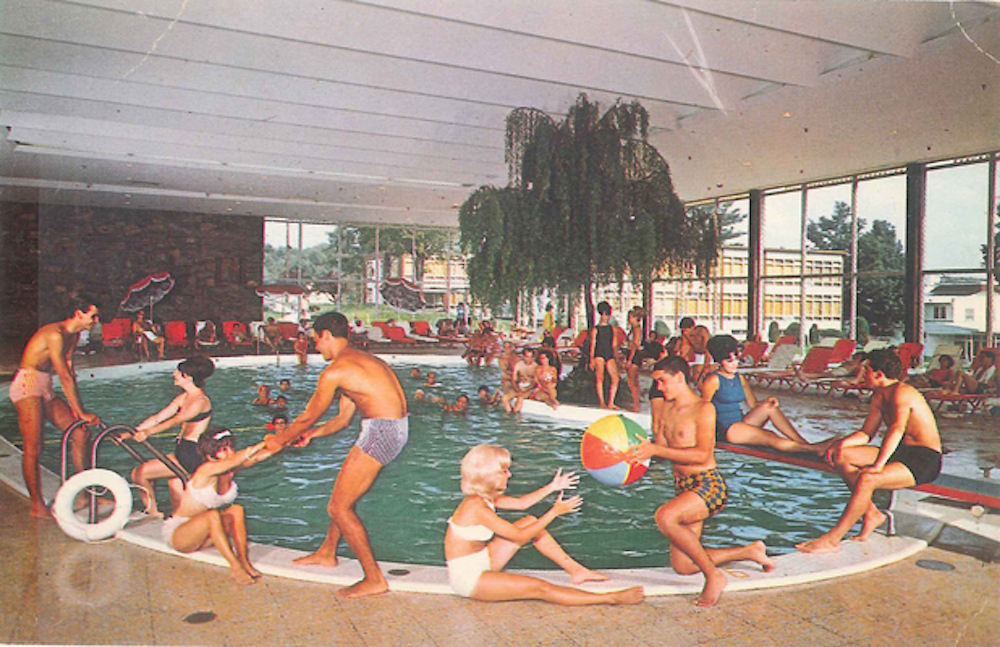
Postcard, Indoor Pool, Laurels Hotel and Country Club on Sackett Lake, Monticello, NY, Original Postcard by Bill Bard Associates, ca. 1960

Outdoor Pool, Nevele Grande Hotel, Ellenville, New York
Over a period of five years, Scheinfeld did just that, documenting the remains of a once-vibrant world that continues to disappear. “They just finished levelling Grossingers, the hotel on the cover of the book,” she says. “That entire complex, which had its own airport and post office, it is gone. It’s a weird, strange place.”
Scheinfeld dug in deep, talking with historians, locals, strangers, and family members to unearth a vital history that has all but disappeared. “I feel like an archaeologist, looking at these off-the-beaten-track places — but I am not interested in tampering with the surface or constructing the scenes,” she says.
“These photographs are like these still lifes arranged by time, change, Mother Nature, and other people who have been going in there to hang out, party, photograph, live, and steal. Most people didn’t understand what I was doing at first. I would often get the remark, ‘There’s nothing there. Why do you want to go there? You’re crazy.’
“My answer is, “Well, you’re not looking.’ None of these images are empty. Here are family histories, unions, marriages, and romances. You can see that these places are worn with life, even though they are worn with decay. There are histories of Jews in America creating a space born out of anti-Semitism.”

Le Roy Hotel, Loch Sheldrake, New York

Poker chips and cards, Grossinger’s Catskill Resort and Hotel, Liberty, New York

Cooper’s Sunrise Bungalow Colony, Rock Hill, New York

Guest room, Tamarack Lodge, Greenfield Park, New York

Indoor Pool, Grossinger’s Catskill Resort and Hotel, Liberty, New York
The Borscht Belt: Revisiting the Remains of America’s Jewish Vacationland is available now on Cornell University Press.
Follow Miss Rosen on Twitter.
Enjoyed this article? Like Huck on Facebook or follow us on Twitter.
You might like

Reynaldo Rivera’s intimate portrait of queer Latino love
Propiedad Privada — Growing up during the AIDS pandemic, the photographer entered a world where his love was not only taboo, but dangerous. His new monograph presents inward-looking shots made over four decades, which reclaim the power of desire.
Written by: Miss Rosen

In photos: The newsagents keeping print alive
Save the stands — With Huck 83 hitting shelves around the world, we met a few people who continue to stock print magazines, defying an enduringly tough climate for physical media and the high street.
Written by: Ella Glossop

The quiet, introspective delight of Finland’s car cruising scene
Pilluralli — In the country’s small towns and rural areas, young people meet up to drive and hang out with their friends. Jussi Puikkonen spent five years photographing its idiosyncratic pace.
Written by: Josh Jones

The last days of St Agnes Place, London’s longest ever running squat
Off the grid — Photographer Janine Wiedel spent four years documenting the people of the Kennington squat, who for decades made a forgotten row of terraced houses a home.
Written by: Isaac Muk

How Japan revolutionised art & photography in the ’60s and ’70s
From Angura to Provoke — A new photobook chronicles the radical avant-garde scene of the postwar period, whose subversion of the medium of image making remains shocking and groundbreaking to this day.
Written by: Miss Rosen

Artifaxing: “We’ve become so addicted to these supercomputers in our hands”
Framing the future — Predominantly publishing on Instagram and X, the account is one of social media’s most prominent archiving pages. We caught up with the mysterious figure behind it to chat about the internet’s past, present and future, finding inspiration and art in the age of AI.
Written by: Isaac Muk


