Inside America’s abandoned ‘Jewish utopia’
- Text by Miss Rosen
- Photography by Marisa Scheinfeld

The Borscht Belt, otherwise known as the Jewish Alps, was America’s premier getaway during the 20th century. Established in response to abject displays of anti-Semitism nationwide, the Borscht Belt consisted of resort hotels bungalow colonies, summer camps, and boarding houses nestled into the Catskill Mountains of New York state.
At its height, the Borscht Belt was the height of a glamour all it’s own — an all-inclusive vacation replete with indoor and outdoor pools, golf, tennis, skiing, ice-skating, dance, and live entertainment from no less than Mel Brooks, Joan Rivers, Billy Crystal, and Rodney Dangerfield. While many Jewish-Americans born before the ’80s know the area well, the 1987 film Dirty Dancing became the cultural touchstone for all who had never lived it for themselves.
But like the Rust Belt, the Borscht Belt has disappeared, lost to the massive socioeconomic shifts that have taken place in recent years. For photographer Marisa Schienfeld, the shift quite literally hit home.
“My dad’s parents met up there in the 1940s, when my grandmother was hitchhiking between one town and another. At that time, the Catskills was pretty busy if you had the means or were going up there for a job. My mom’s parents met in Brooklyn and went up there for their honeymoon,” Scheinfeld recalls.

Dining Room, Pines Hotel, South Fallsburg, New York

Lobby, Grossinger’s Catskill Resort and Hotel, Liberty, New York
“Fast forward: my dad didn’t want to raise his family in the Brooklyn of 1980s. We moved to Monticello, New York, in 1986 when I was six years old. My grandparents owned a condo adjacent to Kutsher’s and we had access to the hotel. We would go swimming and my grandpa played cards. It was like mini-vacations on weekends, where I would engage in the quintessential Borscht Belt activities like bingo and shuffleboard.”
By the time Scheinfeld entered high school, the era had come to an end. She eventually decamped to New York City, then to San Diego, where she began working on her Master’s thesis. “I was grappling with what I wanted to say as a photographer and my mentor, Arthur Ollman said four words that lit the fire: ‘Shoot what you know,’” Scheinfeld remembers.
She returned to Monticello to embark on a series of photographs that would become The Borscht Belt: Revisiting the Remains of America’s Jewish Vacationland (Cornell University Press). “The project started as re-photography, remaking old postcards, to measure time like a ‘Now and Then.’ I did this for a month or two, and then I got bored,” she says.
“What would happen is I would go with my archival image and agenda, then stop in my tracks when I would see something that warranted to taking a picture of it — and that’s how the whole series evolved. I realized there was more of a story to tell.”
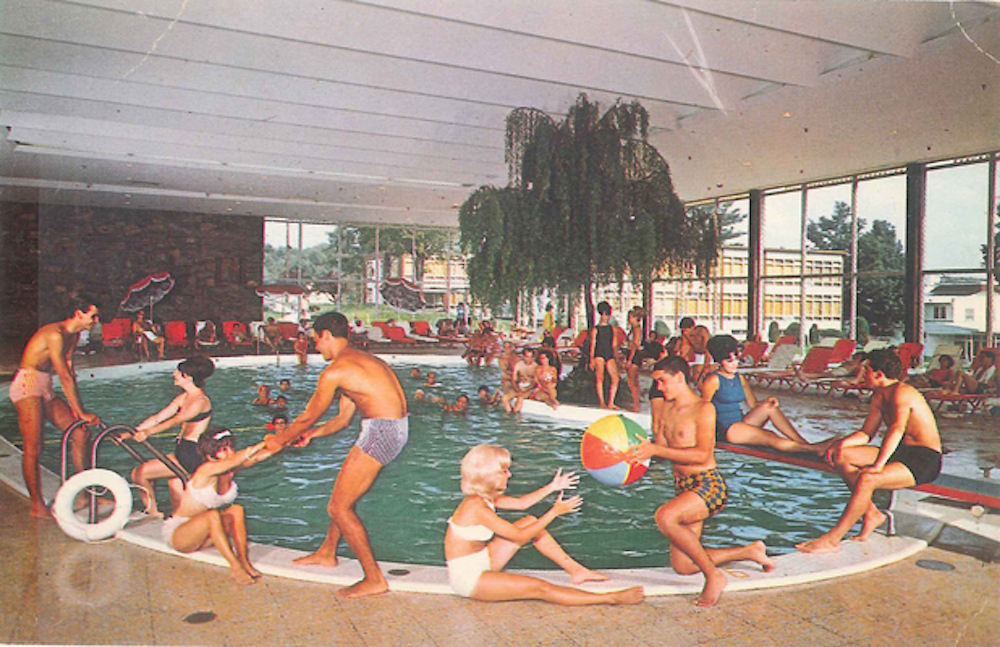
Postcard, Indoor Pool, Laurels Hotel and Country Club on Sackett Lake, Monticello, NY, Original Postcard by Bill Bard Associates, ca. 1960

Outdoor Pool, Nevele Grande Hotel, Ellenville, New York
Over a period of five years, Scheinfeld did just that, documenting the remains of a once-vibrant world that continues to disappear. “They just finished levelling Grossingers, the hotel on the cover of the book,” she says. “That entire complex, which had its own airport and post office, it is gone. It’s a weird, strange place.”
Scheinfeld dug in deep, talking with historians, locals, strangers, and family members to unearth a vital history that has all but disappeared. “I feel like an archaeologist, looking at these off-the-beaten-track places — but I am not interested in tampering with the surface or constructing the scenes,” she says.
“These photographs are like these still lifes arranged by time, change, Mother Nature, and other people who have been going in there to hang out, party, photograph, live, and steal. Most people didn’t understand what I was doing at first. I would often get the remark, ‘There’s nothing there. Why do you want to go there? You’re crazy.’
“My answer is, “Well, you’re not looking.’ None of these images are empty. Here are family histories, unions, marriages, and romances. You can see that these places are worn with life, even though they are worn with decay. There are histories of Jews in America creating a space born out of anti-Semitism.”

Le Roy Hotel, Loch Sheldrake, New York

Poker chips and cards, Grossinger’s Catskill Resort and Hotel, Liberty, New York

Cooper’s Sunrise Bungalow Colony, Rock Hill, New York

Guest room, Tamarack Lodge, Greenfield Park, New York

Indoor Pool, Grossinger’s Catskill Resort and Hotel, Liberty, New York
The Borscht Belt: Revisiting the Remains of America’s Jewish Vacationland is available now on Cornell University Press.
Follow Miss Rosen on Twitter.
Enjoyed this article? Like Huck on Facebook or follow us on Twitter.
You might like

Landmark new exhibition is celebrating 50 years of female punk
God Save the Queens – The Museum of Youth Culture is bringing together rare photography, archive material and a one-night-only supergroup featuring members of X-Ray Spex, The Slits and The Raincoats.
Written by: Ella Glossop

Halcyon, end of summer days in ’80s Massachusetts
Bell Pond — Stephen DiRado’s new photobook is a nostalgic look at blissed out moments of young love, family and coming of age at a swimming pond in Worcester, Massachusetts.
Written by: Miss Rosen

Photographing America’s 20th century rebels
Rebels With a Cause — A new monograph looks back at Jean-Pierre Laffont’s extensive archive documenting counterculture, art, activism and more, shaping the country as it is today.
Written by: Isaac Muk

The groundbreaking photography of Gordon Parks
Voices in the Mirror — A new exhibition dives deep into the legendary lensman’s archive, who captured the Civil Rights Movement and Black America like no other.
Written by: Miss Rosen

A chaotic portrait of an ’80s American farming family
Holy Cow! — Melonie Bennett grew up on a farm in Maine in the ’80s, and documented her family’s idiosyncratic daily life. She presents those humorous, everyday memories in a new exhibition and photobook.
Written by: Miss Rosen

Nick Danziger’s striking vision of everyday British life in the ’90s
The British 1994-1999 — The renowned photojournalist returned to his birth country on the cusp of the Millennium, capturing its contradictions with humour and wit.
Written by: Miss Rosen


