Vintage scenes of suburban America in the 1970s
- Text by Miss Rosen
- Photography by Bill Owens

After serving in the Peace Corps during the 1960s, Bill Owens returned home with the vision of becoming a photographer. “I went back to college and took some photography classes,” he says. “I remember they projected a photograph of a pile of rocks by Aaron Siskind and spent 20 minutes taking out it. Meanwhile there was an anti-war protest going on.”
In 1968, Owens got his first job as a news photographer for the Livermore Independent, a local paper based in a suburb outside San Francisco. On a $110 (£83) week salary, Owens could afford to buy a $2,000 (£1510) house with a two-car garage, and swimming pool for just $99 (£75) down.
Owens, his wife, and two children settled into suburbia well – and soon enough, the young photographer realised there was a story to tell. Owens was fascinated by the cultural mores of mid-century suburban life and sought to create an in-depth portrait that went beyond the shallow, dismissive tropes of suburbia.

We Like to Play War, 1971
At the time, the suburbs had a bad rap. “Malvina Reynolds had a song [‘Little Boxes’] about the ‘ticky tacky’ homes because everyone who lives there must be ‘ticky tacky’ as well,” Owens says.
But he remained resolute, knowing there more to suburbia. Owens envisioned his project as a sociological study inspired by Levittown, which laid the blueprint for the explosion of suburbia across American after World War II.
From the outset Owens crafted a plan, inspire by a visual anthropology class with John Collier. “He told me that when Roy Striker at the FSA sent photographers out in the 1930 and ‘40s they had a shooting script,” Owens says. “So I made my own shooting script and listen 30 things to photograph.”

Richie, 1971

Sunday Afternoon, 1971
Securing a small grant of $3,000 (£2,263) to fund the project, Owen went out every Saturday over the course of the year to document holidays and birthdays, as well as prototypical scenes of suburban life like Tupperware parties, Sunday grilling on the patio, and kids playing on the street.
Envisioning the photographs as a larger project that would eventually become the groundbreaking 1973 book Suburbia, selections from which are currently on view at PDNB Gallery, Owens met the people he photographed six months later with a release form.

‘My dad thinks its a good idea‘, 1971
He then asked them for a comment about the picture, which he included as captions in the book. In Damned Dishes, a woman with curlers in her hair holding a baby stands in her kitchen looking at the sink with contempt. She asked Owens, “How can I worry about the damned dishes when there are children dying in Vietnam?”
“The quote totally flips the image,” Owens says. “It gives you more information, allowing the people to speak for themselves so all of a sudden your stereotypical view of people is gone.”
Half a century later, Owens photographs maintain their fascination and allure, capturing a mythic moment in American life: the apotheosis of the middle class.
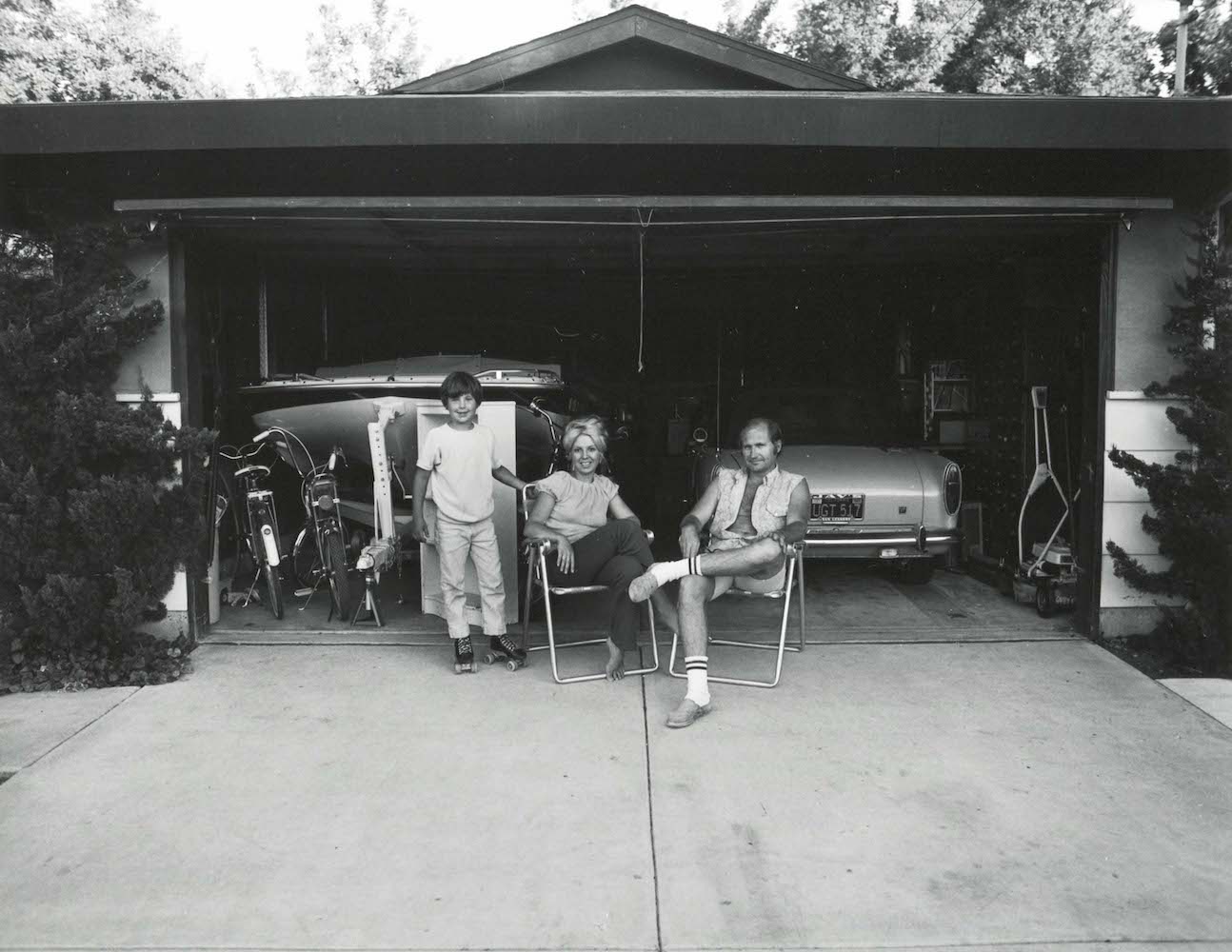
‘Our house is built with the living room in the back, so in the evenings, we sit out front of the garage and watch the traffic go by‘, 1971

‘I enjoy giving a Tupperware party in my house‘, 1971

Monday Tuesday Wednesday Thursday, 1971
Bill Owens: Suburbia is on view at PDNB Gallery in Dallas, Texas, through February 12, 2022.
Follow Miss Rosen on Twitter.
Enjoyed this article? Like Huck on Facebook or follow us on Twitter.
You might like

When David Wojnarowicz became Arthur Rimbaud
Arthur Rimbaud in New York — In 1978, the American artist and his friends donned masks to pay tribute to the French poet, who was born a century before him. Miss Rosen traces the differing yet parallel lives of the queer revolutionaries.
Written by: Miss Rosen

On the set of ‘La Bamba’, lost Latino legend Ritchie Valens’s biopic
The overnight rockstar — The Chicano rock & roll star exploded overnight in the late ’50s, but just as quickly he was gone, killed in a plane crash along with Buddy Holly. An ’80s biopic saw him immortalised on the big screen, which photographer Merrick Morton captured behind the scenes.
Written by: Miss Rosen

Louis Theroux’s ‘Manosphere’ shows men aren’t the problem, platforms are
No Ws for Good Men — The journalist’s new documentary sees him dive headfirst into the toxicities and machinations of the male influencer economy. But when young creators are monetarily incentivised to make more and more outrageous content, who really is to blame?
Written by: Emma Garland

In the 1960s, African photographers recaptured their own image
Ideas of Africa — An exhibition at the Museum of Modern Art explores the 20th century’s most important lensers, including Seydou Keïta, Malick Sidibé and Kwame Brathwaite, and their impact on challenging dominant European narratives.
Written by: Miss Rosen

Reynaldo Rivera’s intimate portrait of queer Latino love
Propiedad Privada — Growing up during the AIDS pandemic, the photographer entered a world where his love was not only taboo, but dangerous. His new monograph presents inward-looking shots made over four decades, which reclaim the power of desire.
Written by: Miss Rosen

In photos: The newsagents keeping print alive
Save the stands — With Huck 83 hitting shelves around the world, we met a few people who continue to stock print magazines, defying an enduringly tough climate for physical media and the high street.
Written by: Ella Glossop


