‘Women have only one way to survive: learning to fight’
- Text by Eva Clifford
- Photography by Alessandro Grassani

The Democratic Republic of Congo (DRC) has endured decades of widespread sexual violence by government forces and militia groups – especially in the eastern conflict zones. Unsurprisingly, those most affected are women and children.
Widely dubbed the ‘rape capital of the world’, the city of Goma, capital of the DRC’s North Kivu province, is one of the world’s worst places to be a woman. Yet against this backdrop of daily violence and injustice, women are donning boxing gloves and learning to fight.
Photographer Alessandro Grassani landed in the DRC for the first time on assignment for an Italian NGO called AVSI, which runs several clinics in the region to provide support for the most vulnerable, specifically women who have been victims of violence. While documenting the NGO’s work, he had the opportunity to meet and converse with these women, hearing firsthand about the horrific violence they had experienced.
“I was so impressed by their stories, particularly by their desire to react and forget this dramatic past, that I felt the need to work on a story about women in the DRC, without reducing them to victims of any sort of injustice,” explains Grassani. “Instead, I wanted to represent them as protagonists of their own destinies.”

Democratic Republic of Congo. Goma. 28/05/2018. 18 year-old Blandini portrayed on the building site where she occasionally spend her nights. She trains in the so-called Friendship Boxing Club.
Grassani knew about the women boxers before arriving in the DRC, but it was only when he was in Goma himself that he realised focusing on this story was the right choice.
Accompanied by writer Carlo Marsilli, Grassani spent 10 days in the DRC, during which time he paid several visits to the boxing clubs, mainly The Club de l’Amitié (The Friendship Club), situated inside Les Volcans stadium and the Radi Star Girls Club.
The Friendship Club is run by coach Balezi Bagunda (aka Kibomango), a Congolese ex-child soldier and ex-boxing champion. Abandoning the ring to dedicate himself to teaching boxing, his club now accommodates a group of women who have found hope and passion in boxing.
“The spirit of the club is that of a family,” says Grassani, “and in a certain sense, Kibomango is the father who, through sport, helps his members have a purpose and objective in life.”
The Radi Star Girls Club is an all-woman boxing club captained by coach Gabriel Moke, an ex-amateur boxer who trains his daughters, granddaughters and other girls living in the vicinity.
“Some of these female boxers are boxing for passion, some to become a champion, some to find a purpose in life and abandon street life, but all of them are boxing to feel stronger and more prepared to face their everyday life and be able to defend themselves,” says Grassani.

Democratic Republic of Congo. Goma. 24/05/2018. Aimerance, 16 years old, portrayed during the daily boxing training session at the Radi Star Girls Boxing Club.
“I asked each of the women if there was a link between the violence of the place they live and their boxing practice, and to tell it in the words of one of the boxers I met, this is the answer: ‘women here have only one alternative to survive: learning to fight.’”
Frequently, Grassani was met with stories of horrific violence. He recalls one story in particular of a woman named Blandini, who has been living on the streets since she was abandoned by her family. One night she was raped, covered with petroleum and set alight by a group of men. Now, burns cover her body, a perpetual reminder of that night. In the DRC, stories like Blandini’s are not uncommon.
Discriminatory social norms are highly restrictive for women in Congolese society – particularly married women, and often place them at greater risk, fuelling permissive attitudes towards gender-based violence.
Despite these societal pressures, Grassani says that, “at the official boxing clubs and the Radi Star Boxing Club, there are women like Gracia Elga, who has a job and a normal life and her dream is to leave Africa, go the USA to become a champion like Mohammed Ali, earn enough money and then return to Goma and open an orphanage for the local abandoned kids.”
Listening to stories like Gracia and Blandini’s was fundamental to the project and helped build trust with the women. “I’m not the kind of photographer who thinks he’s found the story and the subject to photograph. On the contrary, I believe that there was a ‘meeting’ between us and that these women decided to be portrayed by me because they trusted me, and the trust they placed in me is equivalent to the respect I feel for them.”

Democratic Republic of Congo. Goma. 25/05/2018. Nadine, 17 years old, portrayed during the daily boxing training session in the old football stadium of the popular district of Birere.
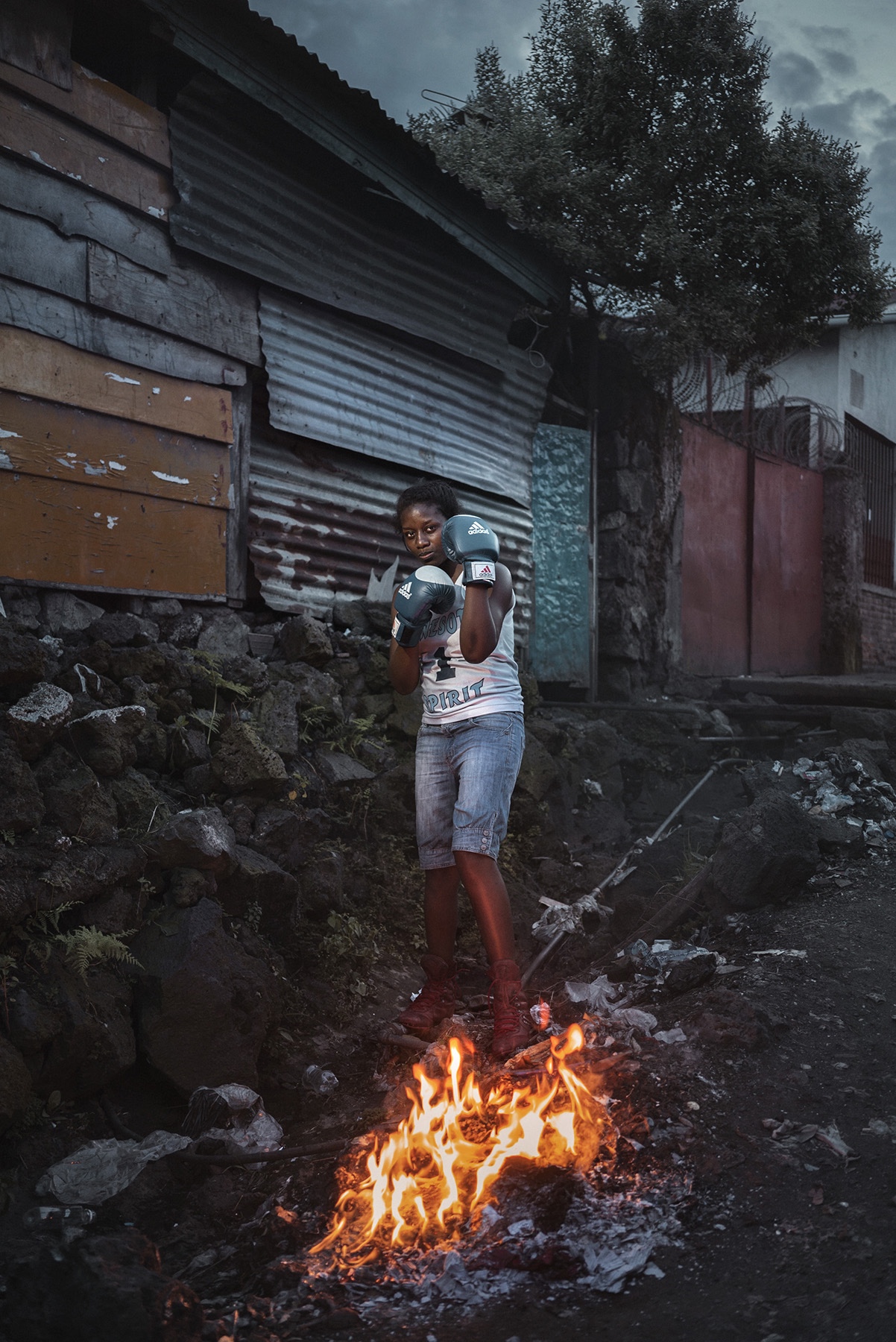
Democratic Republic of Congo. Goma. 24/05/2018. Asitu, 24 years old, portrayed on the streets of Goma just in front of the Radi Star Girls Club.

Democratic Republic of Congo. Goma. 29/05/2018. Elysèe, 16 years old. portrayed on the streets of central Goma, She is part of one of the official boxing clubs of the city.

Democratic Republic of Congo. Goma. 25/05/2018. Gracia Elga, 18 years old, portrayed during the daily boxing training session at the Radi Star Girls Boxing Club.

Democratic Republic of Congo. Goma. 25/05/2018. 14 year-old Anna portrayed during the daily boxing training session in the old football stadium. She trains in the so-called Friendship Boxing Club.
Alessandro Grassani’s series Boxing Against Violence: The Female Boxers of Goma was awarded First place in the Sport category at the 2019 Sony World Photography Awards.
Enjoyed this article? Like Huck on Facebook or follow us on Twitter.
You might like

How Japan revolutionised art & photography in the ’60s and ’70s
From Angura to Provoke — A new photobook chronicles the radical avant-garde scene of the postwar period, whose subversion of the medium of image making remains shocking and groundbreaking to this day.
Written by: Miss Rosen

In west London, Subbuteo is alive and flicking
London Subbuteo Club — The tabletop football game sees players imitate vintage teams with tactics and tiny painted replica kits. Ryan Loftus takes a trip to Fulham to meet a dedicated community and witness a titanic Brazil vs Coventry City showdown.
Written by: Ryan Loftus

Artifaxing: “We’ve become so addicted to these supercomputers in our hands”
Framing the future — Predominantly publishing on Instagram and X, the account is one of social media’s most prominent archiving pages. We caught up with the mysterious figure behind it to chat about the internet’s past, present and future, finding inspiration and art in the age of AI.
Written by: Isaac Muk

Leticia Bufoni is one of the greatest skaters ever. Now she’s tearing up asphalt.
Vamos, Leticia! — The Brazilian trailblazer helped rewrite the rulebook for women in skateboarding – and now she’s setting the pace behind the wheel for Porsche. For Huck’s 20th Anniversary Issue, she reflects on shredding stereotypes, building a career in male-dominated spaces, empowering the next generation, and the lessons that defined her journey.
Written by: Tracy Kawalik

Jodie Ounsley: “Sometimes your biggest strength is admitting when you’re struggling”
Hard Feelings — Fury from the latest generation of Gladiators joins our column on masculinity, speaking to Robert Kazandjian about her new book, her close relationship with her late father, and being a role model for both young boys and girls.
Written by: Robert Kazandjian

The lacerating catharsis of body suspension in Hong Kong
Self-Ferrying — In one of the world’s most densely packed cities, an underground group of young people are piercing their skin and hanging their bodies with hooks in a shocking exploration of pain and pleasure. Sophie Liu goes to a session to understand why they partake in the extreme underground practice.
Written by: Sophie Liu


