
Photos of strippers which celebrate female sexuality

When photographer Elizabeth Waterman decided to embark on a project documenting strippers, she knew it wouldn’t be easy. While certainly no stranger to New York nightlife – she’d just finish working on a project photographing the city’s drag scene, which often entailed staying out till 6am – strippers presented a different challenge. “You can’t really photograph them,” Waterman explains. “They’re secretive.”
Waterman considered becoming a stripper herself to gain access to the scene, but that idea was quickly abandoned. “It turns out I’m a much better photographer than I am stripper,” she says.

Getting stage ready, Show Palace Gentlemen’s Club, Queens, New York, 2017
Eventually, the photographer rang up “about 15” strip clubs in the New York area asking whether she’d be permitted to shoot their performers at work. All responded with a resounding ‘no’ – apart from one venue in Queens. When Waterman got herself down to this club she was met with some hostility from dancers who weren’t necessarily willing to be photographed.
“I had to ask everybody’s permission before I even thought about taking a picture,” explains Waterman, “so for months, I was just in the dressing room talking to people. Eventually, I started to get my groove and they trusted me a little, and they saw the pictures I would make. And they liked it.”
Over the next four years, Waterman would photograph performers at 25 strip clubs across Las Vegas, Los Angeles, Miami, New Orleans and New York. In her photos, dancers can be seen swinging on poles, giving lap dances, changing into outfits, and counting their dollars at the end of a long night. These images are now collected in a new book, titled Moneygame (XYZ Books), which celebrates the beauty and athleticism of adult performers, while offering a more compassionate look at sex work.

Dollars in hand, G5ive, Miami, Florida, 2019

Backbend, G5ive, Miami, Florida, 2019
On how she was able to capture such an authentic portrayal of strippers, Waterman explains: “Usually, if there was a photographer in the [strip] club, it was a male photographer hired by the club to shoot promotional pictures for Instagram. Those types of pictures are highly sexualised porn shots – and I just didn’t see [performers] like that.”
Given that Waterman spent the vast majority of her time working on the project in changing rooms gaining the trust of her subjects, she got to know their stories, and hear their frustrations. Notably, the period over which Waterman created Moneygame saw the introduction of FOSTA-SESTA – a US law intended to curb sex trafficking which has made it more difficult for sex workers to advertise their services online. “It hurt strippers and took away their rights,” she says. “They should absolutely repeal it.”
Other strippers expressed their anger about the ‘mainstreaming’ of sex work, propelled by the likes of OnlyFans and a handful of celebrities: “The [strippers] I knew who were more activists were not happy about people hawking the stripper image, and things like the Hustlers movie,” says Waterman. “No one’s really giving credit to the strippers.”

Brilliant laughing, Treasures Gentlemen’s Club, Las Vegas, Nevada, 2018
While Waterman says her intention behind the project was less about drawing attention to the struggles strippers face, and more about appreciating their craft, it’s been a welcome outcome of the project. Particularly amid a pandemic that has wreaked havoc on the livelihoods of sex workers and forced many women to abandon stripping altogether.
When asked what she hopes people take away from Moneygame, Waterman responds: “I think that there’s an expression of female sexuality that we have yet to fully celebrate in our culture.
“I know that the industry is not perfect, but there’s no job that’s perfect. I want people to see them as autonomous, independent, and beautiful – like I see them. I want to give a little bit of that stripping spirit to women,” she says. “And, more respect for strippers is something that’s sorely needed.”

Dollars on the floor, Crazy Girls, Hollywood, California, 2019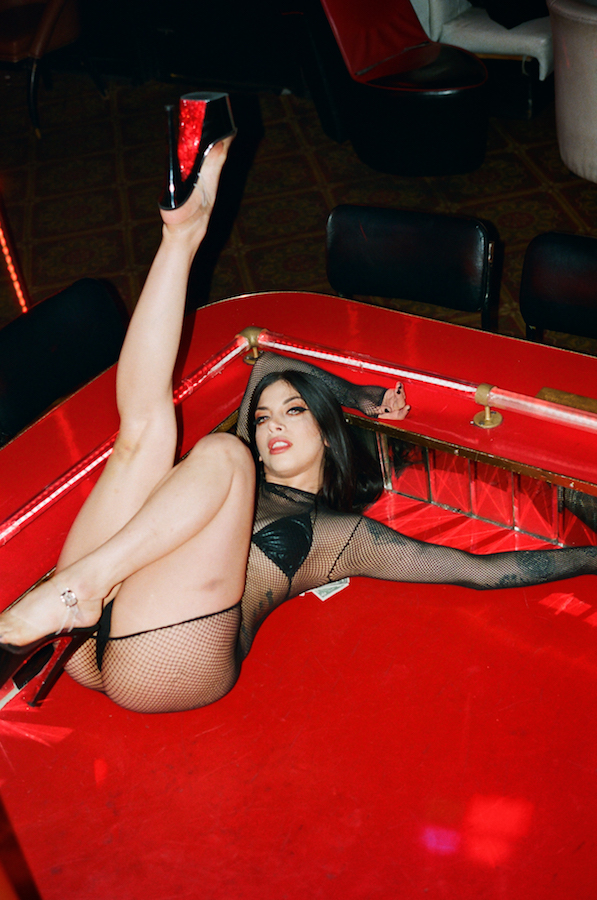

Posing for the camera, Sin City Cabaret, Bronx, New York, 2017

Gem and Tokyo, Show Palace Gentlemen’s Club, Queens, New York, 2017

Mona Marie, Club W, Bronx, New York, 2019
Moneygame is available now on XYZ books.
Daisy Schofield is Huck’s Digital Editor. Follow her on Twitter.
Enjoyed this article? Like Huck on Facebook or follow us on Twitter.
You might like

The lasting community legacy of a legendary Californian boxing gym
Moretón — Since opening in the ’80s, the Coachella Valley Boxing Club has trained multiple world champions, while providing a vital hub for local youth. In his new photobook, Darren Vargas documents its tight-knit, Chicano-led community, while also weaving a deeply personal story.

Inside the grunge golden age with Hole’s former bassist
My ’90s Rock Photographs — Melissa Auf der Maur’s new photobook is a sprawling visual memoir of her time at the heart of the US scene, from Tinker to The Smashing Pumpkins.

Introducing ‘The Chaos Isles’, a new photozine by Huck and Yushy
Normal Island — From unlicensed raves to the solstice at Stonehenge, furries to giant vegetable growers, Yushy is one of the UK’s best lensmen of its wild side. ‘The Chaos Isles’ will be sent out exclusively to Club Huck+ members.

Join Club Huck+ to get the most from Huck
Dispatches from the sharp edge of culture — Members get our print magazine, special photozines, The Huck Long Read newsletter, discounts from our friends and partners, digital versions of back issues and priority access to events.

Signs of solidarity as London marks three years of genocide in Palestine
Never forget — 250,000 people gathered on Saturday as Israeli attacks have continued in Gaza and the West Bank. Daisy Schofield photographed the diverse people and placards in attendance.

Landmark new exhibition is celebrating 50 years of female punk
God Save the Queens — The Museum of Youth Culture is bringing together rare photography, archive material and a one-night-only supergroup featuring members of X-Ray Spex, The Slits and The Raincoats.


