Surreal photos of solitude in the American desert
- Text by Huck
- Photography by Fei Alexeli

“It’s simplicity that you do not experience anywhere else,” says Greek photographer, Fei Alexeli, about her time spent travelling around the American desert. “You’re not defined by your surroundings; there’s no scripted society that you fit into. When you’re in the desert, it feels like you can be anyone”.
After voraciously consuming American media from a young age – from Hollywood movies about road trips, to ‘Americana’ music and Jack Kerouac’s On The Road – Alexeli finally made the trip to California in 2019, and again in 2020. “It was like stepping onto a new planet,” says Alexeli of travelling from Greece to the US desert. “In Greece, we have these mountains and greenery, and it’s very lively.” The dessert, by comparison, was stunningly sparse and isolated.
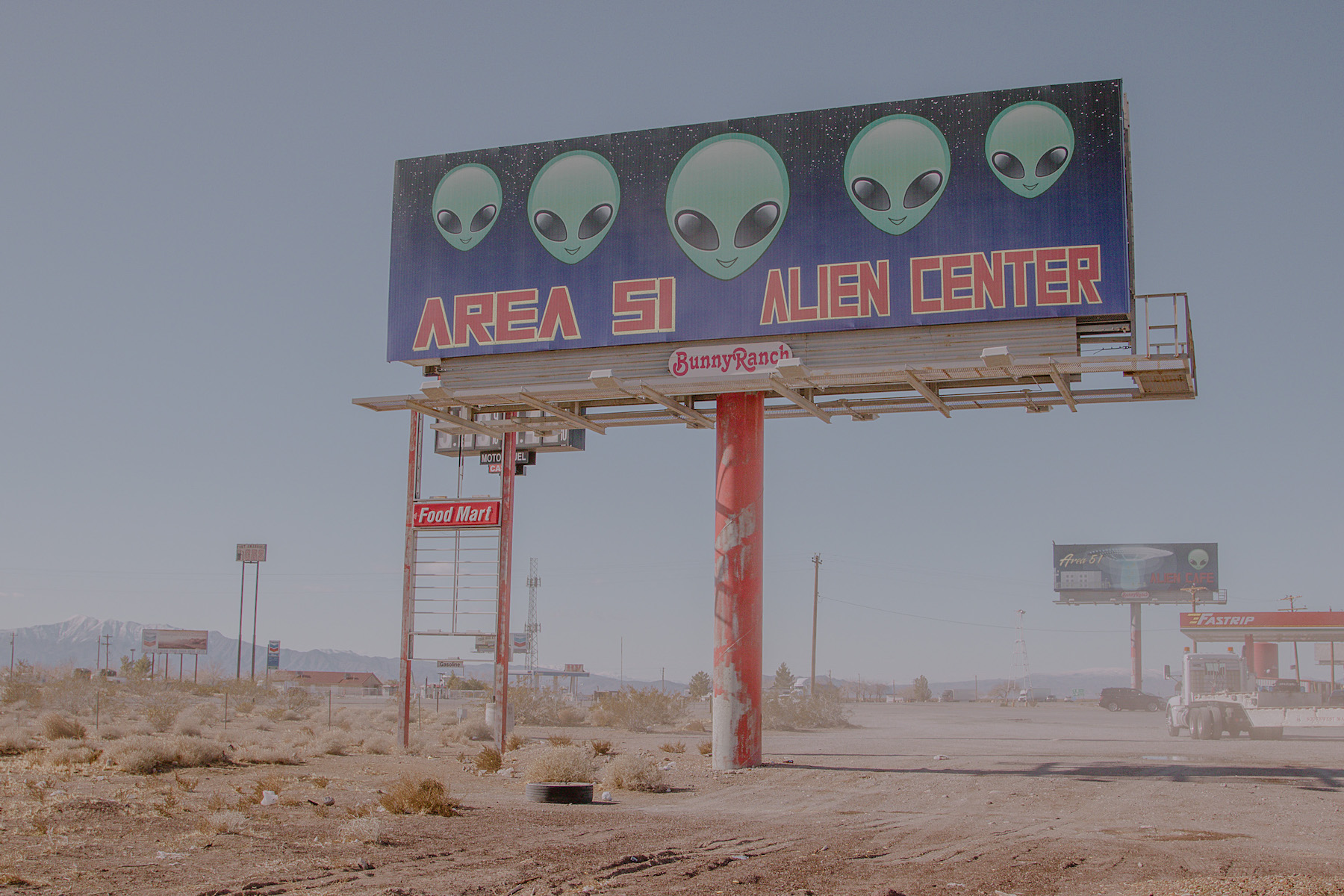

On both trips, Alexelli drove through the American desert with her camera in tow, shooting photos that now form part of a series entitled ShowTown. “My first time (in the US), I was on my own, so the vastness of the dessert was very overwhelming,” she recalls.
“I guess I was looking for some kind of freedom in the desert, but there are also so, so many layers of culture to discover.” Being there at the time of Donald Trump’s presidency was, Alexeli says, “super intense”: she’d often see the former president’s face emblazoned across trailers and flags.


What’s striking about Alexeli’s pictures is just how empty the landscape seems, a setting that imbues her images with an eerie quality. Often, the structures she photographed were abandoned and left empty – particularly in the country’s ‘ghost towns’ – with citizens and tourists nowhere to be seen. “There were often moments where I felt completely alone,” she says.
There are thousands of these ‘ghost towns’ across America, where once-thriving communities have dwindled over the decades, some due to economic hardships, while others were immediately evacuated. These derelict buildings in Alexeli’s photographs – which sit at the mercy of time and nature – offer an intriguing glimpse at the past.
Alexeli says the series is very much ongoing, and she plans to travel back to America when the pandemic ends. But next time, she wants people to feature in her photographs. “People who go to live in the desert is something that I find super fascinating – like, I want to know why,” she says. But for Alexeli, the appeal of going as a visitor is clear: “Being there, you just feel the essence of freedom.”


Follow Fei Alexeli on Instagram.
Enjoyed this article? Like Huck on Facebook or follow us on Twitter.
You might like

Sepia splashed memories of Britain’s ’90s squatting and free party scene
Bygones — Moving into a Hackney squat at the age of 19, Tom Hunter spent years living on London’s edges, while documenting the vibrant, creative community and culture that it enabled. Huck’s art director Sam White chats to him about the freedom that existed, the collectivism and what’s been lost over the decades since.
Written by: Samuel White

A melancholic portrait of youth, rebellion and womanhood in Iran
And They Laughed At Me — Newsha Tavakolian has worked as a photographer all her adult life, as Iran underwent change, upheaval and conflict. Her new photobook explores the formative years of her eye and art amid generational strife, hope and disappointment.
Written by: Miss Rosen

The real life mermaids of Florida’s Weeki Wachee Springs
Old Florida — A relic of pre-Disney tourism in the state, the show – which sees women perform athletic underwater tricks in a natural spring – has been running since 1947. Jack Burke attends, while reflecting on the fragility and fantasy of old America.
Written by: Jack Burke

The intricate, clandestine art of Japan’s traditional tattoos
Irezumi — Having emerged during the Edo Period centuries ago, inking skin has long been associated the country’s working class, and particularly Yakuza. A new book by Manami Okazaki explores the history and deep meaning of the practice, as well as the horishi who dedicate their lives to the needle.
Written by: Isaac Muk

Road tripping across 1970s America
73 Trip West — In 1973, Larry Racioppo set out from Brooklyn to California, armed with a medium format camera. For the first time in over half a century, roadside photographs from his trip have been unearthed.
Written by: Miss Rosen

New exhibition spotlights the ongoing impact of Japanese Women Photographers
1950s to Now — Taking place at The Photographers’ Gallery in London, it showcases work by 27 artists from the past seven decades including Mikiko Hara, Yurie Nagashima and Mao Ishikawa.
Written by: Isaac Muk


