The London squatters who resisted evictions in the ‘70s
- Text by Miss Rosen
- Photography by David Hoffman

While living in York in his late teens, British photographer David Hoffman did odd jobs to survive (“some more nefarious than others,” he admits). He began selling pictures to the Yorkshire Evening Post. The paper had no interest in publishing stories on the horrific living conditions of the working class, so Hoffman resolved that this was something he had to pursue for himself.
In the early 1970s, Hoffman arrived in Whitechapel in London’s East End. “It was filthy and felt abandoned,” he remembers. “Much of the housing was semi-derelict and many of the shops were on their last legs. For many it was the place where they ended up when their lives fell apart. It was clearly a dead end.”

Squatters waiting to resist eviction behind the barricaded front door of a squat, Parfett Street, 1973
Many lived in squats to escape homelessness. “Squatting is mostly a communal activity,” Hoffman says. “It brings people together to repair and improve the, mostly broken-down, housing available. The mutual support – and mutual tensions – helped form political understanding and brought us together in activist groups.”
Hoffman found it shameful that the City of London, located just one mile away, offered no support. “While I was powerless to change any of it, I felt that I could and should at least document it,” says Hoffman.
Under the banner of slum clearance and “urban renewal,” the city council decided to tear down the crumbling buildings where squatters lived, with landlords forcing evictions. With the release of Parfett St Evictions 1973 (Café Royal), Hoffman revisits what became the first British protest photography book when it was first published in 1976.

Waiting for the bailiffs before the eviction of squatters, Parfett Street, 1973
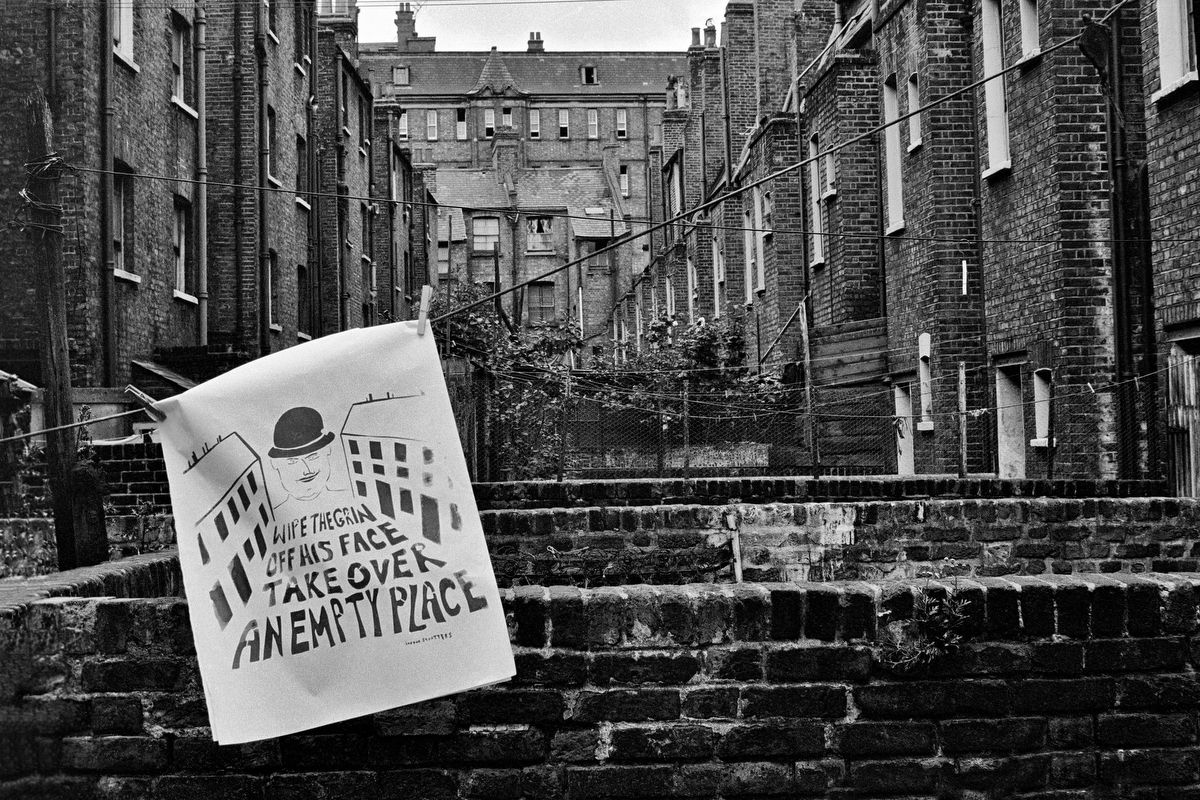
One of many posters around the East End protesting at the eviction of squatters, Parfett Street, 1973
Like many squats the one in Parfett Street housed a wide range of people. “Doris Lerner was the oldest and had been a political activist all her life. Doris would go to auctions of squatted houses and buy them. Being penniless this would delay the sale and extend the life of the squat,” Hoffman says.
“Tony was an early and resolute Gay Rights activist. Duncan was an anarchist and believer in redistribution. Bonkers Piers Corbyn, brother of Jeremy Corbyn would turn up occasionally, try and steal some limelight and then wander off when there was work to be done. We had sex workers, architects, performers, jewellers, musical instrument makers and drug dealers. A healthy mix.”

March on Tower Hamlets Town Hall in Patriot Square protesting against the eviction of squatters, Parfett Street, 1973
Police would regularly harass people around the squats who looked “different,” often stopping and searching them for drugs in the hopes of an easy arrest. “They’d turn up to protect bailiffs in an eviction but they didn’t bother to patrol the area much and generally saw anything to do with us as rubbish work, beneath their dignity,” Hoffman says. “When landlords sent in heavies to make an unlawful eviction, the police were nowhere to be seen.”
Nearly 40 years since these photographs were made, and the lessons they offer are timeless. “We cannot expect the state or those with power to do anything meaningful to alleviate social ills,” Hoffman says. “Banding together is our only route to social justice. If you need a home, take one.”

Police try (and fail) to force a path through squatters and their supporters, Parfett Street, 1973

Fieldgate Mansions, a 19th century tenement block due to be demolished in 1972 but preserved by squatters occupying it

Council official tells squatters who had marched on Tower Hamlets Town Hall that they should go away. Patriot Square, 1973

Fieldgate Mansions, Whitechapel Summer 1985. Scheduled for demolition in 1972 it was squatted by homeless people, artists & Bengali immigrants preventing destruction

Empty house graffitied following the eviction of squatters, Whitechapel, 1973
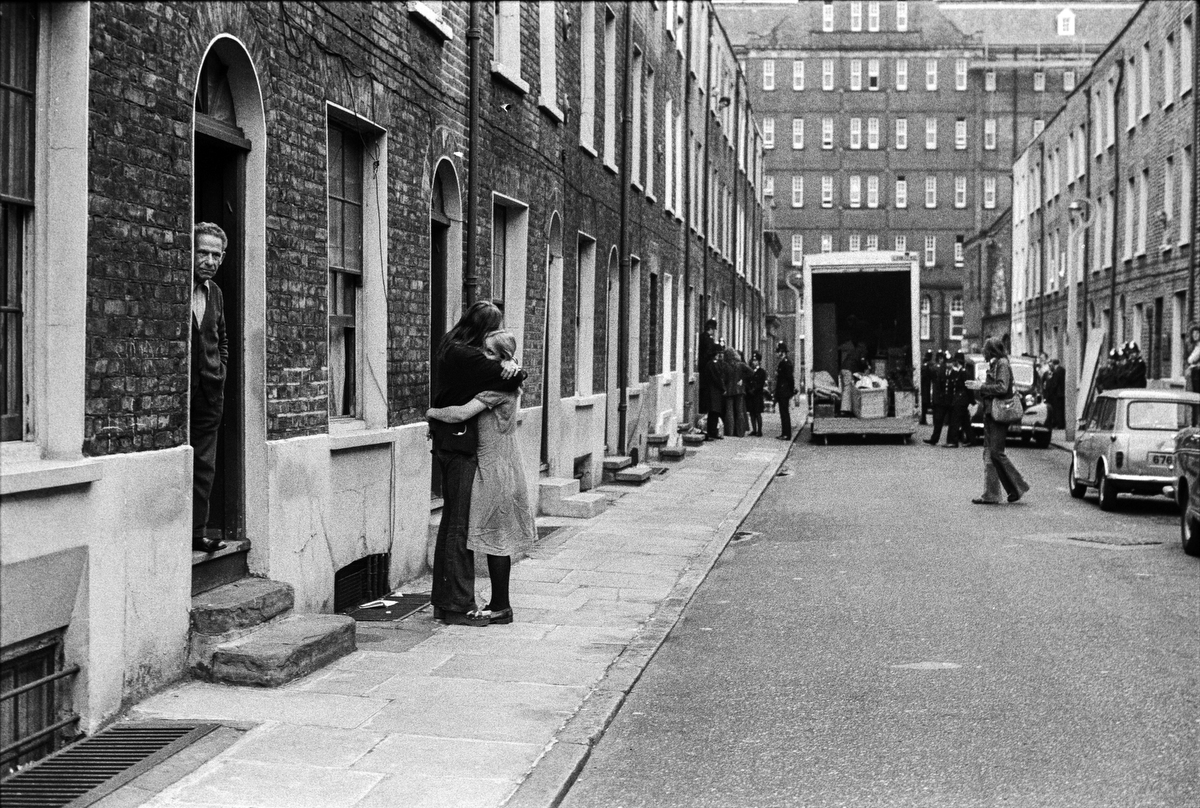
Eviction of squatters from private rented property that was being kept empty in Parfett Street, 1973
Parfett St Evictions 1973 is out now on Café Royal Books.
Enjoyed this article? Like Huck on Facebook or follow us on Twitter.
You might like

Jesse Glazzard’s messy portrait of queer friends, lovers and chosen family
The Sound of Dirt and Beauty — The photographer’s debut monograph explores tender, unpolished moments shaped by the people who he surrounds himself with, while offering a window into the UK’s working-class LGBTQ+ community.
Written by: Sunny Sunday

Behind the curtain at Alternative Miss World 1981
Olympia glamour — Running a subversive take on the traditional beauty pageant, the Andrew Logan organised event prioritised underground creativity and invention. Photographer David Corio went behind the scenes at its biggest edition.
Written by: Miss Rosen

Dan Lacey: “BMX is forever evolving”
Overground — Steph Pomphrey caught up with the two-wheel legend after his latest meet in east London, chatting about fatherhood, music and action sports within the outdoor industry.
Written by: Steph Pomphrey

New exhibition highlights British radical living over 200 years
Earthly Paradise — Taking place at the William Morris Gallery, it explores the homes and lives of artists, writers, musicians and more, as well as the conditions that allowed them to thrive.
Written by: Isaac Muk

What life on the Strait of Hormuz is really like
Southern Winds — Bandar Abbas based photographer Morteza Niknahad has been capturing the diverse communities and stories of his local region since he first picked up a camera. His new series highlights the human impact of war.
Written by: Isaac Muk

Nick Haymes’s intimate portrait of his family’s life
Chronograph — Over 25 years, the photographer documented his son’s lives as they grew into adults. The resulting photobook is an exploration of the passage of time, as well as the optimism of youth.
Written by: Miss Rosen


