The time New York's early-90's club kids met Joan Rivers
- Text by Adam White

The New York club kids of the late ’80s and early ’90s picked up where Studio 54 left off. Gay kids, trans kids, fashion freaks and art weirdoes all converging nightly in cult Manhattan hotspots like Danceteria and the Limelight. They would wear outrageous outfits, party to thumping house music, and consume enough coke and LSD to make your eyes explode. Then it all came to an abrupt end in appropriate volatility.
Prior to that, however, this rampant New York excess somehow converged with mid-afternoon American television on an average day in May 1993, with some of the scene’s most flamboyant characters appearing on an episode of The Joan Rivers Show.
Today the New York club scene of the era is most often associated with something all-together less glam: the murder of Andre ‘Angel’ Melendez by infamous New York club kid Michael Alig twenty years ago this March. Angel’s murder would go on to inspire its own documentary, Party Monster, which in turn would be adapted as a biopic starring Macauley Culkin, Seth Green and Chloë Sevigny. With all of that in mind, it’s no surprise that the scene has been historically treated like one long, indulgent waltz to horrifying violence.
But the blurry YouTube clips of Joan Rivers introducing a parade of glamorous misfits to the mainstream goes some way in re-contextualising the scene to its pioneering fundamentals. The LGBT kids, drag artists, transvestites and outcasts traditionally left out of conventional discourse, all brought together by a fusing of art, fashion and music.
Invited onto the stage are a roll-call of scene A-listers of the time, including Leigh Bowery, Amanda Lepore, Michael Alig and, in a second clip, Richie Rich. Rivers asks them about their lives, their goals, and their annual budget for sequins, while she later hosts a fashion show comprised of drag artists and club performers. All are dressed in homemade costumes of staggering detail and inventiveness. “Who are men and who are women?” Rivers asks in an aside. “It’s all a blur at this point,” replies Rich.
Amanda Lepore is undoubtedly the star of the interview portion of the episode, expressing in a perfectly slurred Little Edie voice that she just doesn’t have the time to have an actual job: “I’m too busy getting ready all the time or going out.”
The crowd is also nicely embracing. That is in spite of the camera cutting away to a flabbergasted member of the audience whenever one of the kids turn their backs to the crowd, lest people at home glimpse a flash of James St. James’ exposed butt cheeks. At one point, a middle-aged man with a thick New York accent stands up in the audience to comment: “I give ’em a lot of credit, they’re not hurting nobody.”
While Alig would go on to spend eighteen years in a New York jail for murder (he was paroled in 2014 and now writes a column for Gay Times), the rest of the characters to make appearances on the show have had alternatively happier legacies.
Lepore remains a trans pioneer, working as a model, performer and artist, and continuing to act as a muse for photographer David LaChapelle. Kabuki Starshine is now an incredibly successful make-up artist, having worked with a who’s-who of A-listers including Madonna, Rihanna, Kylie Minogue, Gwen Stefani and Michael Jackson. Walt Cassidy (formerly Walt Paper) is a noted contemporary artist, Richie Rich went on to become a prominent fashion designer, and Ernie Glam and St. James continue to be fixtures of the New York social scene. Leigh Bowery, who died from an AIDS-related illness in 1994, remains a legendary performance artist, designer and fashion muse – one-time collaborator of artists including Alexander McQueen, Vivienne Westwood, and Lucien Freud, and inspiration to modern acts including Lady Gaga.
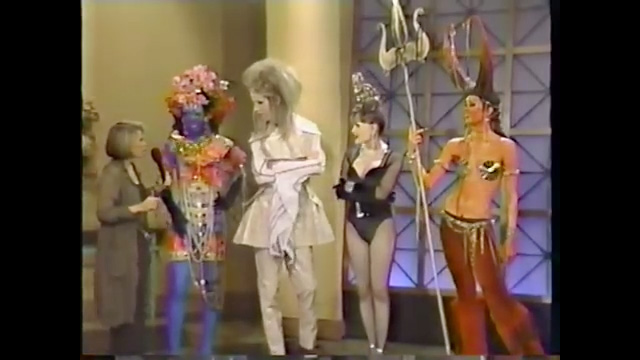
For Joan Rivers’ own legacy, it’s another testament to her life-long breaking of barriers that this appearance even happened. Recorded in 1993, with a Bush in the White House and the country still deep in Reagan-era conservatism, putting something so gender-bending, flamboyant and shamelessly gay on daytime television is radically groundbreaking. Flash forward a couple of years and you’ll get a newly-out Ellen DeGeneres talking about her relationship with actress Anne Heche on The Oprah Winfrey Show. All great until appalled members of the audience express outrage at having to now explain to their children what a gay person is.
In comparison, seeing Rivers so casually champion the overt ‘otherness’ of the club kids in front of an audience of early-90’s, middle-America housewives is unquestionably daring. She makes good on her promise to have them back, devoting an entire episode to a ‘Club Kids Fashion Show,’ and seems to genuinely admire their inventiveness, ingenuity and sheer guts. “Anybody can do this and look wonderful,” she says. “It only takes imagination and time and just freedom.”
Of course, she can’t let them leave without firing off a final Rivers zinger: “One last question: what do you do on Halloween?”
Enjoyed this article? Like Huck on Facebook or follow us on Twitter.
You might like

How Japan revolutionised art & photography in the ’60s and ’70s
From Angura to Provoke — A new photobook chronicles the radical avant-garde scene of the postwar period, whose subversion of the medium of image making remains shocking and groundbreaking to this day.
Written by: Miss Rosen

Artifaxing: “We’ve become so addicted to these supercomputers in our hands”
Framing the future — Predominantly publishing on Instagram and X, the account is one of social media’s most prominent archiving pages. We caught up with the mysterious figure behind it to chat about the internet’s past, present and future, finding inspiration and art in the age of AI.
Written by: Isaac Muk

The lacerating catharsis of body suspension in Hong Kong
Self-Ferrying — In one of the world’s most densely packed cities, an underground group of young people are piercing their skin and hanging their bodies with hooks in a shocking exploration of pain and pleasure. Sophie Liu goes to a session to understand why they partake in the extreme underground practice.
Written by: Sophie Liu

What we’re excited for at SXSW 2026
Austin 40 — For the festival’s 40th anniversary edition, we are heading to Texas to join one of the biggest global meetups of the year. We’ve selected a few things to highlight on your schedules.
Written by: Huck

Wu-Tang Clan forever, and ever
The Final Chamber — RZA, the spiritual leader of one of the most important hip hop groups of all time explains why they won’t rest until their legacy is secured.
Written by: Yoh Phillips

Huck’s 20th Anniversary Issue, Wu-Tang Clan is here
Life is a Journey — Fronted by the legendary Wu-Tang Clan’s spiritual leader RZA, we explore the space in between beginnings and endings, and the things we learn along the way.
Written by: Huck


