A dreamy road trip through the Mississippi Delta
- Text by Miss Rosen
- Photography by William Eggleston

Hailing from Memphis, Tennessee and raised in Sumner, Mississippi, American photographer William Eggleston is a poet of the American South. His vivid images of daily life helped establish colour photography as a medium of fine art during the ’70s.
Gallerist Rebekah Jacob also grew up around the Mississippi Delta, and recalls seeing the photographer in her youth. “Eggleston was somewhat ethereal but evident in the Delta, cruising around and taking pictures,” she recalls.
“You would often see his car perched just off the road and sometimes spot him walking along the paved roads or wandering out in the fields. Some thought he was crazy, others didn’t care to wonder. But it was strange to see anything other than field hands or farmers speckled out in the middle of cotton fields. And there he was, sweeping a camera and capturing the soul of the land, in perfect aperture.”

Minnows (On Highway 61 through the Mississippi Delta), 1972

Farm in the Mississippi Delta, 1970
While many dealers and collectors chase Eggleston dye-transfer photographs, Jacob prefers to focus on his chromogenic work: the intimate, small format images the artist made while exploring rural towns along the Mississippi River. In the new exhibition, William Eggleston’s Snapshots — the c-print, Jacob spotlights these intuitive interpretations of the land they both share.
“Eggleston was a link from the early 20th century artists to the present, modernising the medium in terms of printing and the use of colour,” Jacob says. “Although innovating the medium, he carried the voices of the Delta with integrity, patience, and sensitivity. He photographed the place and its peoples by sweeping the camera, so it has always been fascinating to see ‘my land’ variously angled and tightly formatted – like riding in a car with your head titled against its window.”
Jacob met Eggleston while earning a Masters in Art History at the University of Mississippi, popularly known as “Ole Miss.” “Mr Eggleston arrived true to his reputation,” she remembers. “A southern aristocrat, he was dapper, wearing a high-end sports coat, buttoned shirt, and slacks. He was polite yet mercurial.”
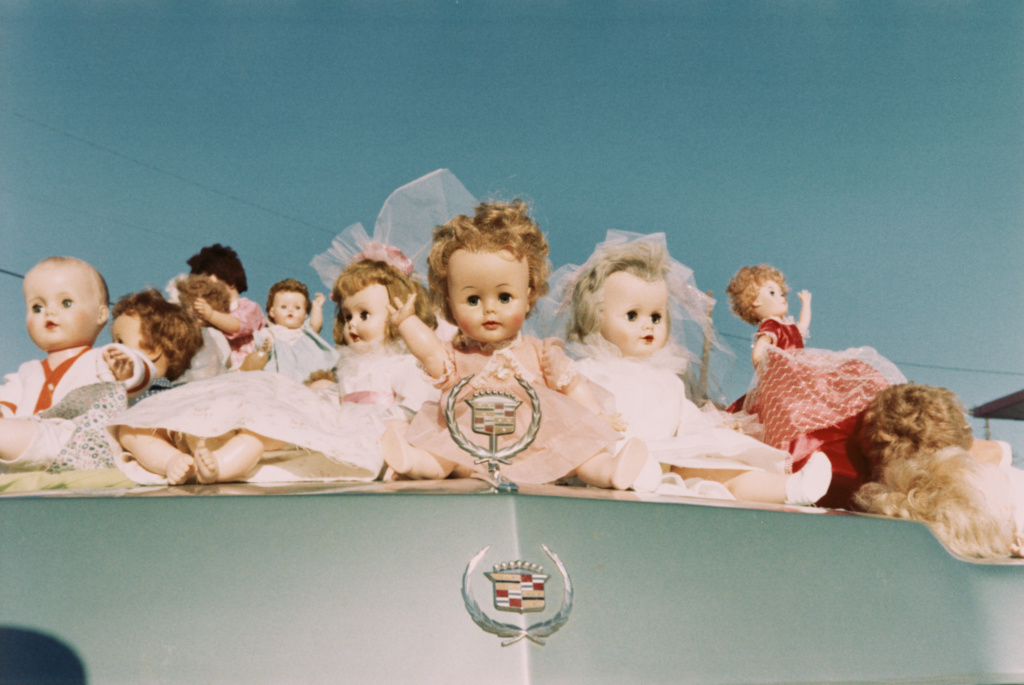
Dolls, Memphis, Tennessee, 1972

Hanover Sign, Oxford, Mississippi, 1971
“He walked in with a small stack of photographs and placed them on a positioned table. He seemed to be magnetised by the piano, another mastered medium and passion. His innovative arrangement of classical music, played by memory with no score, echoed throughout the space so that few words could be heard, but our eyes were in sensory overload.”
Although many critics outside the South didn’t understand what Eggleston was doing at the time, Jacob recognises the significance of his work as a documentarian of a new typography of the South in the 1970s. “He worked to capture the loneliness, isolation and changes brought about by suburbs and other physicalities of American society and culture,” she says.
“New suburbia was descending upon the South at the time, and Eggleston expressed this changing South by focusing on parking lots, shopping malls, neon signs and other ordinary objects in a consumer world. Eggleston is considered a titan in the photography world – a photographer with a pioneering eye for capturing beauty in the ugly and mundane.”

Gulf Sign (Mississippi Delta) from Southern Suite, 1972

Untitled (Martin Luther King, Robert F. Kennedy, John F. Kennedy ; decanters in bar), 1972
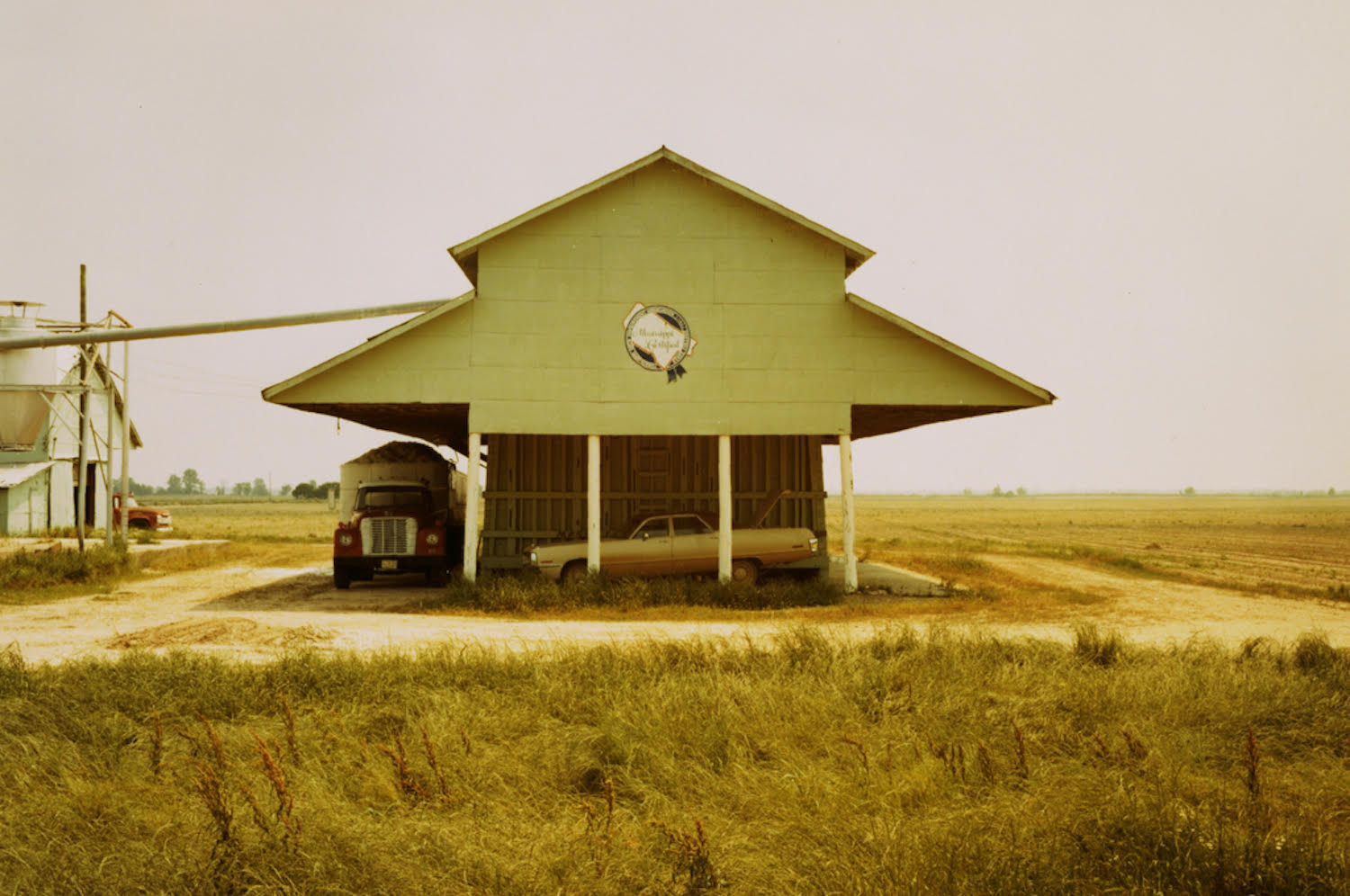
Near Minter City and Glendora, Mississippi (Mississippi Delta), 1969-70
William Eggleston’s Snapshots — the c-print was on view at the Rebekah Jacob Gallery.
Follow Miss Rosen on Twitter.
Enjoyed this article? Like Huck on Facebook or follow us on Twitter.
You might like

In photos: Black Texas life since emancipation
Kinship & Community — A new photobook and exhibition showcases the rich culture, history and community of African American folks in the Lone Star State, whose existence in the region predates colonial Britain.
Written by: Miss Rosen

Youthful joy & end-of-era poignancy at a London school prom
Leavers — For several years, Lewis Khan documented young people as they celebrated the last of their school days and the completion of their exams. The series is now collated in a new self-published photobook and short film.
Written by: Zoe Whitfield

Harry Gruyaert’s vintage, kaleidoscopic scenes of New York
A Sense of Place — For 50 years, the Belgian photographer and Magnum Photos member has been capturing NYC’s colourful chaos. A new photobook and exhibition showcase his unique, technicolour view of the city.
Written by: Miss Rosen

In the pit at one of the UK’s last stock car & banger speedways
Stock Car Racing Isn’t Dead — Photographer Liam McCarthy spent time in and around the Arlington Raceway’s circuit, capturing the diehard community that keeps the sport alive.
Written by: Isaac Muk

Inside Lower Duck Pond, the nicest town on the internet
/r/HaveWeMet — With a population of 2,500 and no fixed location, the subreddit is a space for roleplaying citizens to solve mysteries, host fictional events and ultimately connect. In an internet that’s often divided and toxic, Vicky Jessop hangs out in one of its most wholesome corners.
Written by: Vicky Jessop

A major Nan Goldin exhibition is coming to London
You Never Did Anything Wrong — Opening at the Hayward Gallery in November, the show will debut a new film from the artist and activist, alongside a slate of recent work.
Written by: Jack Dennison-Thompson


