A year on the frontlines of the UK miner’s strike
- Text by Miss Rosen
- Photography by Martin Shakeshaft

In 1984, Martin Shakeshaft was ready for a career change. He was in his mid-20s, working in the NHS as a nurse, but had become disillusioned by lack of funding and resources. “Some things never change,” he says today.
He decided to take a chance and applied for the Documentary Photography program at Newport – run by Magnum Photos member David Hurn. Luckily, Shakeshaft was one of the 12 students accepted.
Inspired by the work of Jo Spence and W. Eugene Smith. Shakeshaft recognised that photography could be used as a tool for activism. “I was very political at the time… I was using a camera to record the world around me, and in a way to help me make sense of it,” he says. “I had a strong sense of justice and couldn’t understand why everyone else didn’t feel the same.”

Orgreave Coking Plant. Near Sheffield, 18 June 1984
When the UK Miners’ Strike began, Shakeshaft headed to the frontlines to document it. His new book, The Miners’ Strike 1984–1985 (Café Royal Books), revisits that fateful year.
Shakeshaft got his start publishing photos of picket lines in political newspaper. But as he got to know the miners, he realised there was a bigger story to tell. “In addition to ‘headline events’, we began to cover what was actually happening in the communities,” he remembers.
During this process, he became close with a miner named Peter Harries. “I used to stay with him and his family in the town of Maerdy. Peter wouldn’t be classed as overtly political, but had no doubts that he was trying to preserve the future of his community. I got a real sense of the camaraderie that the miners felt for each other.”
As the strike continued, it divided the country. “After the previous Tory Government had been bought down by strike action in what had become known as the ‘Winter of Discontent’, Thatcher knew this was a battle she had to win. So the full power of the state was used to defeat the strike,” says Shakeshaft.

Miners and Labour Party Young Socialists demonstrate at the Conservative Party Conference, 1984

Police Horses Charge Through Miners Picket Line. Orgreave Coking Plant. Near Sheffield, 18 June 84
He quickly noticed the discrepancy between media coverage and actual events. Shakeshaft would get home in the evening after photographing on the picket lines, only to see a totally different versions of event played out on the news. He cites the 1984 Orgreave Riot, where 71 picketers were charged with riot and 24 with violent disorder, as an example.
“The BBC News stated that police horses were used to clear pickets, throwing stones at police lines. However, I was there and know that the police used horses and snatch squads against the miners long before a single stone was thrown. When the miners were charged with riot, some of my images where used by the defence to prove that the police had fabricated evidence against them.”
“At the time, riot was punishable by life imprisonment. The trials collapsed when the evidence given by the police was deemed ‘unreliable.’ As a photographer I am sometimes asked if ‘taking a photograph can make a difference’. In this case, it definitely did.”

Orgreave Coking Plant. Near Sheffield – 18 June 1984
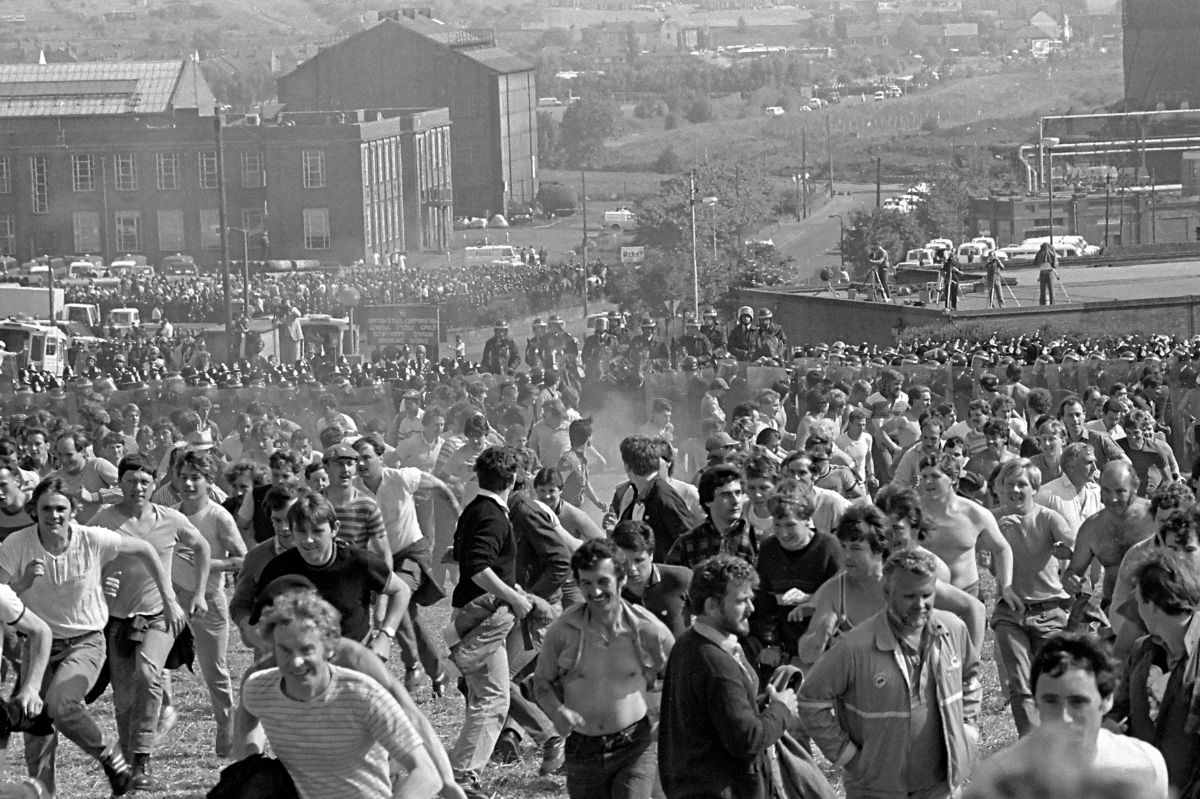
Orgreave Coking Plant. Near Sheffield, 18 June 84

Alun ‘Massum’ Jones. The march back to work, Maerdy, 5 March 1985
The Miners’ Strike 1984–1985 is out now on Café Royal Books.
Follow Miss Rosen on Twitter.
Enjoyed this article? Like Huck on Facebook or follow us on Twitter.
You might like

In photos: Black Texas life since emancipation
Kinship & Community — A new photobook and exhibition showcases the rich culture, history and community of African American folks in the Lone Star State, whose existence in the region predates colonial Britain.
Written by: Miss Rosen

Youthful joy & end-of-era poignancy at a London school prom
Leavers — For several years, Lewis Khan documented young people as they celebrated the last of their school days and the completion of their exams. The series is now collated in a new self-published photobook and short film.
Written by: Zoe Whitfield

Harry Gruyaert’s vintage, kaleidoscopic scenes of New York
A Sense of Place — For 50 years, the Belgian photographer and Magnum Photos member has been capturing NYC’s colourful chaos. A new photobook and exhibition showcase his unique, technicolour view of the city.
Written by: Miss Rosen

In the pit at one of the UK’s last stock car & banger speedways
Stock Car Racing Isn’t Dead — Photographer Liam McCarthy spent time in and around the Arlington Raceway’s circuit, capturing the diehard community that keeps the sport alive.
Written by: Isaac Muk

Inside Lower Duck Pond, the nicest town on the internet
/r/HaveWeMet — With a population of 2,500 and no fixed location, the subreddit is a space for roleplaying citizens to solve mysteries, host fictional events and ultimately connect. In an internet that’s often divided and toxic, Vicky Jessop hangs out in one of its most wholesome corners.
Written by: Vicky Jessop

A major Nan Goldin exhibition is coming to London
You Never Did Anything Wrong — Opening at the Hayward Gallery in November, the show will debut a new film from the artist and activist, alongside a slate of recent work.
Written by: Jack Dennison-Thompson


