Art behind bars: a portrait of the California prison system
- Text by Miss Rosen
- Photography by Peter Merts

In the late 1970s, photographer Peter Merts was one of nearly 500 youth who trespassed to protest the construction of a nuclear power plant on an earthquake fault. For this act of civil disobedience, Mert was arrested.
Merts spent 14 days in San Luis Obispo County jail, an experience that helped him to understand that “the folks inside – be they inmates or officers – were not that different from people on the outside, and that treating them with respect, consideration, and discretion would be appreciated and reciprocated”.
At that time, Merts began volunteering at Bread & Roses – a San Francisco Bay Area non-profit organisation providing free, live entertainment to institutionalised audiences. “I said to myself, ‘This is amazing; someone should document this!’” says Merts. “Within a week I bought a used Nikon.”

Students rehearse for a dance/spoken word piece, in the Protestant chapel at San Quentin State Prison, 2015
Over a period of 15 years, Merts would traverse California, documenting art classes in all 36 adult prisons. “Numerous studies, including those by Dr. Larry Brewster, with whom I published Paths of Discovery: Art Practice and Its Impact in California Prisons, show the efficacy of prison art programs,” Merts says, listing a host of psychological, behavioural, interpersonal, and intellectual benefits.
“More than one artist has described to me their art room as a ‘sanctuary’ from the harsh realities of prison,” says Merts. “The unwritten rules of the yard are relaxed in the art room as men and women teach, learn, mentor, and collaborate across racial and cultural divides.”
In the new book, Ex Crucible: The Passion of Incarcerated Artists (Daylight), Merts provide an intimate look at the therapeutic and rehabilitative powers of drawing, painting, singing, acting, sculpting, dancing, playing musical instruments, spoken word and movement.

Painting students in the Catholic chapel at Sierra Conservation Center, 2016

A dance student leaps in a visiting room, at Central California Women’s Facility, 2017
Merts shares the story of Adam – a young man incarcerated for murder – whose experience in a men’s prison group and art classes helped him develop and grow, giving him the strength necessary to finally leave a prison gang.
“When he subsequently fell into an intense identity crisis, it was these same programs that allowed Adam to re-create himself,” Merts says. “He took a prison job assisting a disabled fellow inmate, and later completed his high school diploma. Adam has recently been found suitable for parole by the board; he is now waiting for the governor’s signature.”
In addition to documenting the classes and the artwork itself, Merts makes portraits of prisoners, an empowering process that helps them rehabilitate their self-image. “There are no mirrors inside, due to security concerns,” he says. “Bathrooms have polished steel plates bolted to the wall that give a hazy, blurry, indistinct reflection. Consequently, some incarcerated people have not seen their own face clearly for decades.”
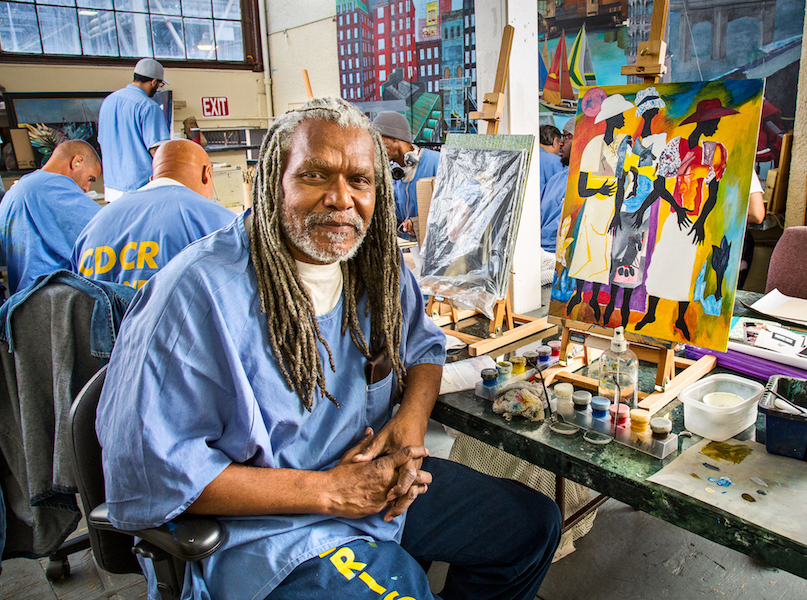
Student with his painting reproduction, in the art studio at San Quentin State Prison, 2015

A songwriting student tries a melody, in a bare warehouse space at CCI Tehachapi, 2018
Merts’s work also helps to change public perception of prisoners – an image shaped by ‘copaganda’ promulgated by Hollywood and corporate media. “When I began showing these images, I received comments such as, ‘They don’t deserve art classes’ – suggesting that incarcerated people are undeserving, irredeemable, or unable to benefit from art,” says Merts.
“This is how I came to realise my most profound aspiration for this work: to illuminate the humanity and authenticity of these incarcerated artists. Only with empathy and compassion can we begin to correct some of the injustices of our justice and carceral systems.”

Carving a linoleum block for printing, in the art studio at San Quentin State Prison, 2008

Students of Shakespearean theater warm up with an exercise, at Solano State Prison, 2015
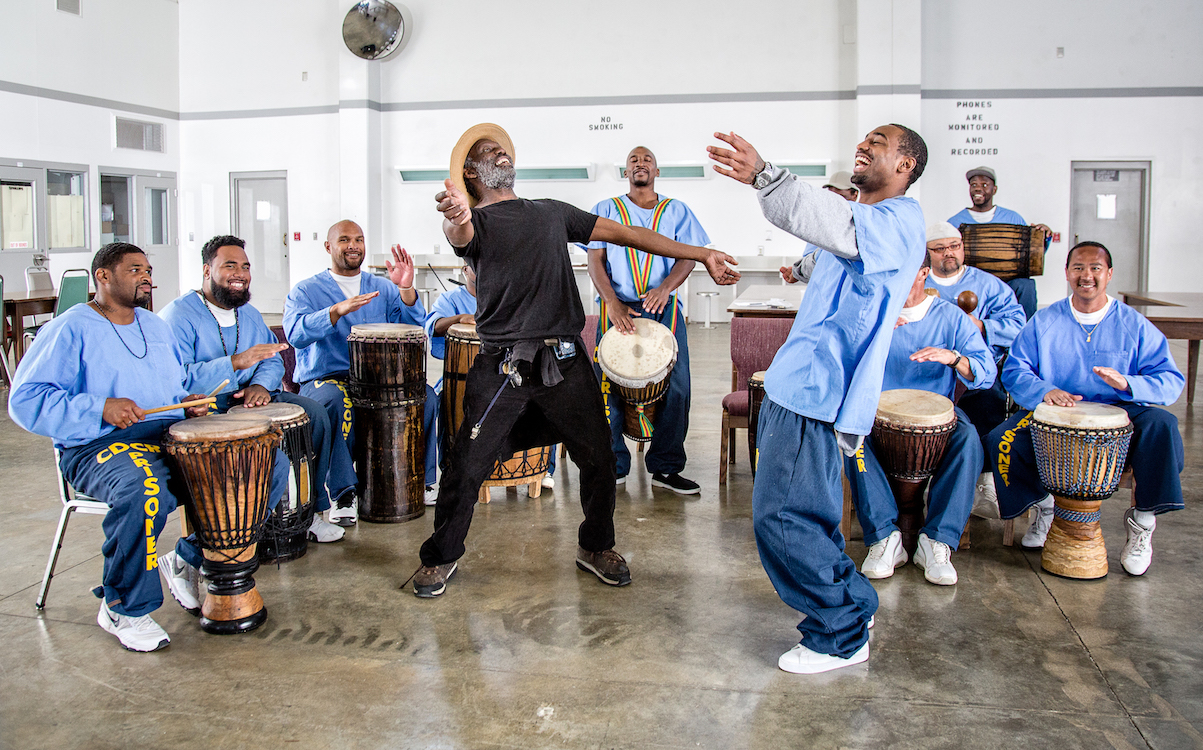
The instructor and a student dance during drumming class, in a gym at Salinas Valley State Prison, 2015

A student rehearses for a dance/spoken word performance, in the Protestant chapel at San Quentin State Prison, 2016

A student wearing theatrical makeup emotes during class at Ironwood State Prison, 2018

A student stops to inspect his painting in window light, in a gym at Pleasant Valley State Prison, 2019

Portrait session in the art studio at San Quentin State Prison, 2006
Ex Crucible: The Passion of Incarcerated Artists is out now on Daylight.
Follow Miss Rosen on Twitter.
Enjoyed this article? Like Huck on Facebook or follow us on Twitter.
You might like

In photos: Black Texas life since emancipation
Kinship & Community — A new photobook and exhibition showcases the rich culture, history and community of African American folks in the Lone Star State, whose existence in the region predates colonial Britain.
Written by: Miss Rosen

Inside Parkuir: the art project queering sport, space and our bodies
Lie and play — Founded by Maria Laudes and Guiu Gimeno, it provides a framework for engaging, subverting, and celebrating the small details that make people unique – and queer.
Written by: Molly Lipson

Youthful joy & end-of-era poignancy at a London school prom
Leavers — For several years, Lewis Khan documented young people as they celebrated the last of their school days and the completion of their exams. The series is now collated in a new self-published photobook and short film.
Written by: Zoe Whitfield

Harry Gruyaert’s vintage, kaleidoscopic scenes of New York
A Sense of Place — For 50 years, the Belgian photographer and Magnum Photos member has been capturing NYC’s colourful chaos. A new photobook and exhibition showcase his unique, technicolour view of the city.
Written by: Miss Rosen

In the pit at one of the UK’s last stock car & banger speedways
Stock Car Racing Isn’t Dead — Photographer Liam McCarthy spent time in and around the Arlington Raceway’s circuit, capturing the diehard community that keeps the sport alive.
Written by: Isaac Muk

Inside Lower Duck Pond, the nicest town on the internet
/r/HaveWeMet — With a population of 2,500 and no fixed location, the subreddit is a space for roleplaying citizens to solve mysteries, host fictional events and ultimately connect. In an internet that’s often divided and toxic, Vicky Jessop hangs out in one of its most wholesome corners.
Written by: Vicky Jessop


