Black and white photos of pre-gentrification Hackney
- Text by Huck
- Photography by Neil Martinson

Neil Martinson was still at school when he first picked up the camera. Growing up in Hackney during the ’70s, he saw it as an opportunity to engage with a world much larger than the one immediately available to him – one that felt, at times, fairly unforgiving.
“It was a cultural wasteland,” he says, describing his neighbourhood back then. “There were no bookshops, derelict houses littered the streets, and the cinemas were closing one by one. It was a depressing place to be. Many people just got out.”
Photography, though, provided respite. Not only did his surroundings open up, but people – interactions – did too. The “magic” that came with developing and printing his own photos kept him hooked, even when he was still finding his feet as a storyteller.
 “It was very hit and miss at the beginning. My first camera was a Russian Zenit-E – built like a tank. It wasn’t an easy camera to use compared to how they developed. I couldn’t afford much film so I had to be careful in thinking about what photos to take.”
While he was primarily documenting what he could see around him, Martinson was always particularly concerned with social action. As he grew older, much of his work began to centre around campaigns and activism: from the occupation of Hackney Town Hall in 1981, to a long-term project on the housing crisis that played a role in successfully convincing the local council to change its policy on putting up homeless families in squalid, run-down hotels.
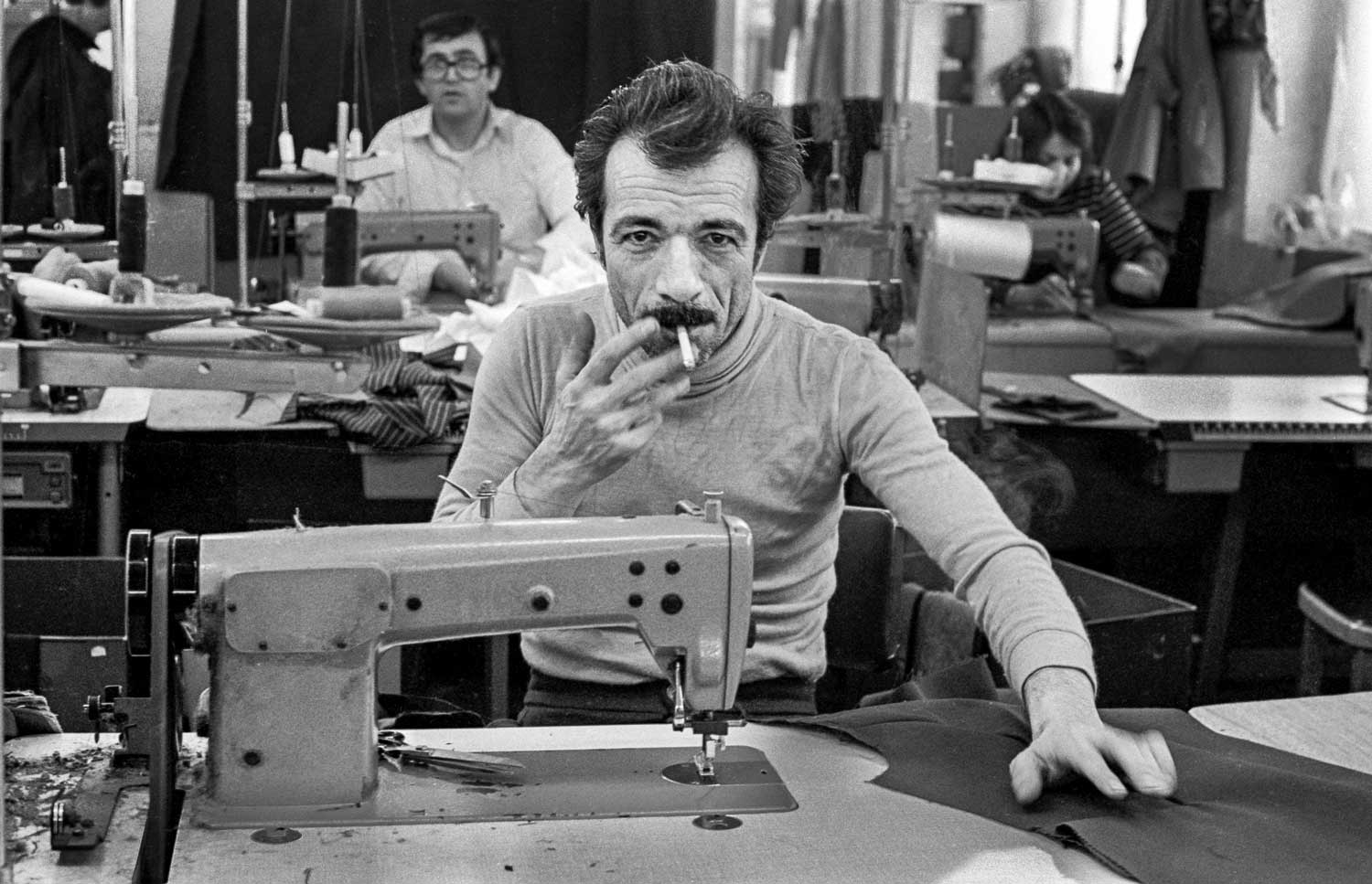
 Now, all of that work features together in Hackney Archive: Work and Life 1971 – 1985, the seventh instalment in Hoxton Mini Press’ Vintage Britain series. Taking the reader on a 14-year journey, it begins with Martinson’s first pictures, before concluding with Hackney on the cusp of sweeping gentrification.
“Cities and places within them have always changed,” Martinson says. “My grandparents came from Holland and Russia to make new lives. Many of the factories I documented [during the ’70s] lay empty for 15-20 years. But some are now loft apartments, or have been taken over by the digital industry.”
“Immigration always brought new energy and ideas. The empty houses and cheap rents in the ’70s and ’80s created the space for artists, radicals and diversity. That’s changed and it’s only people with money that can afford to move to Hackney. So… it’s a mixed blessing.”


 Hackney Archive: Work and Life 1971 – 1985 is available now from Hoxton Mini Press.
Enjoyed this article? Like Huck on Facebook or follow us on Twitter.
You might like

In photos: Black Texas life since emancipation
Kinship & Community — A new photobook and exhibition showcases the rich culture, history and community of African American folks in the Lone Star State, whose existence in the region predates colonial Britain.
Written by: Miss Rosen

London’s largest indoor skatepark to be demolished for padel courts
Better Extreme — The Barking skatepark’s fate follows that of similar indoor spaces in recent years, with operators GLL citing falling visitor numbers as the reason behind the decision.
Written by: Isaac Muk

Youthful joy & end-of-era poignancy at a London school prom
Leavers — For several years, Lewis Khan documented young people as they celebrated the last of their school days and the completion of their exams. The series is now collated in a new self-published photobook and short film.
Written by: Zoe Whitfield

Harry Gruyaert’s vintage, kaleidoscopic scenes of New York
A Sense of Place — For 50 years, the Belgian photographer and Magnum Photos member has been capturing NYC’s colourful chaos. A new photobook and exhibition showcase his unique, technicolour view of the city.
Written by: Miss Rosen

In the pit at one of the UK’s last stock car & banger speedways
Stock Car Racing Isn’t Dead — Photographer Liam McCarthy spent time in and around the Arlington Raceway’s circuit, capturing the diehard community that keeps the sport alive.
Written by: Isaac Muk

Inside Lower Duck Pond, the nicest town on the internet
/r/HaveWeMet — With a population of 2,500 and no fixed location, the subreddit is a space for roleplaying citizens to solve mysteries, host fictional events and ultimately connect. In an internet that’s often divided and toxic, Vicky Jessop hangs out in one of its most wholesome corners.
Written by: Vicky Jessop


