Portraits of America’s ‘plain ordinary working people’
- Text by Niall Flynn
- Photography by Daniel Kraus

In 2012, photographer Daniel Kraus was working for an organisation that ran projects in communities with high poverty rates. As part of the role, he’d take different youth groups to stay with families in isolated areas around Williamsburg, Kentucky, where they’d lend a hand with upkeep and general service work.
Over the course of the summer, he became close with a couple – Martha and Arnold – who lived in an old secluded cabin which they needed help taking care of. One day, when he was helping the pair reorganise their home, he stumbled upon a sleeve of old negatives discarded on the floor, discarded among “decades worth” of plastic bags and newspapers. After picking them up and confirming with Arnold that they weren’t family photos, he decided to keep hold of them.
 “The first quality which drew my curiosity was how withered and destroyed they were,” Kraus remembers. “There was a sense of mystery as well, because I could see they were portraits – but didn’t have any way to look at them for several weeks. [It] was almost like I had found a treasure that had been waiting for me.”
That sense of mystery only deepened when he was finally able to scan them in, revealing what the pictures actually were: Walmart employee headshots from 1986. How they’d come to arrive in the cabin, he had no idea. What he did know, however, was that he needed to do something with them.
 “I tried to make work with them for a few years, never really taking them to their full potential. However, after starting graduate school, I showed them during my second critique, and from that point on I started a new approach. Some of my colleagues asked if I had every tried to find out more about the photographs – who was in them, where did they come from, and why they were made.”
“I wasn’t so inspired initially by this idea at first. I loved these images because of their ambiguity, but I felt like I should try and see what I could dig up. It was during this time and research that I really honed my ideas for the project and settled on the fact that my interests did in fact lie in solving the mystery rather than perpetuating it.”
 After two years of letters, phone calls, searching archives and embarking on cross-country drives, Kraus was eventually able to find, interview and photograph five of the 14 Walmart employees depicted in the original images. The result is Plain Ordinary Working People, a project that explores identity, origin and small-town life in America – through the prism of one of its most recognisable institutions.
“Socially, Walmart store parking lots are where teenagers in small town pass the nights and socialise. For a busy family it means that all their needs, from getting new tires on the car to buying baby formula, can be bought in one place,” he says. “To describe the significance of Walmart to someone outside the US today might be something akin to a brick and mortar Amazon store. Walmart sold everything for less than anybody – and you had easy access to it.”
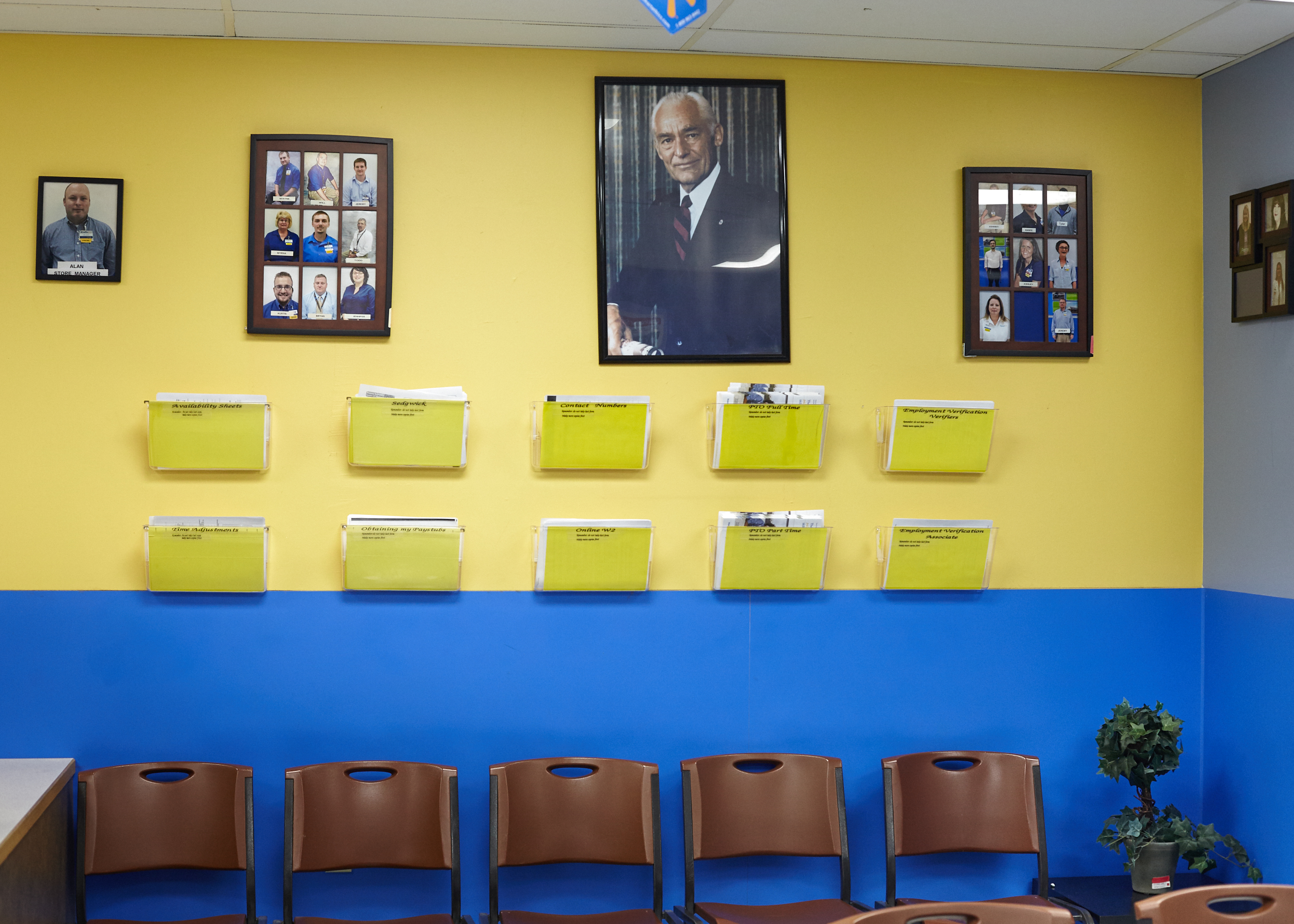 The project’s title comes courtesy of founder Sam Walton, who wrote of how they were “no limit” to what “plain ordinary working people” could accomplish when given the opportunity. It’s a sentiment that’s interrogated in the work, through both the images and the subsequent interviews he conducted. In its early days, that altruism remained largely sheltered; but as the company grew, Kraus discovered, benefits and incentives (such as profit sharing) began to dry up In that sense, the Walmart narrative is entangled with the American one.
“Sam Walton wrote an autobiography entitled Made in America which elaborated on his story of starting Walmart and what early habits and philosophies made him so successful. At it’s best it’s a story of frugality and pulling oneself out of an impoverished place. At its worst, it’s suspiciously nostalgic and slick. I think those two aspects make its history complex – and perfectly American.”


 Learn more about Plain Ordinary Working People, and see more of Daniel Kraus’ work, on his official website.
Enjoyed this article? Like Huck on Facebook or follow us on Twitter.
You might like

In photos: Black Texas life since emancipation
Kinship & Community — A new photobook and exhibition showcases the rich culture, history and community of African American folks in the Lone Star State, whose existence in the region predates colonial Britain.
Written by: Miss Rosen

Youthful joy & end-of-era poignancy at a London school prom
Leavers — For several years, Lewis Khan documented young people as they celebrated the last of their school days and the completion of their exams. The series is now collated in a new self-published photobook and short film.
Written by: Zoe Whitfield

Harry Gruyaert’s vintage, kaleidoscopic scenes of New York
A Sense of Place — For 50 years, the Belgian photographer and Magnum Photos member has been capturing NYC’s colourful chaos. A new photobook and exhibition showcase his unique, technicolour view of the city.
Written by: Miss Rosen

In the pit at one of the UK’s last stock car & banger speedways
Stock Car Racing Isn’t Dead — Photographer Liam McCarthy spent time in and around the Arlington Raceway’s circuit, capturing the diehard community that keeps the sport alive.
Written by: Isaac Muk

Inside Lower Duck Pond, the nicest town on the internet
/r/HaveWeMet — With a population of 2,500 and no fixed location, the subreddit is a space for roleplaying citizens to solve mysteries, host fictional events and ultimately connect. In an internet that’s often divided and toxic, Vicky Jessop hangs out in one of its most wholesome corners.
Written by: Vicky Jessop

A major Nan Goldin exhibition is coming to London
You Never Did Anything Wrong — Opening at the Hayward Gallery in November, the show will debut a new film from the artist and activist, alongside a slate of recent work.
Written by: Jack Dennison-Thompson


