Felipe Merida’s powerful illustrations reveal America’s hidden Latino workers
- Text by Alex King
- Illustrations by Felipe Merida

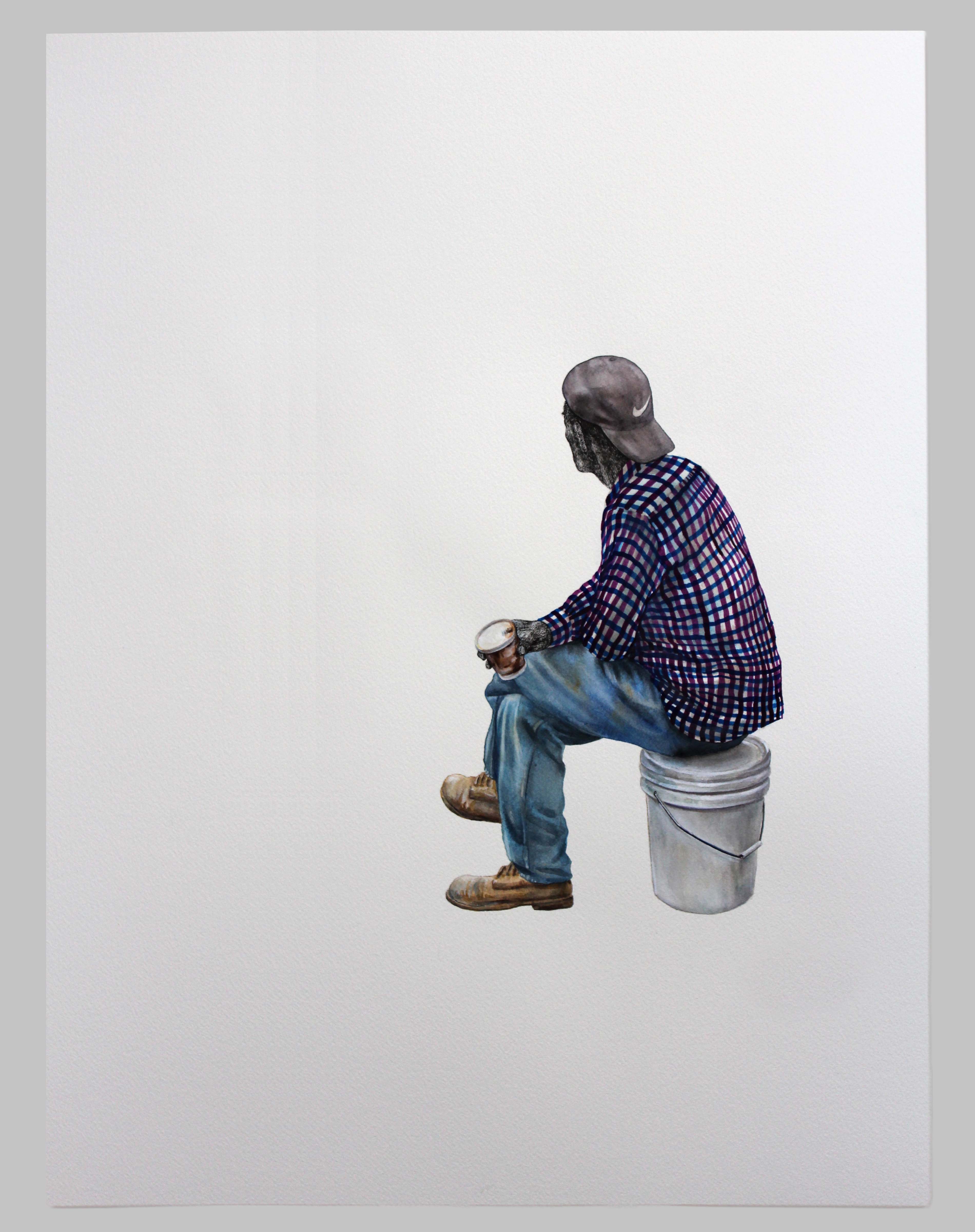
Worn Levi’s 501 jeans, Timberland construction boots, Nike baseball caps and all-American branded caps, tees and sweaters. To the untrained eye, they’re just items of clothing, but to those who can read the symbols, like artist Felipe Merida, they’re a uniform that identifies them as Latinos: hard-working motherfuckers, keeping America moving – largely unnoticed.
Latinos USA is a solo exhibition by Guatemala-born/Brooklyn-based artist Felipe Merida, AKA Tipi Thieves at LA’s Paul Loya Gallery.
A migrant himself, Felipe’s family moved from Guatemala to San Francisco in 1997 where he went on to study at the San Francisco Art Institute.
Latinos USA is a series of portraits made from anonymous photographs Felipe took around his Brooklyn neighbourhood. His attention to detail brings to life the character of each worker through their dress, the two cultures that come together in them and quietly celebrates the Latin community’s contribution to America.
What is Latinos USA all about?
The collection is a nostalgic reminder of my roots. Coming from a central-America Latino background I am taken back to my childhood. Their work ethic is admirable, the importance of earning money for their family is so noble – this collection is to celebrate them.

What drew you to the people you chose to paint?
I am attracted to their style. My work is detail orientated, I aim to capture the texture of the textile, the facial expression in strokes of ink, the material of the shoes, age and other defining characteristics in each portrait.

How do you hope your paintings will change how people see them?
I don’t hope my painting will change how people see them, I merely present them for people to see.

What’s the most important thing you learned or the most poignant moment/interaction you experienced in putting together the series?
Other than my own nostalgia for the culture, I learned to pay even more attention to detail. The smallest detail can make the painting more authentic. Most of the portraits are from behind, so I needed to capture the culture without using facial features. Hence the importance of the details.

Do you feel Latinos’ contributions to American society are adequately recognised?
Without generalising, Latinos are happy to have work, rather than being too selective about the work they do.Their work ethic is focus on providing for the family… In some ways I don’t think they are too concerned with being recognised for their work – family is the focus.

Donald Trump’s recent comments suggest Latinos are still not accepted by large sections of American society. How long do you think it will take for Latinos to be accepted as Americans, like the Irish and Italians have been, finally?
Living in New York City I don’t have a sense that Latinos are not accepted. In this multicultural city, we are all finding our own direction. In other states of America, there is a lot of cultural unrest, not only Latinos, but many other races are still not accepted even if you are born American. This may never fully change.

What role does art have to play in breaking down those barriers?
Art is a means of publicity, highlighting society and life. If it falls in the eyes of the right people, it may increase awareness, others may just appreciate its beauty. I believe each individual brings their own thoughts and reactions when studying art, the artist is not in control of that.
Felipe Merida’s Latinos USA is at Paul Loya Gallery, Los Angeles until October 17.
You might like

In photos: Black Texas life since emancipation
Kinship & Community — A new photobook and exhibition showcases the rich culture, history and community of African American folks in the Lone Star State, whose existence in the region predates colonial Britain.
Written by: Miss Rosen

Inside Parkuir: the art project queering sport, space and our bodies
Lie and play — Founded by Maria Laudes and Guiu Gimeno, it provides a framework for engaging, subverting, and celebrating the small details that make people unique – and queer.
Written by: Molly Lipson

A major Nan Goldin exhibition is coming to London
You Never Did Anything Wrong — Opening at the Hayward Gallery in November, the show will debut a new film from the artist and activist, alongside a slate of recent work.
Written by: Jack Dennison-Thompson

Tender portraits of women serving life sentences in America
Looking Inside — While working as a public defender attorney in New York State, Sara Bennett found dilapidated prisons and forgotten people. Her new photobook harnesses the power of images and shines a humanising light on those imprisoned for serious crimes and their reintegration into society, while asking questions of the USA’s incarceration system.
Written by: Miss Rosen

The real life mermaids of Florida’s Weeki Wachee Springs
Old Florida — A relic of pre-Disney tourism in the state, the show – which sees women perform athletic underwater tricks in a natural spring – has been running since 1947. Jack Burke attends, while reflecting on the fragility and fantasy of old America.
Written by: Jack Burke

Road tripping across 1970s America
73 Trip West — In 1973, Larry Racioppo set out from Brooklyn to California, armed with a medium format camera. For the first time in over half a century, roadside photographs from his trip have been unearthed.
Written by: Miss Rosen


