For Karl Read, surfing and street art are enmeshed
- Text by Huck

Surfing has always been a huge part of Karl Read’s life. He grew up riding waves on Britain’s South Coast, before leaving for university to pursue his other clear passions: art and design.
After graduating, he decided he wanted to combine them all when it came to a career. This eventually took him to Animal, where he’d work for a total of 17 years in a variety of different creative roles, all the while completing a variety of different personal art projects on the side.
Karl had always wanted to start his own brand. At the beginning of last year, during the throes of lockdown, that dream became a reality. “That period gave me the opportunity to finally start working on a brand,” he says. “Lockdown was the catalyst of change, [it was] what felt like the perfect time to do what I had always dreamt about.”
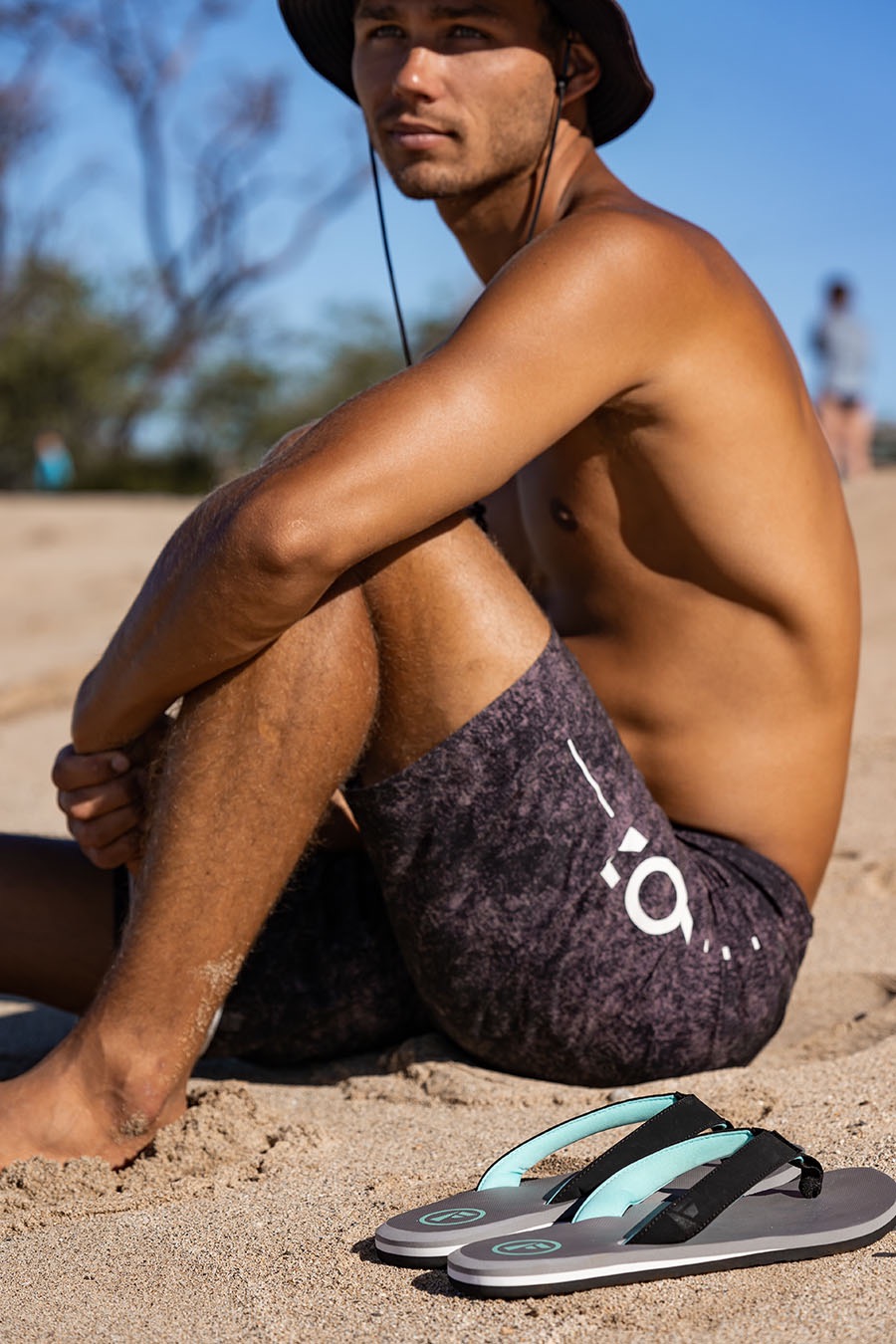
With that mindset, he took the leap. The result is FoamLife, a company specialising in flip-flops that Karl runs as Creative Director, alongside his colleagues and co-founders Timo Mullen and Daniel Macauly.
“It is so important that a brand has authenticity,” adds Karl. “We are always at the beach, we both surf, live on the South Coast, travel as much as possible all while juggling a career, married life and children. Flip-flops as a category just felt right and something we could feel really passionate about. From there, the brand was born.”
As Karl gears up to develop the brand’s 2022 collection, alongside working on an aim to increase the amount of sustainability in future ranges, Huck sat down with him to discuss FoamLife’s journey so far.

© Adam Sims
What’s the best creative advice anyone has ever given you?
It’s hard to pinpoint just one piece of advice, as I’ve worked with lots of talented people over the years and have learnt a lot along the way. Some of it has been advice given, and some of it you just work out for yourself.
I think it’s important to push yourself, try new things that are out of your comfort zone. Take constructive feedback but don’t let it consume you, as one thing I’ve learnt is you can’t please everyone. Research as much as possible, consume as much creativity as you can, new and old. It’s interesting thinking back to when I was younger in my career, how I was only interested in new design and art. As I’ve got older, I have found myself looking back more to the pioneers of art movements and brands.
Being a creative, it’s good to have thick skin – or not worry too much about what others think. When I have an idea in my head, I have to get it down on paper or blurt it out in a creative meeting. Not everything has to be a masterpiece or genius idea. In my mind there is no such thing as a bad idea. It’s all part of the process and will always lead on to something better.
What advice would you give someone who wants to turn their passion into a career?
I think this depends so much on where you are in your career. Ignore the get-rich-quick formulas you see on social ads… there are no shortcuts. When starting out in your career, gain as much experience as you can and don’t be so focused on how much you’re getting paid. Experience is invaluable, use that time to learn, experiment, network as much as possible and the financial rewards and/or job satisfaction will follow.
If you’re wanting to change your career or leave full-time employment to work for yourself, this can be harder, especially if you have important commitments like a mortgage and children to support – but it’s never too late. In this position, I think creating a side-hustle around your passion is a great idea. It’s easy to say you don’t have time, but just finding an hour or two each evening to work on something goes a long way. From a financial point of view, it’s great to have that extra income, however small, and there is less pressure if you’re in full-time employment. Enjoying the process of working towards your end goal is so important.
Sooner or later, it’s about taking that leap and not worrying about what anyone else thinks. It’s easy to have the fear of failing, but surely that’s better than looking back and thinking, ‘What if?’

© W1 Curates
How do you remain inspired – where do you look?
I love Instagram. Whether I’m looking at photography, street art, brands, artists or designers, I love the fact that, as long as you have your phone, it’s accessible anywhere and anytime of the day. I don’t post often enough myself, but it’s scary the amount of time I spend on it. Social media has it’s negatives but what better time for creatives to be able to get their work out there for the world to see.
You can’t beat just getting out and about, though. I’m only two hours on the train from London and find it a great source of inspiration – whether that’s looking in stores, markets or visiting an art exhibition… and of course London is great for street art.
I would usually have at least two trips abroad a year, anywhere from Amsterdam to Australia, so I’m really looking forward to being able to travel again. Visiting a city is great but being based by the coast is where I love to be. Sometimes the best ideas come from just being in a place that you love – for me, that’s in the water surfing with mates. It frees my mind and it’s where a lot of ideas happen for me.
What’s the biggest challenge you’ve had to overcome in your career to date?
Definitely starting FoamLife. It’s not the hard work that’s involved, I’m definitely no stranger to putting in long hours, It’s having the guts to take the leap and go for it, the further along in your career you are, the harder it is because you feel like there are more eyes on you. You have to get past that, there is only so long you can say, ‘one day’ I will do something. Turning down full-time work and an income to concentrate on building the brand was hard but it’s what makes it feel real, it gives you that drive to really make it work.
© Amanda Breenan
Who do you look up to in the world of design – how does their work inform your own?
Where do I start? There are too many to mention. Shepard Fairey stands out the most for me though. I love Shepard’s work and he is definitely the artist that inspired me to start painting murals with stencils and spray paint. But his work ethic is what I really admire about him. Shepard founded Obey clothing, releases limited-edition screen prints pretty much each week, does multiple gallery shows internationally, founded creative agency Studio Number One, created the Obama Hope image – which in my opinion helped Obama win the election.
What do you have planned next?
For FoamLife, we have lots of exciting projects going on, we will be working more with brands and organisations that sit alongside our own brand values like – The Wave in Bristol. and the charity we support, Surfers Not Street Children, to name a few. We have decent distribution of our range in the UK and are now focusing on growing our International distribution in Europe and Australia as well as opening up our online store to international customers.
From a personal point of view, I’m currently speaking with a gallery in Dubai about putting on an art exhibition of my work towards the end of this year which I’m really excited about. Lastly, I’m hoping to paint a mural or two this summer, one of which will be for Upfest in Bristol, which is Europe’s largest street-art festival. I have painted at every one since it began back in 2008. This year, the festival was recently called off due to Covid as it attracts big crowds. However, they have invited various artists to paint 75 walls in 75 days, so I’m honoured to be part of that this year.
 Find out more about FoamLife on their official website.
Enjoyed this article? Like Huck on Facebook or follow us on Twitter.
You might like

Behind the curtain at Alternative Miss World 1981
Olympia glamour — Running a subversive take on the traditional beauty pageant, the Andrew Logan organised event prioritised underground creativity and invention. Photographer David Corio went behind the scenes at its biggest edition.
Written by: Miss Rosen

Kristina Rozhkova’s scatty, confronting portrait of captivity
Gut Feeling — The Russian artist’s 2024 arrest and subsequent detention opened her eye towards the omnipresent dynamics of power and control. Her new photobook is a stark exploration of being trapped.
Written by: Isaac Muk

Washing strangers’ feet at Houghton Festival
Pedilavium — As part of artist Henry Krokatsis’s performance piece at the weekender, we sat down with over 30 others to clean the dusty digits of passersby, while reflecting on the power of collective ritual and human connection.
Written by: Isaac Muk

The anti-tourism guides revealing Lisbon’s true, radical heart
We Hate Tourism Tours — The Portuguese capital sees millions of people visit a year, against a backdrop of political turbulence and a housing crisis fuelled by short term holiday lets. Jack Burke meets the crew subverting their city’s perception, while bringing lesser seen stories and monuments to light.
Written by: Jack Burke

The art of paying attention: How Austria’s Alps reward slowing down
Lebensgefühl — With a growing movement of art and music rooted in the area’s mountains, trees and waterfalls, the region is showcasing the importance of the human relationship to nature.
Written by: Sophie Lou Wilson

Inside Parkuir: the art project queering sport, space and our bodies
Lie and play — Founded by Maria Laudes and Guiu Gimeno, it provides a framework for engaging, subverting, and celebrating the small details that make people unique – and queer.
Written by: Molly Lipson


