Gordon Parks’ luminous photos of Black American life

Gordon Parks (1912–2006) was a singular figure in the 20th century, transcending every boundary erected against Black America to become one of the greatest artists of our times. The self-taught photographer, who barely escaped lynching as a child and ended up homeless as a young teen, used the injustice levelled against him as fuel to chart his own path through the mainstream in order to tell stories of Black America from the inside.
As the first Black photographer working for LIFE magazine, Parks’ photographs of segregation in the South, pictures made in his hometown of Fort Scott, Kansas, scenes of crime in major cities in the 1950s, and documentation of the Civil Rights Movement have become some of the most indelible images of mid-century America.
The new exhibition, Gordon Parks: Half and the Whole, offers an intimate portrait of the complex realities for Black Americans between 1942 and the 1970s. The exhibition opens with an essay by New Yorker journalist Jelani Cobb, drawing parallels between the lives of George Floyd and Gordon Parks, both of whom moved to Minneapolis, Minnesota, in search of a better life.

Untitled, New York, 1963

Department Store, Mobile, Alabama, 1956
Parks, the youngest child of 15, moved to the city in 1928 after his mother’s death; Floyd arrived nearly a century later, in 2014, to rebuild his life after serving time – only to be killed by Police Officer Derek Chauvin in a moment captured on video that launched the biggest Civil Rights protests in the history of the world.
“The great tragedy and beauty of Gordon Parks is that his work continues to resonate so much today: he captured the zeitgeist of his time, including many issues we still face,” says gallerist Jack Shainman.
The parallels between the past and the present are evident throughout much of Parks’ work, though perhaps not quite so clearly stated as in a 1963 photograph where a Black man holds a protest sign bearing the words, “WE ARE LIVING IN A POLICE STATE.”
Despite the trauma Black people have endured in the United States, Parks understood the story of Black America could not be told unless one embraced tender moments of beauty, peace, and bliss as evidence of the triumph of spirit over the forces of destruction.

Untitled, Mobile, Alabama, 1956

Untitled (Malcolm X) Harlem, New York, 1963
“Always, there is a glimpse of the joy that perseveres even in the most hostile circumstances, the glint of light peering through foreboding clouds,” Cobb writes in his essay.
Parks understood survival required more than just struggle: it necessitates the pleasures of family, friends, and being one with nature itself. In his photographs made in Shady Grove, Alabama, in 1956, Parks offers tender moments of daily life; poignant mediations on the quiet dignity human life.
“The images in this exhibition show more than just half the story, encompassing not just the struggles but the everyday lives of his subjects,” Shainman says. “In his photographs, we see injustices, but also moments of play, love, learning, and pleasure. Gordon’s keen eye captured the whole story, which is evident throughout our show.”

Untitled, Harlem, New York, 1963

Untitled, ca. 1946
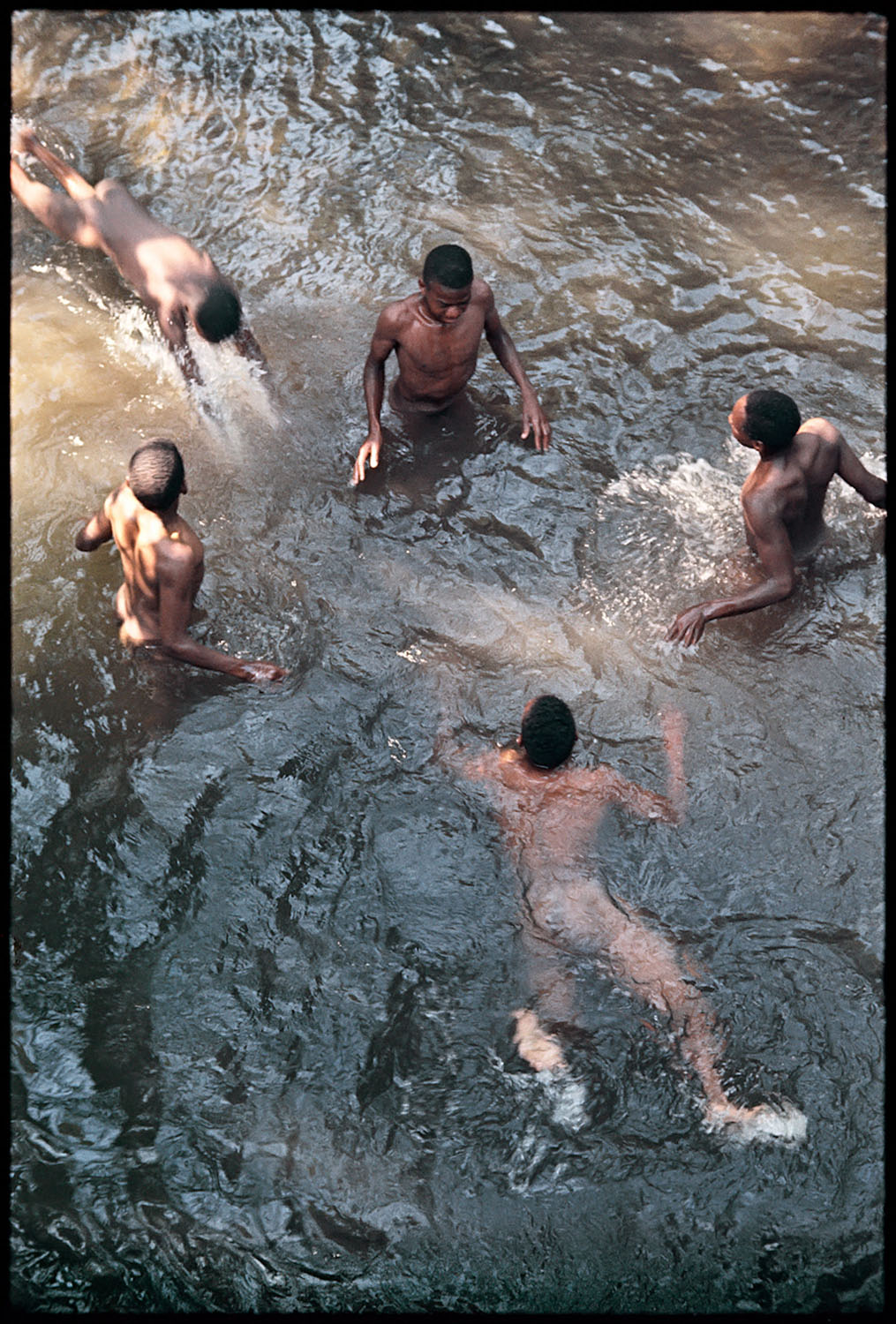
Watering Hole, Fort Scott, Kansas, 1963

Outside Looking In, Mobile, Alabama, 1956

Untitled, Chicago, Illinois, 1957

Untitled, Harlem, New York, 1963
Gordon Parks: Half and the Whole is on view at Jack Shainman Gallery in New York through February 20, 2021.
Follow Miss Rosen on Twitter.
Enjoyed this article? Like Huck on Facebook or follow us on Twitter.
You might like

In photos: Black Texas life since emancipation
Kinship & Community — A new photobook and exhibition showcases the rich culture, history and community of African American folks in the Lone Star State, whose existence in the region predates colonial Britain.
Written by: Miss Rosen

Youthful joy & end-of-era poignancy at a London school prom
Leavers — For several years, Lewis Khan documented young people as they celebrated the last of their school days and the completion of their exams. The series is now collated in a new self-published photobook and short film.
Written by: Zoe Whitfield

Harry Gruyaert’s vintage, kaleidoscopic scenes of New York
A Sense of Place — For 50 years, the Belgian photographer and Magnum Photos member has been capturing NYC’s colourful chaos. A new photobook and exhibition showcase his unique, technicolour view of the city.
Written by: Miss Rosen

In the pit at one of the UK’s last stock car & banger speedways
Stock Car Racing Isn’t Dead — Photographer Liam McCarthy spent time in and around the Arlington Raceway’s circuit, capturing the diehard community that keeps the sport alive.
Written by: Isaac Muk

Inside Lower Duck Pond, the nicest town on the internet
/r/HaveWeMet — With a population of 2,500 and no fixed location, the subreddit is a space for roleplaying citizens to solve mysteries, host fictional events and ultimately connect. In an internet that’s often divided and toxic, Vicky Jessop hangs out in one of its most wholesome corners.
Written by: Vicky Jessop

A major Nan Goldin exhibition is coming to London
You Never Did Anything Wrong — Opening at the Hayward Gallery in November, the show will debut a new film from the artist and activist, alongside a slate of recent work.
Written by: Jack Dennison-Thompson


