The strange, seductive digital art of Olga Fedorova
- Text by Alice Bucknell
- Photography by Olga Fedorova

Both hypnotic and uncanny, seductive and foreboding – the digital artworks of Russian artist Olga Fedorova leave an immediate impression that’s hard to shake.
Rendered with 3D technology, her eerie scenes are charged with a symbolism that brings to mind the Belgian surrealists like René Magritte and Paul Delvaux. Her influences create a strange and wonderful aesthetic that resists an easy read.
Highly sexualized female bodies are always at the centre of the action, often nude save for helmets, knee-high boots, stilettos, or furry skintight suits. They perform elaborate exercises that dangle between idle play and ritual. The scenes could be cutting critiques of girl-on-girl surveillance and domestic entrapment, global capitalism and its anxious effects on the body – or just as a crop of surreal and funny avatars.
It’s easy to forget that – with her background in classical painting and a degree from the Ecole Nationale Supérieure des Arts Visuels de La Cambre (ENSAV) in Brussels – Olga still remains relatively new to the digital world. And as her she gets ready to open her first solo show in London this month, we caught up with her to find out more about her strangely seductive creations.

Always on my mind, 2017.

Rivals, 2017.
Who are the women in your work? What are they doing?
They are all women from my life, who I create through observing and analysing their behaviours. I place them in different environments and situations and let them interact. They are ambiguous and sometimes funny, sometimes friends and sometimes enemies. But they are always somehow erotic. They are stuck in a sort of technological and digital trance.
Tell me about your influences. I see tropical plants and animals mashed up with creepy modernist interiors.
I work intuitively and mix stories from my life with fictional stories. I was particularly inspired by an old Italian horror movie Suspiria (1977) which was inspired by Thomas De Quincey’s collection of psychological fantasy essays, Suspiria de Profundis (1858). The film blends supernatural and horrific with domestic settings. This tension interested me. I think that this is partially the reason why my women are often indoors.

Whitedog, 2017

In My House, 2017.
How does your background as a painter play into your new digital work?
It helps me a lot in thinking about the colour and composition of my digital paintings. But I am still exploring this new medium and experimenting with different approaches and perspectives.
Is feminism a part of your practice?
Feminism is a strong movement that has gained power in the digital revolution. My women are charged with a female energy, which I collect from observing the women in my everyday life situations. But the aesthetic side is always a secondary part for me.
How would you like outsiders to read your work?
There’s a quote from Jean-Paul Sartre: “A man is always a teller of stories. He sees everything that happens to him through them. And, he tries to live his life, as if he were telling a story.”
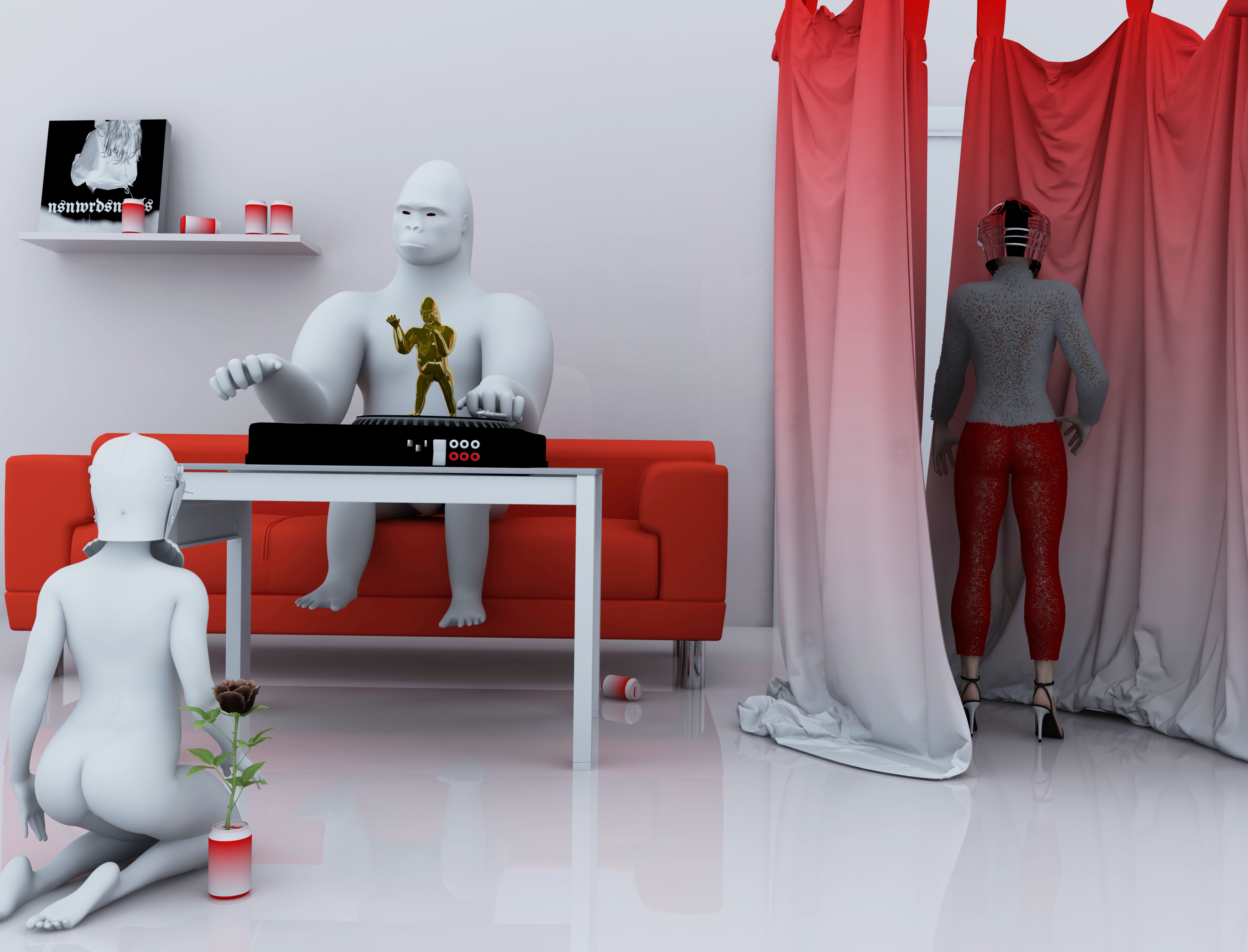
DJ set, 2017

Hot Work, 2017

Swimming Pool, 2017

Selfie, 2017
Generic Jungle is on show at Annka Kultys Gallery from November 16 – December 16 2017. It is the artist’s first solo show in London.
Enjoyed this article? Like Huck on Facebook or follow us on Twitter.
You might like

Exploring girlhood and land ancestry in Sudan’s cotton fields
Cotton Queen – A new feature debut from filmmaker Suzannah Mirghani explores the legacy of colonialism and the fight for self-determination through the tender eyes of a teenage girl.
Written by: Roxana Diba

Kristina Rozhkova’s scatty, confronting portrait of captivity
Gut Feeling — The Russian artist’s 2024 arrest and subsequent detention opened her eye towards the omnipresent dynamics of power and control. Her new photobook is a stark exploration of being trapped.
Written by: Isaac Muk

Washing strangers’ feet at Houghton Festival
Pedilavium — As part of artist Henry Krokatsis’s performance piece at the weekender, we sat down with over 30 others to clean the dusty digits of passersby, while reflecting on the power of collective ritual and human connection.
Written by: Isaac Muk

The anti-tourism guides revealing Lisbon’s true, radical heart
We Hate Tourism Tours — The Portuguese capital sees millions of people visit a year, against a backdrop of political turbulence and a housing crisis fuelled by short term holiday lets. Jack Burke meets the crew subverting their city’s perception, while bringing lesser seen stories and monuments to light.
Written by: Jack Burke

The art of paying attention: How Austria’s Alps reward slowing down
Lebensgefühl — With a growing movement of art and music rooted in the area’s mountains, trees and waterfalls, the region is showcasing the importance of the human relationship to nature.
Written by: Sophie Lou Wilson

Inside Parkuir: the art project queering sport, space and our bodies
Lie and play — Founded by Maria Laudes and Guiu Gimeno, it provides a framework for engaging, subverting, and celebrating the small details that make people unique – and queer.
Written by: Molly Lipson


