How Michelle Zauner is healing through sound
- Text by Biju Belinky

“I just feel that life is really meaningless. Music is the only thing that makes me feel like I am contributing anything at all to the world, or creating any kind of meaning,” Michelle Zauner (also known as Japanese Breakfast) tells me point-blank as we sit on a raised patch of concrete flooring in the shade of a huge Shoreditch garage.
When talking to Michelle, you can tell she isn’t your run-of-the-mill Portland art kid. The only child in a family of Korean immigrants, she spent her younger years relying on her imagination for amusement while living in a small town by the woods with very strict parents. Her first connection to an instrument was not through a hand-me-down guitar in some dingy basement smelling of weed, but rather through being made to take piano lessons at a very young age “like most Asian kids do”. Back then, it was not about the music – rather, it was about the discipline.
When she hit thirteen, thanks to the influence of her friends, Michelle started developing a taste for music – listening mostly to Pacific Northwest indie rock bands, such as Death Cab for Cutie, Grandaddy, and Mount Eerie. She yearned to pick up a guitar, but was only allowed to by her mother three years later. The moment the instrument was in her hands, Michelle taught herself to play and started writing – but it wasn’t until much later that music managed to claimed its spot as the focus of her life.
“When I was 25 it was the first time I worked a 9-to-5 job – an advertising job, where I was sitting at a desk all day. I was there for a year, and I would sit for 8 hours, being busy, eating lunch at my desk… I would leave the office feeling like I had accomplished absolutely nothing.”
“I just felt completely unfulfilled. That’s when I finally realised that music was something that I had to pursue. It was this thing I kept trying to push away, and it kept coming back into my life. It was what I was meant to be doing.” Michelle goes on to speak of a certain envy for bandmates and colleagues who saw music as a vocation from an early age, whereas she is still going through a learning process – but she wouldn’t have her trajectory be any different.
“In some ways I feel like I needed to struggle, and not be allowed to pursue music so easily, just to know that it was what I really wanted to do, and be able to work so hard at it now. I don’t come from a family of musicians – I really had to prove to myself that music is what I wanted to. Or rather, music had to prove itself to me.”
She joined a band called Little Big League when she moved to Philadelphia at the age of 18, but had to leave the project after graduating college to care for her mother who had been diagnosed with cancer. Michelle’s first album under the moniker Japanese Breakfast, Psychopomp, came three years later, right after her mum’s passing. It was her way of dealing with the feelings of grief and sadness that come with losing someone close after a long period of struggle.
“I really thought that Psychopomp was going to be my last album – that I was going to put it out and have it there just for me,” she tells me. “That’s when I moved to New York to get a job, because I just didn’t think I could tour anymore. I didn’t think I had it in me. I just felt like I had hit 25, and if it hadn’t worked out by now, it wasn’t meant to.”
But much to Michelle’s surprise, the dreamy and emotional indie record was received with extensive critical acclaim, and, while at the time of writing she had no label, and no expectations to see it amass any sort of success, after its release she had been signed to independent label Dead Oceans.
“It’s hard not to feel like there was some force in the death of my mother,” she muses, quietly. “That the birth of this career was almost like a gift from her to me. I’m not a religious person or anything, but quietly that’s how I feel sometimes. It’s very sad.”
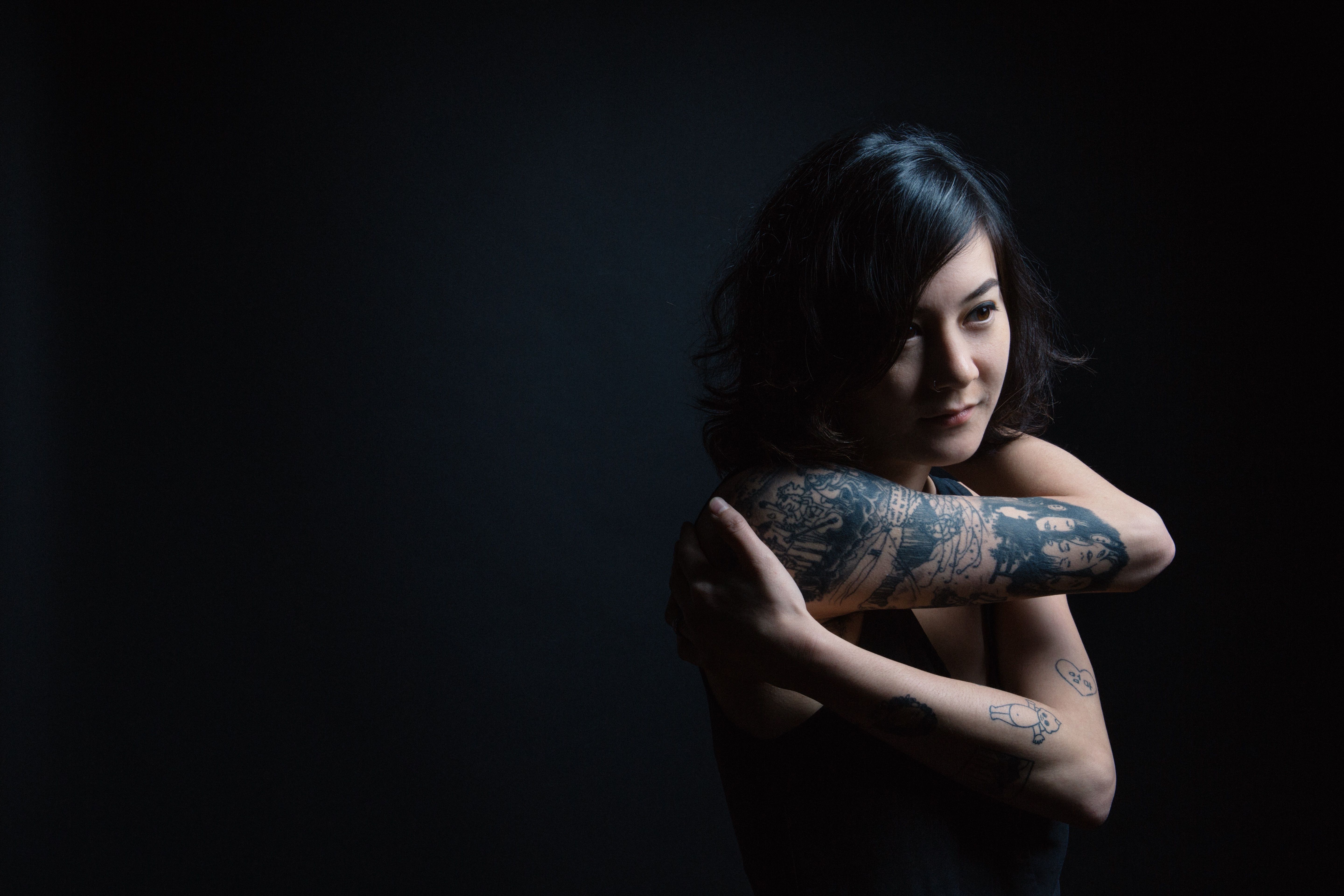
Japanese Breakfast
Now, a year later, Michelle is gearing up to release Japanese Breakfast’s second offering, Soft Sounds From Another Planet. Her newest album is full of dualities, speaking of emotions through technology and of art through discipline – it reflects on the contrasts present in the year right after the release of Psychopomp, in which the happy culmination of 10 years trying to be an artist came hand-in-hand with the strong feelings of grief that were still present in Michelle’s life.
In Soft Sounds, Sci-fi visuals are combined with lyrics describing familiar situations that end up leading to catharsis – an almost imperceptible point of access to feelings that were bubbling just beneath the surface. For Michelle, the explicit connection she makes between technology and humanity is not just about the detachment of modern life that we all can relate to – but also about the way she was, once again, processing her own feelings.
“For that past year [after Psychompomp] I had been very emotionally shut off. I felt like being a caretaker for six months had really made me turn off my emotions, because I was afraid that, if I really allowed myself to feel them I would never climb out of the depression that would come out of that.”
“I think I was relearning how to feel this past year, trying to be less of a robot, less of a machine – remembering how it was to be emotional again.”
Her piano lessons might not have not left much for Michelle in terms of her ability to play, but as far as her artistry goes, being disciplined is still pretty important. Despite dealing with strong emotions and being a very sensitive person, she does not subscribe to the “chaotic creator” tropes. “I don’t wait for inspiration to strike because I think that this is my job, and as such, it’s my job to work at it”, she explains. Michelle tries to write a song a day, and has plenty of rules established for herself, both as a form of creating and as a form of keeping depression at bay.
Ultimately, for Michelle, music is not just a form of expression – but a way of living, feeling and belonging.
“I spent so much of my young adult life feeling really different and feeling misunderstood,” she sighs, as the crowds of tourists start to approach our spot by the garage. I ask what she means.
“You just feel so alone in your experiences you know – as a young person, thinking that you’re the only one that must feel this way, or that you’re the only one who has dealt with death or with illness. And then you finally find these hundreds of people all over the world who come to you and say: ‘I understand you.’”
“It’s really sad, but it’s beautiful that you’re not alone in your pain – you’re not alone in your feelings. There are hundreds and thousands of people in the world who feel the same way. And they were able to find you through your art.”
Soft Sounds From Another Planet by Japanese Breakfast comes out on July 16. You can pre-order it through Michelle’s website.
Enjoyed this article? Like Huck on Facebook or follow us on Twitter.
You might like

Green Man is more than a music festival
Planting roots — For nearly a quarter century, the fiercely independent weekender has been flying the flag for Welsh arts and music. As an ecosystem now bubbles around it, Anna Stafford meets the people who keep the fire burning.
Written by: Anna Stafford

Julian Cashwan Pratt: “We fought security until the cops showed up”
Hard Feelings — The lead singer of Show Me the Body joins Rob Kazandjian’s column on fatherhood and masculinity to talk about mentors, scrapping Zionists at shows, and finally making his father proud.
Written by: Robert Kazandjian

Lost photos from the heyday of punk and new wave
Crash Bang — DB Burkeman’s latest photobook unearths photographs from his younger years as an aspiring music photographer, which sat undeveloped in his family home for decades.
Written by: Miss Rosen

Analogue Appreciation: Xmunashe
Make Yourself At Home — In an ever more digital, online world, we ask our favourite artists about their most cherished pieces of physical culture. Today, it’s elusive freeform explorer Xmunashe.
Written by: xmunashe

Grainy, yearning memories of Europe’s ’90s free rave heyday
Never Alone — A new photobook from Cheyenne Clementi and Valentina Morandi presents pictures they made over seven years while touring the continent as part of the Tekno Mobil Squad soundsystem crew. It archives parties, people and a lifestyle largely consigned to the past.
Written by: Isaac Muk

As Hanoi’s nightlife faces raids & repression, its underground scene modulates
Spaces Between the Beats — Tensions between nightlife and authorities have grown in recent times, as police target venues and their patrons with increasingly frequent drug testing and searches. With clubs becoming hostile spaces as a result, Hanoi’s electronic music community is finding new spaces and forms of expression, reports Martin Guttridge-Hewitt.
Written by: Martin Guttridge-Hewitt


