The British sisters documenting the lives of Syrian refugees
- Text by Marta Bausells

Sisters Georgia and Sophia Scott went into Lebanon in October 2014, literally one day after they finished shooting their first ever documentary, In the Shadow of War, which followed four young Bosnians twenty years after the conflict ended. And they didn’t finish shooting until about a month ago.
Georgia and Sophia have spent most of these two and a half years on the ground in Lebanon, following four Syrians who are among the estimated 1.5 million refugees living in the neighbouring country today, having fled the bloody conflict in their country.
The pair, who’ve founded a production company called Groundtruth Productions, made a point of securing enough funding to work alone and make all the calls. “I’m so lucky to have a best friend, a sister and a work colleague all in one,” says Georgia. The only negative thing about working together, they say, is the potential danger of getting kidnapped or otherwise hurt. “Can you imagine if our mum lost both of us? That would be really shitty.”
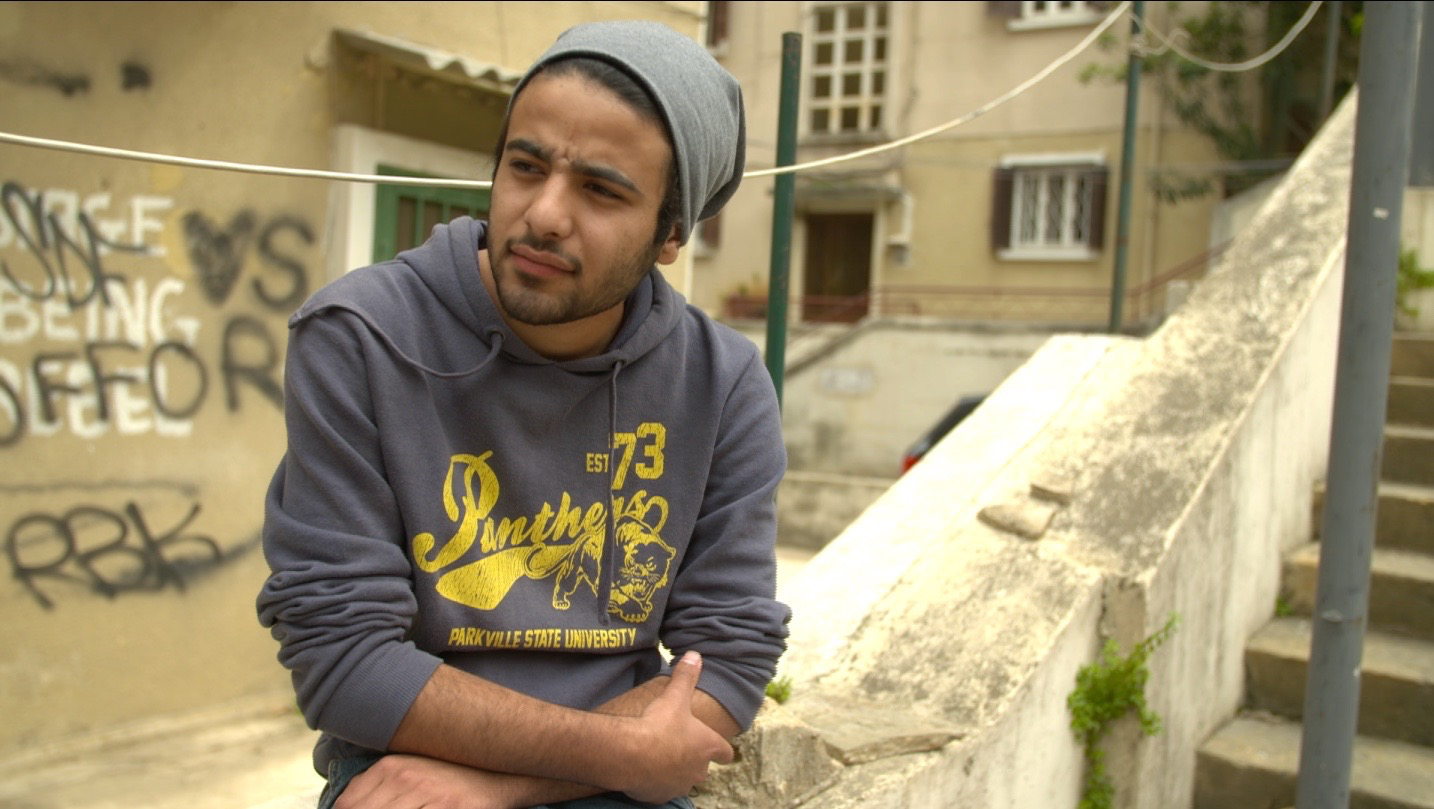
Lost in Lebanon follows four characters, whom the sisters took the time to get to know through the years, and filmed around the country. They travel between the infamous Palestinian refugee camp of Shatila in Beirut to refugee camps in areas of the north where most news outlets don’t even due to because of its proximity with the Syrian border.
 Where did the idea for the film come from?
Sophia: Our first film followed four young people 20 years after the conflict in Bosnia. We wanted to tackle the Syrian conflict next, but obviously it’s a very dangerous place and we wouldn’t have had access to the types of stories that we could actually carry on following all the time, so instead we went to Lebanon, where there are many Syrians.
Georgia: We were also a bit frustrated about how the Syrian refugee crisis was being portrayed in the media, and how our society and the whole world has become a bit immune to statistics and numbers; so we wanted to try and make a film that really got under the skin of things and became very personal.
Did you set out to follow four people again, or do you land on a country and go with the flow?
Georgia: We make films in a very freeing way. We never go with a plan.
Sophia: Actually, following four characters in the short time that a documentary allows is very challenging. There’s a lot to condense. But by having so many characters, there’s more likely to be a character that someone in the audience can identify with.
 The film did achieve that for me as a viewer, almost immediately. It really makes you feel like these people could be you, or your friends or family.
Sophia: We try to take the Syrian conflict away from numbers and news reports, and to put a human face to it and give the dignity back to those individual people. We want to show that conflict can affect any one of us. Identifying with them enables us to feel compassion and feel beyond the news reports that we see of people drowning in the Mediterranean. It can bring it back home.
Georgia: If there’s one thing we wanted this film to do is for the audience to go: ‘Hang on a minute, that young woman could be me.’ Because it’s true.
What’s a moment that is stuck in your memory from these last two years?
Georgia: Whenever I think back at our time there, I remember being so close to the border and being able to hear the distant shelling. It sends a deep dark shiver into your body, and only then can you really imagine – in a tiny way – what it must be like for all those Syrians who are still living in that atmosphere.
But I also remember sitting around having dinner with Sheikh Abdo and his family, up in the north, in their little camp place. It was one of the fondest and nicest moments of my life.
You talk about how the conflict is so misunderstood. Was there anything that surprised you about your own misconceptions?
Sophia: Going into Lebanon and into spending time in the Middle East, we felt that being female might be difficult, that we wouldn’t be accepted into some of the male communities, but in fact it was completely the opposite. We were so very welcomed and completely respected and felt very safe with the Lebanese people and the Syrians that we spent time with, so that was a refreshing attitude shift.
How do you think it will be read, given that it’s coming out in the growing dumpster fire that is 2017?
Georgia: If we ask ourselves the question: can we envision a world without war? The answer, to me, is no. I think it will always be there. So the way forward has to be looking at ways of trying to lessen the destructiveness of conflict. And we, as human beings, have failed epically on all fronts with that.
Sophia: Making a film like this is very timely when we have a threat of terrorism, western countries generating more fear about the other, and everything else. The average Syrian is a friend rather than a foe, and can be a huge asset and a constructive part of society in any country. And if they can’t live in their home because of war, then we have a responsibility to welcome them.
Lost in Lebanon premieres worldwide on 12 and 13 March 2017 as part of the Human Rights Watch Film Festival, London, which runs 6 – 17 March 2017.
You might like

London’s largest indoor skatepark to be demolished for padel courts
Better Extreme — The Barking skatepark’s fate follows that of similar indoor spaces in recent years, with operators GLL citing falling visitor numbers as the reason behind the decision.
Written by: Isaac Muk

Youthful joy & end-of-era poignancy at a London school prom
Leavers — For several years, Lewis Khan documented young people as they celebrated the last of their school days and the completion of their exams. The series is now collated in a new self-published photobook and short film.
Written by: Zoe Whitfield

A major Nan Goldin exhibition is coming to London
You Never Did Anything Wrong — Opening at the Hayward Gallery in November, the show will debut a new film from the artist and activist, alongside a slate of recent work.
Written by: Jack Dennison-Thompson

Burning rubber with the Middle East’s women rally racers
Ripping dirt — Across the Middle East and North Africa, women are increasingly chasing the thrill of speed, competition and freedom that comes with driving on gruelling terrain, as well as podium positions. Roxana Diba speaks to trailblazers of the scene, who are reshaping ideas of what women are capable of behind the wheel.
Written by: Roxana Diba

Joe James: “I will never be absent in my children’s lives because I know it doesn’t feel nice”
Hard Feelings — As the silky MC prepares to release his debut album ‘The Ends Never Ends’, he joins our column on fatherhood and masculinity to discuss leaving his childhood home at 16, the manosphere and his risk-embracing approach to life.
Written by: Robert Kazandjian

Sepia splashed memories of Britain’s ’90s squatting and free party scene
Bygones — Moving into a Hackney squat at the age of 19, Tom Hunter spent years living on London’s edges, while documenting the vibrant, creative community and culture that it enabled. Huck’s art director Sam White chats to him about the freedom that existed, the collectivism and what’s been lost over the decades since.
Written by: Samuel White


