Susan Meiselas: A life in groundbreaking photography
- Text by Susan Meiselas (as told to Cian Traynor)
- Photography by Susan Meiselas / Magnum Photos

I think one of the things that becomes evident looking back through my career is a focus on relationships that get built very much over time.
It’s an acknowledgement of the relationships outside the images: when I know more than what the photographs might reveal, I want to find layers and different approaches to complement them.

Self-portrait, 44 Irving Street, 1971.
That began early on with 44 Irving Street [1971], when I made portraits of my neighbours in the boarding house where I lived, then I asked them to write about how they saw themselves in the pictures.
With Carnival Strippers [1972-1975], I spent three summers photographing and interviewing women [who performed striptease at carnivals in New England, Pennsylvania and South Carolina] without necessarily maintaining the same relationships with the same girls over that time.
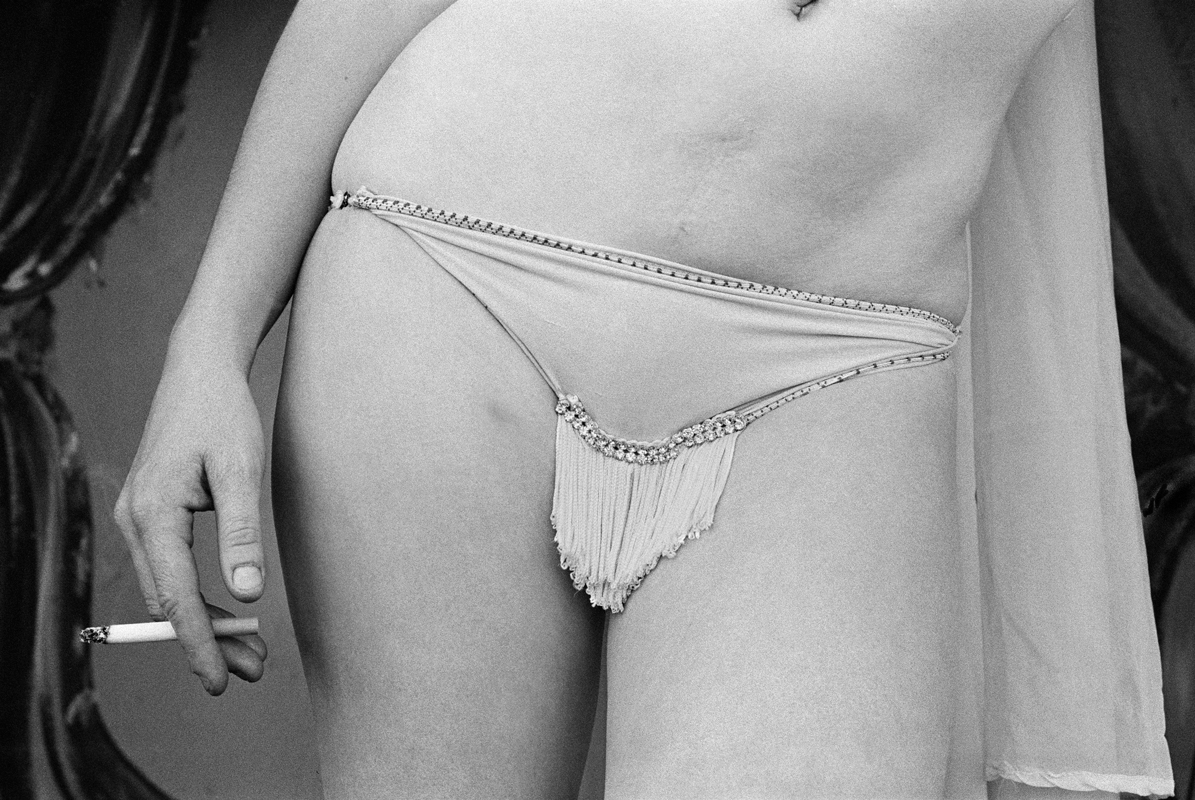
Shortie on the Bally. Vermont, 1974.
But by also interviewing boyfriends, show managers and customers, there’s a collaging of voices where I’m trying to reveal the power network around them.
With Prince Street Girls [1976-1979], I am in my own neighbourhood [in downtown Manhattan], fascinated by the relationships between these young girls, watching them become women over a longer period of time.
I didn’t study the history of photography before I became a photographer. They didn’t teach it then and I didn’t even self-identify as one initially. When I was 19, I travelled around the world for a year as part of a large group of students and got to live with a Japanese family for two months, then an Indian family, a Turkish family, a Yugoslavian family.

Carol, JoJo and Lisa hanging out on Mott Street, 1976

Dee, JoJo, Frankie and Lisa after school on Prince Street, NYC, 1976.

Roseann on the way to Rockaway Beach, 1978.
It’s not that I wanted to be a world traveller who just dipped and dived through cultures; I had taken a course in anthropology and I think I was still trying to give shape to my interests. Those very primary experiences of diversity led me to be more curious about the world, putting me into a certain mode of exploration and openness to difference at a young age.
When I look at the work now, I realise there’s a dichotomy between some of the early portraiture, where there’s still that feeling of awkwardness or being less comfortable with street photography, and the more reportage work where I’m happily immersing myself and capturing the dynamic of interactions that I’m not part of.
I think you really see that progressing into Nicaragua or El Salvador: I’m very interested in the frame, capturing a multifocal viewing of what’s happening in front of you.

Children watch the training of Nicaragua’s National Guard at the EEBI (Basic Infantry Training School), Managua, 1978.
The picture that’s best known from Nicaragua is the one of the three masks with contact bombs, but I feel like they made that image for me. It was a very particular situation where a local journalist brought me to this clandestine network and I think the unusual circumstances were part of the setup, as it were.
To be trusted in a place where others were at risk was a very important aspect of what lies behind or around that photograph. Still, there’s a performative quality to it. In today’s culture, they probably would have made it for themselves and put it on Instagram. But there are other images in that sequence where I don’t think they saw what I was seeing.
In one picture, for instance, there was something about the way a woman behind a mask placed her hand on some barbed wire that, to me, felt like a very intuitive moment.

A Traditional Indian dance mask from the town of Monimbo, adopted by rebels fighting against Nicaraguan dictator Anastasio Somoza Debayle in order to conceal their identity, 1978.
There are always people who choose to define you in one way or another. First I was the woman who photographed women, then I was a war photographer because I photographed war. “That’s photojournalism; that’s not documentary.” I saw myself more as just being a photographer in different kinds of settings using multiple platforms.
Now I’m considered an art photographer because the pictures are on the walls. I feel like I cross all those boundaries and yet I’m not particularly interested in them; I don’t think they’re useful when you make work.
For me, the more interesting question is how the work changes when it circulates, when it’s expressed in different forms. ‘Molotov Man’ is the famous example of that.

‘Molotov Man.’ Sandinistas at the walls of the Esteli National Guard headquarters, Nicaragua, 1979.
You’re seeing the life of an image go through multiple stages, evolving from what I captured and documented to become a symbol of what it represented – the Sandinista revolution – and how it continues to raise questions in a dynamic way that I never anticipated.
So when I take a photographic book back to Nicaragua, looking for the people in the images years later, it’s like a search to understand the act of a photograph and its existence over time.
This is all still based on intuition for me. I don’t know the outcomes of the process that I commit to. I’m not sure I want to either, as that becomes a little mechanical. Instead I like letting the path unfold, giving shape in a way that I can’t fully anticipate.

Note to Meiselas from Prince Street girls.
Susan Meiselas / Magnum Photos
This article appears in Huck 67 – The Documentary Photography Special VI. Buy it in the Huck Shop or subscribe now to never miss another issue.
Enjoyed this article? Like Huck on Facebook or follow us on Twitter.
You might like

In photos: Black Texas life since emancipation
Kinship & Community — A new photobook and exhibition showcases the rich culture, history and community of African American folks in the Lone Star State, whose existence in the region predates colonial Britain.
Written by: Miss Rosen

Youthful joy & end-of-era poignancy at a London school prom
Leavers — For several years, Lewis Khan documented young people as they celebrated the last of their school days and the completion of their exams. The series is now collated in a new self-published photobook and short film.
Written by: Zoe Whitfield

Harry Gruyaert’s vintage, kaleidoscopic scenes of New York
A Sense of Place — For 50 years, the Belgian photographer and Magnum Photos member has been capturing NYC’s colourful chaos. A new photobook and exhibition showcase his unique, technicolour view of the city.
Written by: Miss Rosen

In the pit at one of the UK’s last stock car & banger speedways
Stock Car Racing Isn’t Dead — Photographer Liam McCarthy spent time in and around the Arlington Raceway’s circuit, capturing the diehard community that keeps the sport alive.
Written by: Isaac Muk

Inside Lower Duck Pond, the nicest town on the internet
/r/HaveWeMet — With a population of 2,500 and no fixed location, the subreddit is a space for roleplaying citizens to solve mysteries, host fictional events and ultimately connect. In an internet that’s often divided and toxic, Vicky Jessop hangs out in one of its most wholesome corners.
Written by: Vicky Jessop

A major Nan Goldin exhibition is coming to London
You Never Did Anything Wrong — Opening at the Hayward Gallery in November, the show will debut a new film from the artist and activist, alongside a slate of recent work.
Written by: Jack Dennison-Thompson


