Asia’s first major LGBTQ exhibition is opening this week

In a historical move, the Museum of Contemporary Art, Taipei will be the first major-scale public institution in Asia to host an art exhibition entirely focused on the history and struggles faced by the continent’s LGBTQ community.
Spectrosynthesis – Asian LGBTQ Issues and Art Now has been in the works for over two years, and will showcase 51 creations by 22 artists hailing from Taiwan, Singapore, China and Hong Kong, as well as Chinese-American artists based in North America.
The MOCA Taipei website explains: “The exhibition represents the life stories and related issues of the post-war Chinese LGBTQ community as the artworks on view touch upon a profusion of subject matters such as identity, equality, exploitation by mass media, social predicaments, comments on individuals/groups, human desire, as well as life and death.”
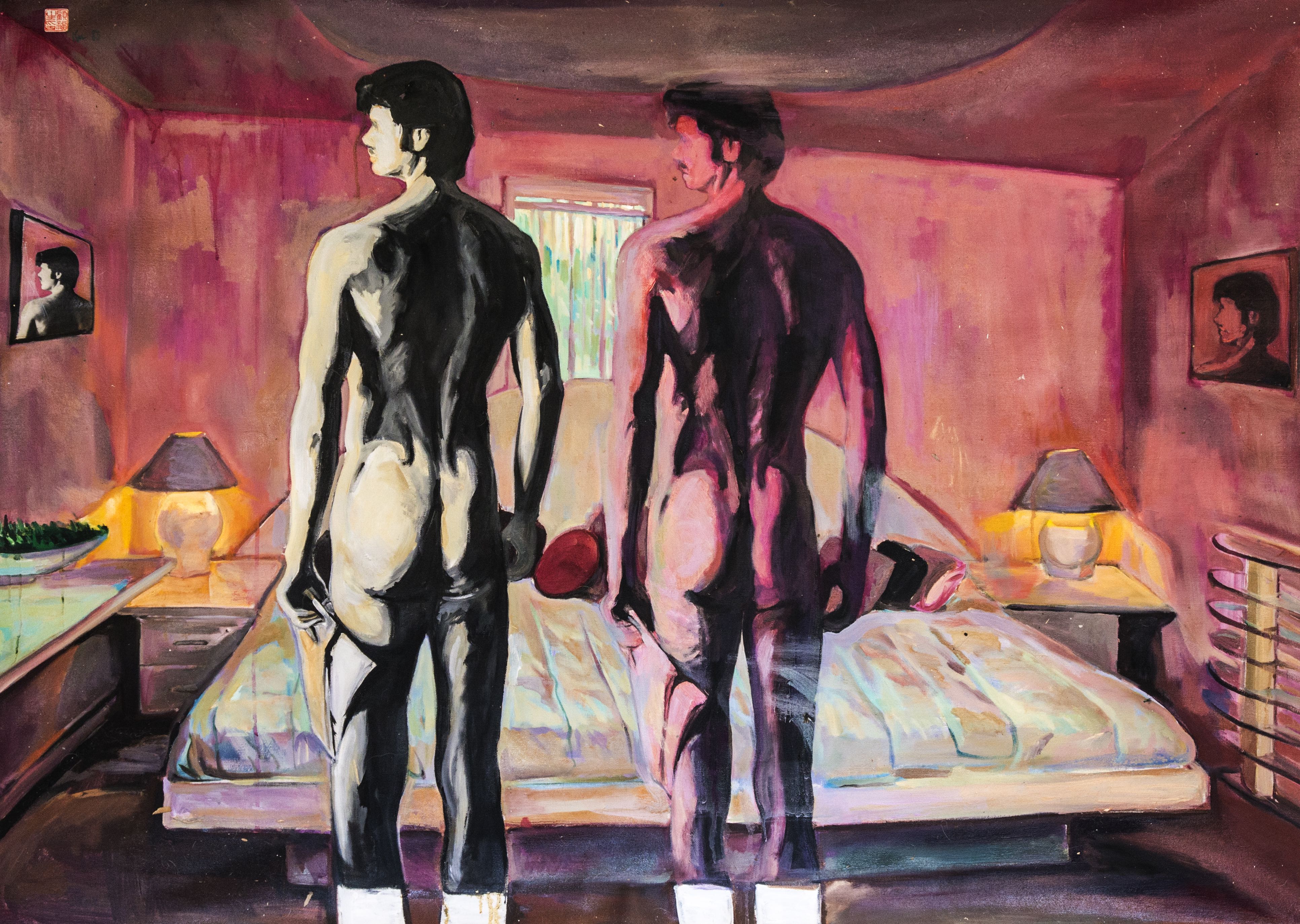
Ku Fu-sheng, “The Room at the Top of the Stairs”, 1983. Courtesy of MOCA Taipei.

Ming Wong, “Life and Death in Venice” (Video), 2010. Courtesy of MOCA Taipei
The opening of the Spectrosynthesis is taking place only four months after a landmark ruling in the country that determined the then-current marriage laws that failed to acknowledge the rights of same-sex couples to be unconstitutional. This ruling has put Taiwan on its way to becoming the first country to legalise gay marriage in the continent. The exhibition will also coincide with Taipei’s Pride parade, which attracted an estimated 80,000 people last year alone.
The event is co-organised by the Sunpride Foundation, a non-profit organisation with an extensive collection of LGBTQ artwork, based in Hong Kong. Sunpride seeks to positively expand the conversation about LGBTQ rights within both the art world and the wider social context, on a local and global capacity.

Jimmy Ong, “Heart Sons”, 2004. Courtesy of FOST Gallery and MOCA Taipei
In his statement, curator Sean C. S. Hu affirmed that the intention is to bring the exhibition to more countries within the continent following its debut in Taipei.
The highlighting of Asian LGBTQ artists and history in such a respected mainstream platform will hopefully assist in pushing the conversation of representation, respect and acceptance forward, helping with the de-stigmatisation of queer expression in a continent where the battle is far from won.
“We hope that this exhibition, by virtue its divergence in values and ideas, would create a rippling effect on other Asian societies in terms of value, ideas and thoughts regarding the issues of gender diversity,” reads Sunpride’s curatorial statement.
“Just like photosynthesis used by plants to sustain life, this exhibition attempts to liberate people’s thoughts and value systems from the rigid and deep-rooted biases against LGBTQ people by providing a space for mutual-gazing and understanding between both sides. In sum, the whole task is fundamentally based on the expectation of human equality with love as the point of departure.”

Jun-Jieh Wang, “Passion” (Video Installation), 2017. Courtesy of MOCA Taipei.

Samson Young, “Muted Situations #5: Muted Chorus” (Video), 2014. Courtesy of MOCA Taipei.

Tseng Kwong Chi, “San Francisco, California (Golden Gate Bridge)”, 1979. Courtesy of MOCA Taipei.
Spectrosynthesis – Asian LGBTQ Issues and Art Now is on at the Museum of Contemporary Art Taipei from September 9 until November 5, 2017.
Enjoyed this article? Like Huck on Facebook or follow us on Twitter.
You might like

Jesse Glazzard’s messy portrait of queer friends, lovers and chosen family
The Sound of Dirt and Beauty — The photographer’s debut monograph explores tender, unpolished moments shaped by the people who he surrounds himself with, while offering a window into the UK’s working-class LGBTQ+ community.
Written by: Sunny Sunday

Kristina Rozhkova’s scatty, confronting portrait of captivity
Gut Feeling — The Russian artist’s 2024 arrest and subsequent detention opened her eye towards the omnipresent dynamics of power and control. Her new photobook is a stark exploration of being trapped.
Written by: Isaac Muk

Washing strangers’ feet at Houghton Festival
Pedilavium — As part of artist Henry Krokatsis’s performance piece at the weekender, we sat down with over 30 others to clean the dusty digits of passersby, while reflecting on the power of collective ritual and human connection.
Written by: Isaac Muk

Surveying community and resistance in LGBTQ+ nightlife
Sex, Clubs Dissent — A new book collates queer nightlife photography over the past 50 years, and the people who found refuge and safe spaces after dark.
Written by: Miss Rosen

The anti-tourism guides revealing Lisbon’s true, radical heart
We Hate Tourism Tours — The Portuguese capital sees millions of people visit a year, against a backdrop of political turbulence and a housing crisis fuelled by short term holiday lets. Jack Burke meets the crew subverting their city’s perception, while bringing lesser seen stories and monuments to light.
Written by: Jack Burke

The art of paying attention: How Austria’s Alps reward slowing down
Lebensgefühl — With a growing movement of art and music rooted in the area’s mountains, trees and waterfalls, the region is showcasing the importance of the human relationship to nature.
Written by: Sophie Lou Wilson


