Mohamedou Ould Slahi on his 14 years inside Guantánamo
- Text by Beth Webb
- Photography by still from The Mauritanian, credit Graham Bartholomew/STX Films

In the second half of December, Barack Obama releases a list of his favourite films of the year. It’s intended as a celebration of artistic talent, but this year, a new Hollywood film will undoubtedly bring new weight to the annual tradition – whether it makes the list or not.
The Mauritanian is adapted from Mohamedou Ould Slahi’s biography Guantánamo Diary, which offers a devastating account of the author’s life inside of the notorious detention camp. In July 2002, Slahi – who authorities had believed to be associated with Al-Qaeda – was stripped, shackled, and flown from a prison in Jordan to Guantánamo Bay. He would be held there for 14 years without charge. His order for release in 2010 was appealed by the Obama administration, and resulted in another six years in the camp.
Today Slahi, who is now 50, resides back home in Mauritania, though he is far from free. The years of physical and psychological torture that he endured under the U.S. military’s special interrogation plan have ended, but Slahi is still denied entry to most countries on account of his imprisonment, including Germany, where his wife and son live.
On the day that we speak just ahead of the film’s release – which stars A Prophet’s Tahar Rahim as Slahi – the former prisoner has received a visit from his young son, who sits on his lap and eats peanuts, blissfully unaware of the trauma that his father has endured.
Upon returning home to Mauritania you were denied a passport. What is your current situation?
The only country outside of Mauritania and Senegal that has granted me a visa was South Africa. The UK and Europe are off-limits.
How do you feel about that?
I don’t think that it’s healthy that the west listens to everything that the United States says without a mind of their own. They don’t know me, and I find it frustrating that there’s no investigation, nothing. It means that I can’t visit my wife and son in Germany, they can only come to visit me.
What were your first thoughts when you heard that your story was being considered for a Hollywood film?
When you hit rock bottom, I feel that you have nothing to lose. This whole operation that I was involved in shows Muslims and Arabs to be faceless people. The worst of the worst. The fact that I could write this book and smuggle it out, and for it to be made into a movie with A-list actors, is proof that the pen is mightier than the sword.
Does it feel significant to you that Hollywood has made a film with a leading character who is Muslim?
I don’t like to divide the world between Muslims or Christians or Buddhists. I think we’re all human beings, and I consider myself a global citizen. There was a book in the 1990s called Clash of Civilisation by Samuel P. Huntington that brackets those worlds into western and non-western civilisations. In those brackets, you are a westerner, and I am a Muslim, but that’s so untrue. You are also a female, and you might be a feminist. You might be gay, or not gay, or religious, or not religious. There are so many identities that you carry around that it would be unfair to put you into one bracket. You might have more in common with a person in India than the person who lives next door to you.
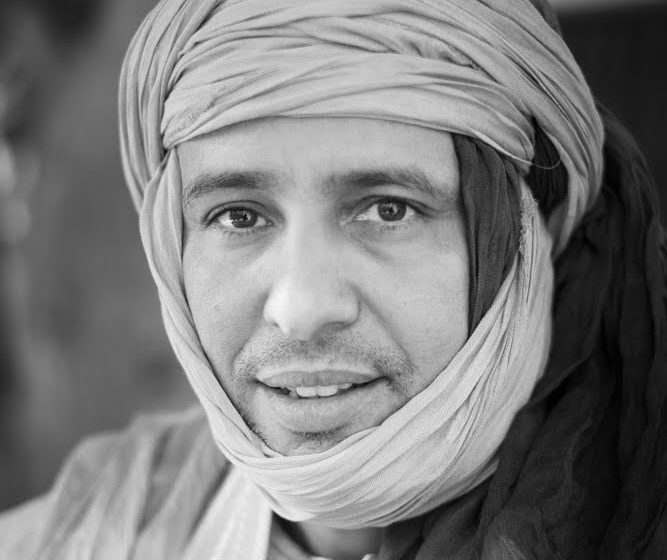
Photo of Mohamedou Ould Slahi
What was the process of getting your book out into the world like?
I wasn’t allowed paper or pens in Guantánamo and so I would steal them and then write and write. Once I’d found my voice, I wrote 160 pages, and when they were passed to my lawyers, they told me to keep going. But not a single word could be shown to the public, and so for eight years, I was fighting for my voice to be heard. Finally, thank god, it came out. It felt like freedom to me, even though I was still in prison and couldn’t read the book myself.
How were you hoping to use your story to change people’s perceptions of Guantánamo Bay?
When I decided to share my story, I made myself very vulnerable. I don’t have a country like the UK to protect me. I write and talk about my experiences though because this has to stop. It’s not just happening in Guantánamo Bay; people in Arab countries, the Middle East and Africa are also taken without due process. Dictators are having people kidnapped and tortured.
President Obama’s administration filed a notice of appeal for your release which kept you in Guantánamo for over six more years. Do you know if President Obama has seen the film?
I wanted to WhatsApp him and tell him to watch the movie. I can see that he has a passion for public service and activism, but the President of the United States only has so much power. You have congress and you have the judiciary, and most importantly you have the interest groups. It takes courage to say: “I’m going to use my power to do good things.” To step outside of that zone. He had the CIA, the FBI, and homeland security all coming to him and telling him how to respond. He did not have the courage to do the right thing, unfortunately.
How are you hoping that your story will invoke change?
Before I die, I want my sons, my nieces, my nephews, to have the same rights as you. I don’t want them to be put in prison because they said shit. I don’t want them to be captured or kidnapped or tortured. That’s my dream.
Follow Beth Webb on Twitter.
Enjoyed this article? Like Huck on Facebook or follow us on Twitter.
The Mauritanian is available to stream on Amazon Prime from April 1.
You might like

In photos: Black Texas life since emancipation
Kinship & Community — A new photobook and exhibition showcases the rich culture, history and community of African American folks in the Lone Star State, whose existence in the region predates colonial Britain.
Written by: Miss Rosen

Youthful joy & end-of-era poignancy at a London school prom
Leavers — For several years, Lewis Khan documented young people as they celebrated the last of their school days and the completion of their exams. The series is now collated in a new self-published photobook and short film.
Written by: Zoe Whitfield

A major Nan Goldin exhibition is coming to London
You Never Did Anything Wrong — Opening at the Hayward Gallery in November, the show will debut a new film from the artist and activist, alongside a slate of recent work.
Written by: Jack Dennison-Thompson

Tender portraits of women serving life sentences in America
Looking Inside — While working as a public defender attorney in New York State, Sara Bennett found dilapidated prisons and forgotten people. Her new photobook harnesses the power of images and shines a humanising light on those imprisoned for serious crimes and their reintegration into society, while asking questions of the USA’s incarceration system.
Written by: Miss Rosen

The real life mermaids of Florida’s Weeki Wachee Springs
Old Florida — A relic of pre-Disney tourism in the state, the show – which sees women perform athletic underwater tricks in a natural spring – has been running since 1947. Jack Burke attends, while reflecting on the fragility and fantasy of old America.
Written by: Jack Burke

Road tripping across 1970s America
73 Trip West — In 1973, Larry Racioppo set out from Brooklyn to California, armed with a medium format camera. For the first time in over half a century, roadside photographs from his trip have been unearthed.
Written by: Miss Rosen


