The music video stripping back the Black British experience
- Text by Angel Lambo
A centrepiece of red peppers, yams and coconuts interrupts what might otherwise have been a rather quaint English afternoon tea. The exotic mingles with the traditional as porcelain cups are drawn to ivory lips. Brother Portrait, the artist behind the music, forks a plate of Jollof rice and looks at his guests as they acknowledge that all is not quite right with this scene.
The latest collaboration between London poet Hadiru Mahdi aka Brother Portrait and artistic director Nadira Amrani smacks of art house storytelling in its portrayal of the “Black” experience in 21st century Britain.
Black Britain is not a new topic, but it is in vogue. Since the opening of the Black Cultural Archives in south London there have been a wave of exhibitions, documentaries and commentaries about the history of people of colour this side of the Atlantic.
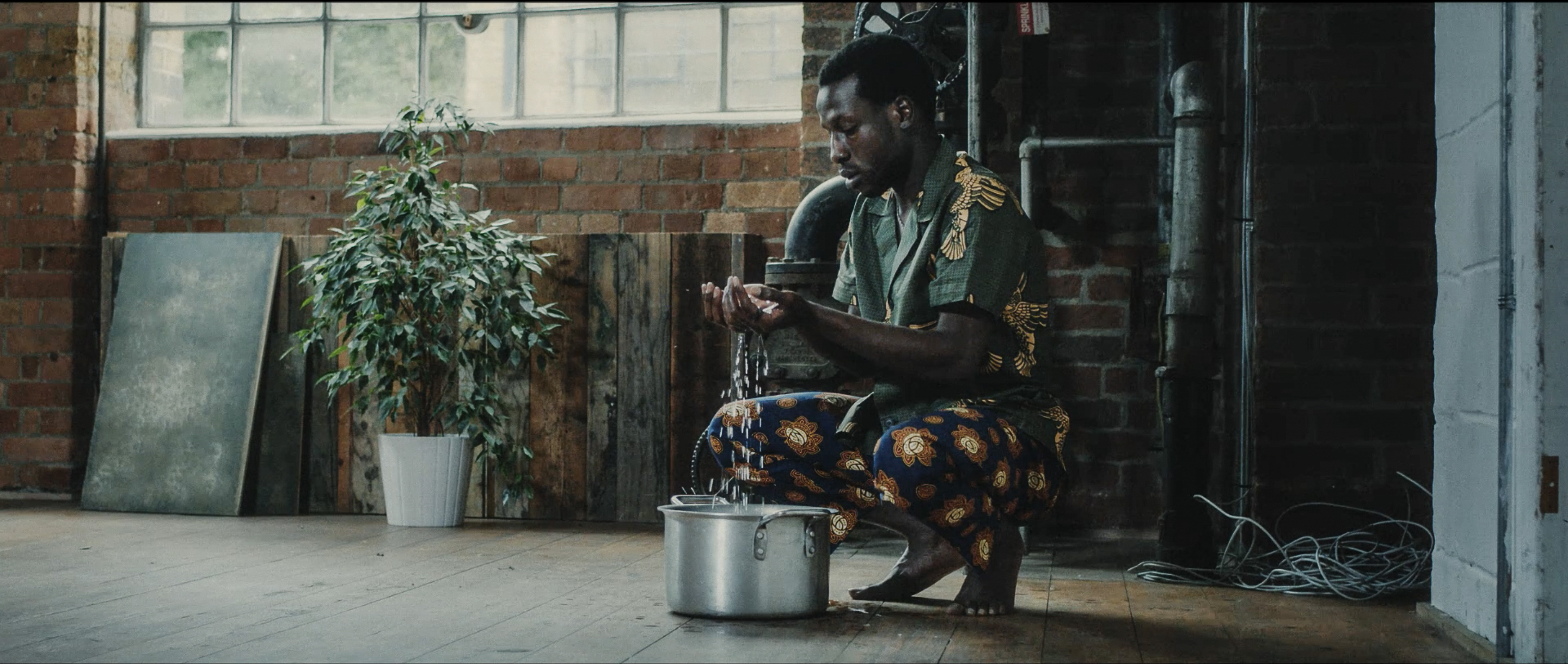
Seeview/Rearview pulls the veil off our perceived notions of cultural identity as an audience witnesses an artist waking up to the reality around him. “Looking back on your life is like looking through another lens,” Hadiru says. “The things our parents were shielding us from altered our experience of growing up in a multicultural Britain.”
As major cities wave the flag of tolerance, diversity and liberal consciousness people still fail to realise that being a person of colour is not a homogenous experience. Hadiru uses clothing to express his multi-faceted existence: He enters as the suit-wearing dandy, changes into a traditional West African dashiki and kneels in an Arabic kaftan.
“In the course of an hour I can have a very African experience while also having a very London one,” he continues. “I want to show all of those sides of me without it being remarkable. From Freetown in Sierra Leone to London I have grown up wearing these clothes. These identifiers are not a costume. These patterns and colours are the way of the world.”
In a time of #blackgirlmagic and #melanninpoppin, in a time where people of colour must be their own cheerleaders Hadiru illustrates that society makes it difficult to embrace both a British identity and their Caribbean or African roots without being a contradiction to themselves. “Living in London we’re all accepting of multiculturalism but we never actually share each other’s cultures.”
Hadiru hopes that his video doesn’t get overlooked in the same way that the Black British experience has been: “From the Blues to Hip Hop, audiences have always enjoyed the end product. They love to sing along and they love to dance to our beats, but they don’t embrace the hardship. They love the glitter on the pain because we make it bearable. In art and music what’s created is undoubtedly beautiful but there’s no attempt to comprehend the history behind the experience.”
Seeview/Rearview speaks as loudly as any other campaign this year and addresses the continual dichotomies and personalities that people of colour must face in their day to day.
We may think in technicolour but our language is still black and white and this leaves many second and third generation immigrants in a perpetual state of limbo. Unable to relate to a culture they have inherited, unable to identify with the history of the country they’re in today.
Enjoyed this article? Like Huck on Facebook or follow us on Twitter.
You might like

Green Man is more than a music festival
Planting roots — For nearly a quarter century, the fiercely independent weekender has been flying the flag for Welsh arts and music. As an ecosystem now bubbles around it, Anna Stafford meets the people who keep the fire burning.
Written by: Anna Stafford

Julian Cashwan Pratt: “We fought security until the cops showed up”
Hard Feelings — The lead singer of Show Me the Body joins Rob Kazandjian’s column on fatherhood and masculinity to talk about mentors, scrapping Zionists at shows, and finally making his father proud.
Written by: Robert Kazandjian

In photos: The enduring resistance of Notting Hill Carnival
Carnival of Resistance — A new photobook by Wayne Campbell and Wayne Crichlow reflects on the protest beginnings of Europe’s biggest street festival, along with the traditions keeping its original spirit alive today.
Written by: Isaac Muk

Lost photos from the heyday of punk and new wave
Crash Bang — DB Burkeman’s latest photobook unearths photographs from his younger years as an aspiring music photographer, which sat undeveloped in his family home for decades.
Written by: Miss Rosen

Analogue Appreciation: Xmunashe
Make Yourself At Home — In an ever more digital, online world, we ask our favourite artists about their most cherished pieces of physical culture. Today, it’s elusive freeform explorer Xmunashe.
Written by: xmunashe

Grainy, yearning memories of Europe’s ’90s free rave heyday
Never Alone — A new photobook from Cheyenne Clementi and Valentina Morandi presents pictures they made over seven years while touring the continent as part of the Tekno Mobil Squad soundsystem crew. It archives parties, people and a lifestyle largely consigned to the past.
Written by: Isaac Muk


