Protest artist arrested after setting fire to Paris Bank
- Text by Niall Flynn

The Russian protest artist Petr Pavlensky has been arrested after setting fire to the Banque de France in Paris.
The blaze, started during the early hours of Monday morning, was part of a protest performance in response to the “economic system in Europe.” In a statement, Pavlensky – who has been residing in France after fleeing Moscow in January – called for a “great French revolution” in order to bring down the financial system, denouncing the “bankers (who) took the place of the monarchs.”
“The Bastille was destroyed by the rebels,” the artist said in a statement. “The people destroyed her as a symbol of tyranny and power. On the same place, a new home of slavery was built… The Bank of France has taken the place of the Bastille, the bankers have taken the place of the monarchs… The rebirth of the French Revolution will set off the fire of worldwide revolution.”
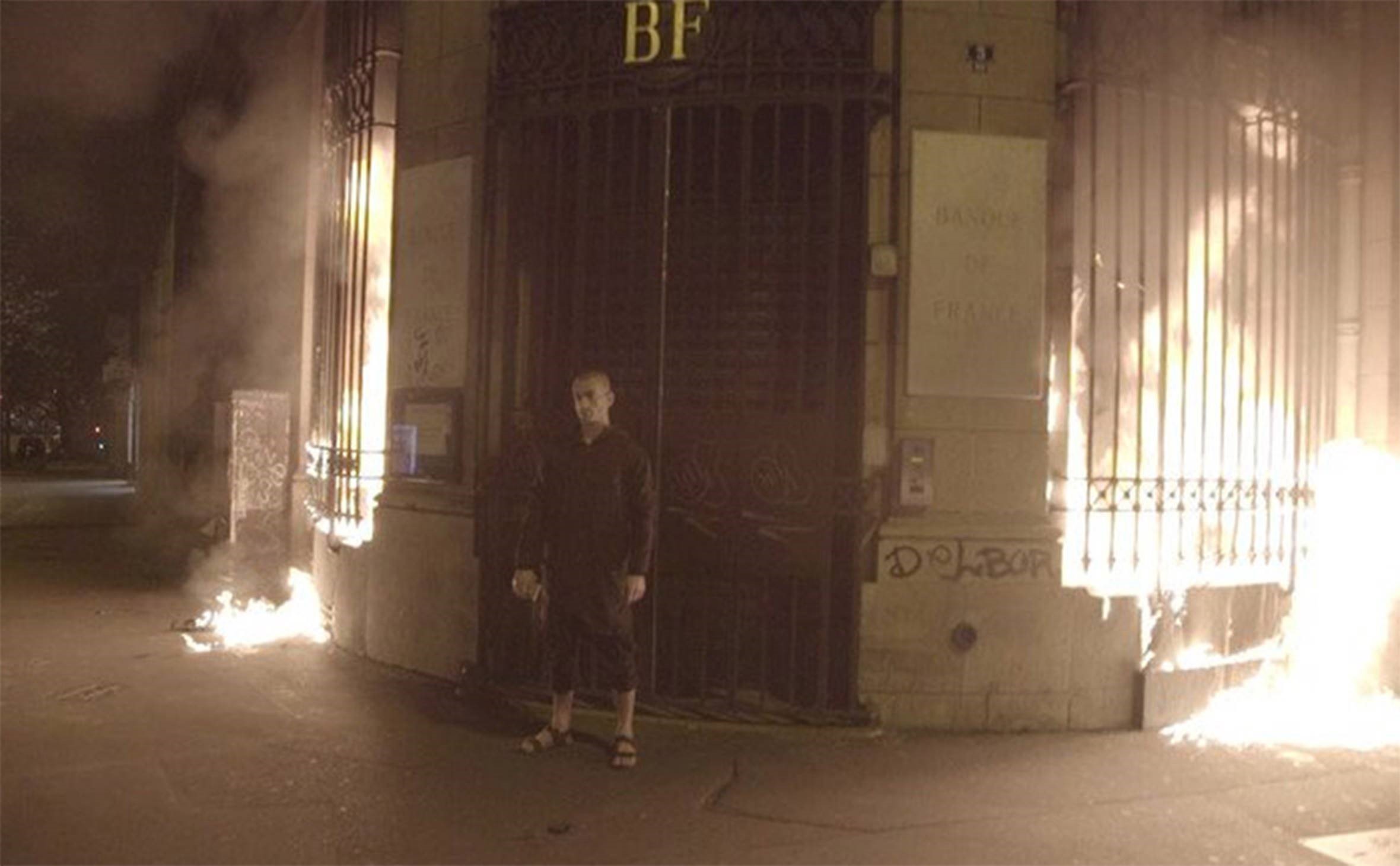
Petr Pavlensky in front of the Banque De France
The 33-year-old artist first gained notoriety in 2012 after sewing his mouth shut in protest against the incarceration of activist punk group Pussy Riot. Subsequent performances have seen him wrap himself in barbed wire, nail his scrotum to Red Square in Moscow and slice off his earlobe while sitting naked on the roof of the infamous Serbsky Center. He left Moscow for Paris at the beginning of 2017 after he and his partner Oksana Shalygina were accused of sexual assault – an allegation he denies.
The first ever exhibition of Pavlensky’s work is set to run at the Saatchi from 16th November – 31st December 2017, as part of Art Riot: Post Soviet Actionism at the Saatchi gallery.
Enjoyed this article? Like Huck on Facebook or follow us on Twitter.
You might like

Kristina Rozhkova’s scatty, confronting portrait of captivity
Gut Feeling — The Russian artist’s 2024 arrest and subsequent detention opened her eye towards the omnipresent dynamics of power and control. Her new photobook is a stark exploration of being trapped.
Written by: Isaac Muk

Washing strangers’ feet at Houghton Festival
Pedilavium — As part of artist Henry Krokatsis’s performance piece at the weekender, we sat down with over 30 others to clean the dusty digits of passersby, while reflecting on the power of collective ritual and human connection.
Written by: Isaac Muk

Tens of thousands gather to remember Jason Arday at London vigil
Stand Up to Racism — It took place in Trafalgar Square, with speakers paying tribute to the former Cambridge professor’s life and achievements, while calling for accountability over the reporting he faced from the mainstream press.
Written by: Ella Glossop

The anti-tourism guides revealing Lisbon’s true, radical heart
We Hate Tourism Tours — The Portuguese capital sees millions of people visit a year, against a backdrop of political turbulence and a housing crisis fuelled by short term holiday lets. Jack Burke meets the crew subverting their city’s perception, while bringing lesser seen stories and monuments to light.
Written by: Jack Burke

The art of paying attention: How Austria’s Alps reward slowing down
Lebensgefühl — With a growing movement of art and music rooted in the area’s mountains, trees and waterfalls, the region is showcasing the importance of the human relationship to nature.
Written by: Sophie Lou Wilson

Queer resistance & sun-soaked solidarity at the world’s largest trans pride march
Our Future, Our Fight — Over the weekend, over 150,000 people marched at the London Trans+ Pride, with the parade ending at Trafalgar Square for the first time in history.
Written by: Ella Glossop


