Photographer Diàna Markosian is raising funds for Armenian genocide survivors
- Text by Andrea Kurland
- Photography by Diana Markosian

The refugee crisis unfurling across Europe may feel unprecedented in form and scale, or unlike anything our generation has seen before. But the story of displacement – of being driven from your home – traces a dark arc back through time.
In 1915, untold thousands of people fled present-day Turkey to escape the Armenian genocide. The Ottoman government had embarked on the “systematic extermination” of the Armenian minority, whose historical homeland sat within the Ottoman Empire. Intellectuals and men were rounded up and killed, and everyone else – women, children, the elderly and frail – were sent on death marches into the Syrian desert. History failed to document their lives; between 800,000 to 1.5 million people were killed. But there are stories of survival.
A hundred years on, Armenian-American photographer Diàna Markosian has connected with three survivors living in Armenia and re-embedded their names in history. Yepraksia Gevorgyan, Movses Haneshyan and Mariam Sahakyan fled their homes as children, but their homeland never really left them. Telling their story posed a particular type of challenge, so instead of simply documenting their present lives Diàna found a way to reconnect the three survivors with the warmer moments of their pasts.

Mariam Sahakyan, 101, was born in Sason, Turkey, which was a major site of massacres. She escaped to Syria with her mother and older brother, whom they dressed as a girl for safety.
“When I told each of the survivors I was going to visit their former homes in Turkey, they asked me to fulfil a wish,” says Diàna. “Movses, from Musa Dagh, wanted me to find his church and leave his image there. Yepraksia, from Kars, asked me to find her older brother whom she was separated from after the genocide. Mariam, from Sason, requested a handful of Turkish soil for her to be buried in.”
Those personal histories came together as 1915, a photography project that saw Diàna travelling to and from Turkey to make images of each survivor’s former home. Today, those photographs hang on the three centurion’s walls, like a window facing back through time. But Diàna is determined to affect some kind change that can pull them forward, too.

Yepraksia Gevorgyan, now 110, escaped by crossing the river to what is now present-day Armenia. She watched the Ottomans kill the Armenians, throwing their bodies into the water, which she described as “red, full of blood.”
“I wanted to give back in some way, but was unsure of how to go about it,” she explains. “I decided to launch a print sale because it’s the one thing I could do as a photographer to help these individuals who have lived most of their life unnoticed.”
The sale, launched in partnership with London-based photo lab Genesis Imaging, consists of five prints in limited-edition runs of ten. Diàna hopes to raise $10,000 for each survivor and their families, in the hope that they may live out their final years with more than just basic necessities.
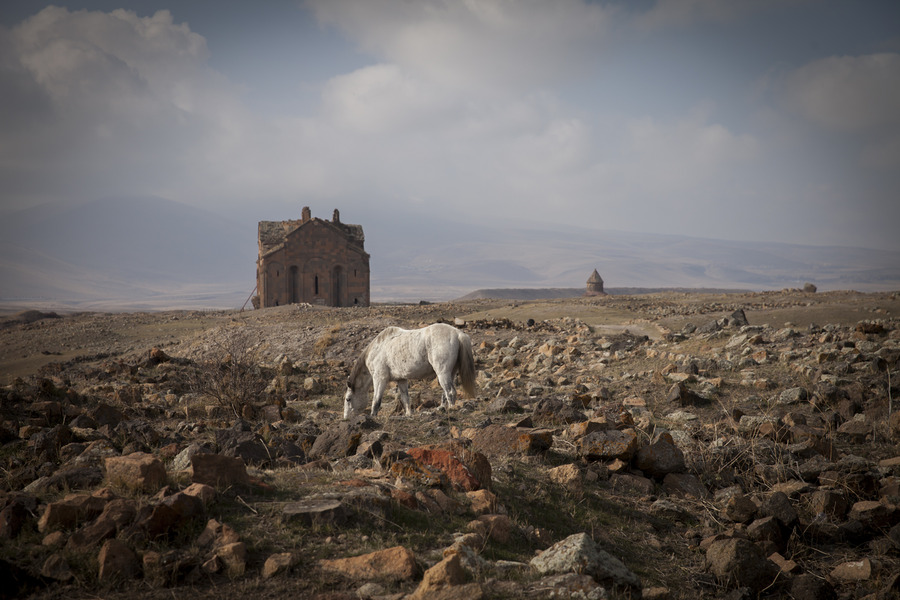
Once the capital of an ancient Armenian Kingdom, Ani, was known as the “city of 1,001 churches.” After the genocide, Turkey cut Armenia from its history, with no mention of who built or inhabited it. Today, the city remains abandoned, apart from the occasional presence of Turkish border guards.
“So much of our profession is about taking — and I found myself in a rare position, where my role shifted from photographer to active participant,” says Diàna. “I think this is the first time I am seeing my own photography change the lives of those who I profiled. I noticed the impact when I delivered the backdrops of their homelands, but then I followed up with them last week, and found that each of the survivors had pasted it in their bedroom. It really moved me. I felt like I had done something worthwhile. Perhaps it is just for a tiny amount of people, but at least I’ve had some sort of impact, which is a lot more than I could have said a few years ago about my work.”
Support the fundraising drive here and read the full story behind Diàna Markosian’s 1915 project in Huck 52 – The Documentary Photography Special III.
You might like

In photos: Black Texas life since emancipation
Kinship & Community — A new photobook and exhibition showcases the rich culture, history and community of African American folks in the Lone Star State, whose existence in the region predates colonial Britain.
Written by: Miss Rosen

Youthful joy & end-of-era poignancy at a London school prom
Leavers — For several years, Lewis Khan documented young people as they celebrated the last of their school days and the completion of their exams. The series is now collated in a new self-published photobook and short film.
Written by: Zoe Whitfield

Harry Gruyaert’s vintage, kaleidoscopic scenes of New York
A Sense of Place — For 50 years, the Belgian photographer and Magnum Photos member has been capturing NYC’s colourful chaos. A new photobook and exhibition showcase his unique, technicolour view of the city.
Written by: Miss Rosen

In the pit at one of the UK’s last stock car & banger speedways
Stock Car Racing Isn’t Dead — Photographer Liam McCarthy spent time in and around the Arlington Raceway’s circuit, capturing the diehard community that keeps the sport alive.
Written by: Isaac Muk

Inside Lower Duck Pond, the nicest town on the internet
/r/HaveWeMet — With a population of 2,500 and no fixed location, the subreddit is a space for roleplaying citizens to solve mysteries, host fictional events and ultimately connect. In an internet that’s often divided and toxic, Vicky Jessop hangs out in one of its most wholesome corners.
Written by: Vicky Jessop

A major Nan Goldin exhibition is coming to London
You Never Did Anything Wrong — Opening at the Hayward Gallery in November, the show will debut a new film from the artist and activist, alongside a slate of recent work.
Written by: Jack Dennison-Thompson


