Documenting London squatting culture from the inside
- Text by Alex King
- Photography by Pawel Dziemian

If you believe everything you read in the tabloids, squatters are a dirty bunch of freeloaders who leave a trail of drugs and destruction in their wake. But cast your eyes back through history – particularly through the history of cities in times of crisis – and you’ll see it has often been squats that have birthed creative resurgences and movements of political resistance.
In times and places where the cities around them have been rotting and on the brink of collapse, squats have provided sanctuary for those who would otherwise have nothing. They’ve helped sow the seeds for the new creative lights to emerge from the darkness – think of the empty warehouses on the Lower East Side in the ‘70s and ’80s, when New York was threatened with bankruptcy and pounded by austerity; or Brixton and Hackney in London, where punks and anarchists built a vibrant counterculture to resist the unemployment and despair of Thatcher’s Britain during the 1980s.
Squatting is always political – and the art and creativity of resistance often goes hand in hand.

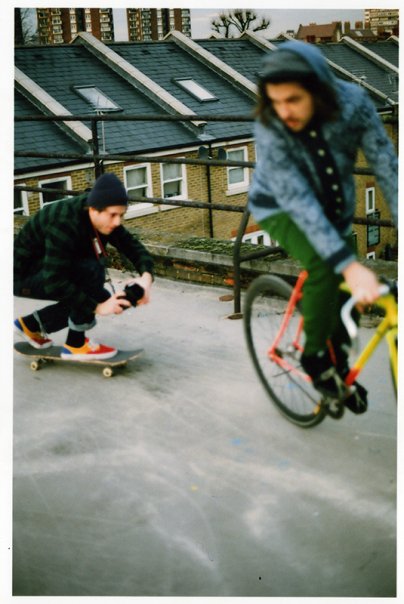 After graduating from his art master’s in Poland, Pawel Dziemian arrived in London in August 2009 and was introduced to the squatting scene through a friend. With no plans after finishing university and a hunger to carve an alternative path, the squatters’ lifestyle immediately appealed to him. “I had no plan, no money and no job,” he remembers. “But I had a craving for life, for extreme experiences and I wanted to go beyond my comfort zone.”

 Over the next two years, Pawel lived in a series of squats, in Walworth, New Cross and across South London. Picking up his camera, he shot an intimate portrait of life in London’s many squatted houses and commercial buildings – even dropping in to document squats north of the river, in Hackney and elsewhere, too.
In the wake of the 2007 financial crisis, it was a time when people were coming together to challenge the powers that be. “Financial crisis, credit crunch, Occupy movement, going green and student protests: I think back then we felt that we could shape socio-political reality,” Pawel reflects.

This hunger for change was widespread, but particularly resonated in London’s squat communities. “Squatting was particularly important then because it provided an alternative scene and space for young creatives of all kinds,” he says. “It also helps to tackle homelessness and the lack of adequate housing, in general. The legal protections provided to squatters support the less privileged, vulnerable urban dwellers, when the state usually sides with the landlords and big capital.”
Squatting in commercial properties is still legal, but the British government criminalised residential squatting in 2012. Combined with the meteoric rise of the property market and development, which has swallowed up much of the empty housing stock, the law change has reduced the proliferation of squats in the capital – but the community is still active and squatting remains a defiant protest against inadequate housing and inequality.


But even before the law change, the life of a London squatter was still chaotic and unpredictable – but also exciting, sociable and creatively stimulating, which is why Pawel picked up a camera to begin documenting life around him. “There were a number of reasons I began shooting,” he says, “but above all it was a search for beauty: beauty in leftovers of consumer reality, beauty in the grime and the cold.
“Looking back, I would also say that the camera was helping to deal with the unpredictable, tough conditions of squatting life. In those two years, the lens become a kind of barrier separating myself from the subject, from the sometimes harsh surroundings. There were many times I couldn’t shoot, when I wasn’t comfortable enough to separate myself from reality – like the two times I was arrested for squatting, for example.”

 In hindsight, Pawel feels much of the optimism of those years he spent squatting in buildings around London is gone. “After the financial crisis, many people believed that we might be able to change the world,” he reflects. “Nowadays, London and the UK appear more and more capitalistic, like New York and America, where every man is for himself and everyone has to be entrepreneur. ‘Business as usual’ won again.”


 Find out more about Pawel Dziemian’s work.
Enjoyed this article? Like Huck on Facebook or follow us on Twitter.
You might like

In photos: Black Texas life since emancipation
Kinship & Community — A new photobook and exhibition showcases the rich culture, history and community of African American folks in the Lone Star State, whose existence in the region predates colonial Britain.
Written by: Miss Rosen

London’s largest indoor skatepark to be demolished for padel courts
Better Extreme — The Barking skatepark’s fate follows that of similar indoor spaces in recent years, with operators GLL citing falling visitor numbers as the reason behind the decision.
Written by: Isaac Muk

Youthful joy & end-of-era poignancy at a London school prom
Leavers — For several years, Lewis Khan documented young people as they celebrated the last of their school days and the completion of their exams. The series is now collated in a new self-published photobook and short film.
Written by: Zoe Whitfield

Harry Gruyaert’s vintage, kaleidoscopic scenes of New York
A Sense of Place — For 50 years, the Belgian photographer and Magnum Photos member has been capturing NYC’s colourful chaos. A new photobook and exhibition showcase his unique, technicolour view of the city.
Written by: Miss Rosen

In the pit at one of the UK’s last stock car & banger speedways
Stock Car Racing Isn’t Dead — Photographer Liam McCarthy spent time in and around the Arlington Raceway’s circuit, capturing the diehard community that keeps the sport alive.
Written by: Isaac Muk

Inside Lower Duck Pond, the nicest town on the internet
/r/HaveWeMet — With a population of 2,500 and no fixed location, the subreddit is a space for roleplaying citizens to solve mysteries, host fictional events and ultimately connect. In an internet that’s often divided and toxic, Vicky Jessop hangs out in one of its most wholesome corners.
Written by: Vicky Jessop


