Photos documenting Japan’s underground subcultures
- Text by Isaac Muk
- Photography by Bruce Gilden

In the heady spring of 1974, a young Bruce Gilden went to see the latest exhibition at New York’s Museum of Modern Art (MoMA). Adorning the walls was New Japanese Photography, a collection of shots from the most eminent photographers from the East Asian archipelago.
The exhibition provided a glimpse into Japanese art, culture, and daily life – featuring photographers such as Shomei Tomatsu, Yasuhiro Ishimoto, Daido Moriyama and Masahisa Fukase. Gilden was drawn in: “They were influenced by [western] photographers like Ed van der Elsken and William Klein – yet they had their own take on it,” he says.
Feeling inspired, but also an urge to compete with their work, Gilden asked himself: “If they take good pictures there, why can’t I?”

JAPAN. Asakusa. 1998. Two members of the Yakuza, Japan’s mafia.
“It only took me 20 years to get there,” he says, with a wry smile. “The thing is when I arrived there, it wasn’t the 1960s or 70s, it was 1995, so it totally changed.”
His recently published book, Cherry Blossom, is a collection of photographs from his travels to Japan between 1995 and 1999. Venturing to Tokyo, Osaka and beyond, Gilden sought out the colourful and unexpected characters, taking him far off the beaten track for tourists, capturing it all in his own up close and personal, uncompromising style.
Spanning tattooed Yakuza gang members, homeless people living on the streets and smart-suited young men sporting greased back teddy boy haircuts, the photos explore the diverse array of characters and cultures within Japanese society before the turn of the century.

Businessman at lunchtime outside JR station. Tokyo, Kaeda, 1996.

Japan, 1999.
Prominently featured is the San’ya district in northeast Tokyo, an area that was met with bemused reactions from locals upon mention. Gilden says that when he told people that his favourite place to take photographs in the capital was San’ya, the usual response would be: ‘Where?’
“I’m sure they knew the name but they didn’t want to admit they knew of San’ya, or maybe there was a place like San’ya in Tokyo,” he says. “It’s a very interesting area, but also dangerous, because some people don’t like westerners – and some people are a little crazy. It’s a place where a few journalists have gotten killed.”
These journalists Gilden refers to were the directors of Yama—Attack to Attack, a 1985 documentary about the infamous district, who were murdered by members of a Yakuza gang.

Japan, 1999.
The Yakuza’s reputation as hardened, dangerous criminals still didn’t stop Gilden from searching them out for photos, which landed him in a few hairy situations. In Osaka, he ended up in a fistfight with a “low-level” gang member, who took exception with him taking a photograph.
“He was drunk and telling me, ‘you can’t do that’, and I’m like ‘mind your own fucking business’,” Gilden says. “I was with a Japanese person who was taking me around and they had to separate us.”
Why doesn’t he shy away from putting himself in potential danger? “My father was a gangster, so I know how to act around them. I’m very comfortable – you give respect, you get respect,” he says.

Right-Wing Nationalist at Yasakuni temple. Japan, Kyoto, 1999.
Years later, Gilden’s work has led to him meeting some of the photographers who originally contributed to the New Japanese Photography exhibition, including having dinner with Shomei Tomatsu and sharing an exhibition at a gallery with Daido Moriyama.
Sadly, he was unable to meet Masahisa Fukase. “He fell down a flight of stairs,” Gilden says. (Fukase died in 2012, having been in a coma for 20 years following a near-fatal fall down the stairs of his favourite bar in 1992.) “It’s interesting, because his photographs always for me were very violent, and that’s who he is.
“And that’s what makes the photographs so good – because you can only photograph who you are.”
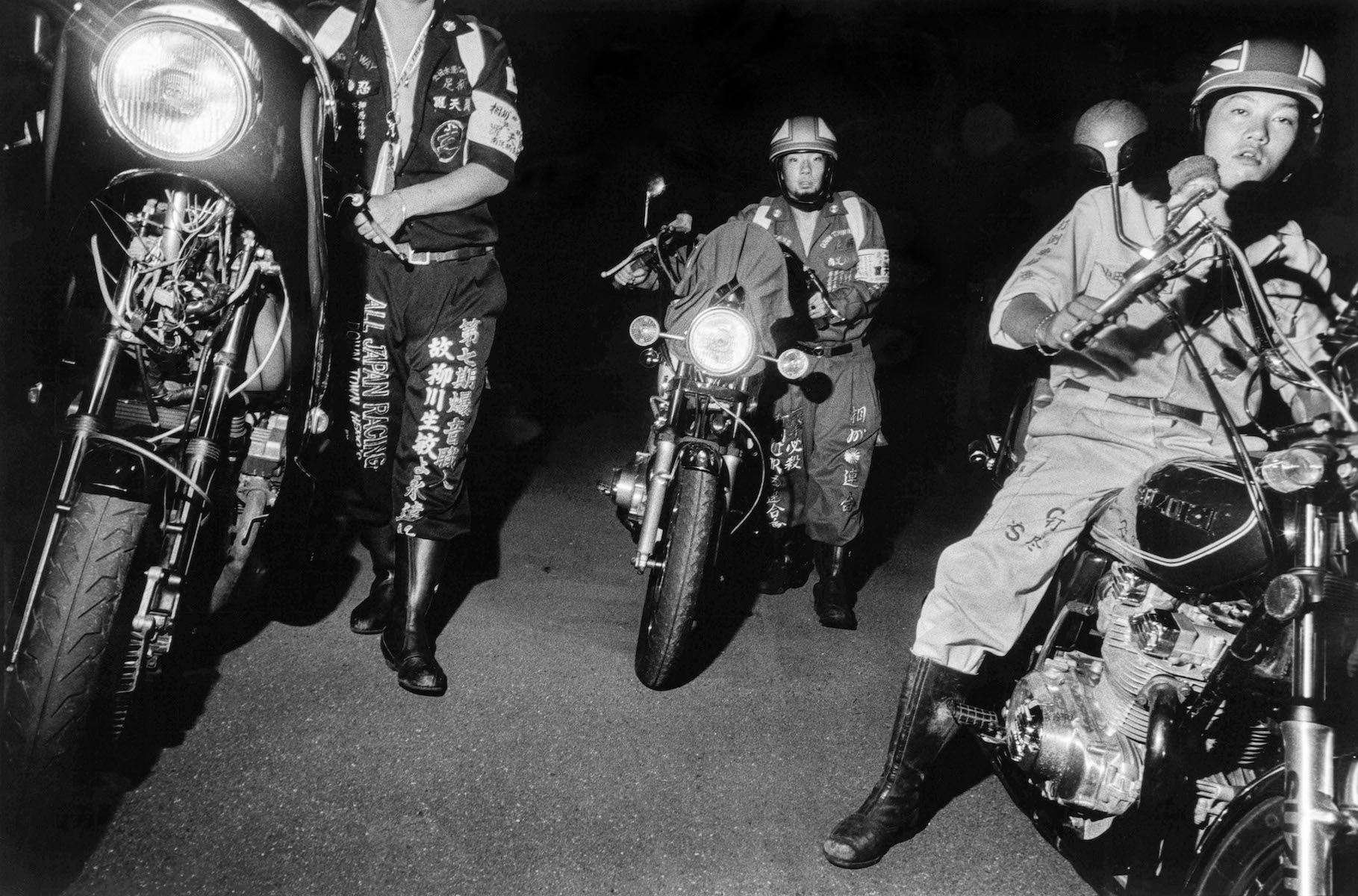
Bikers leave motorcycle meeting while being chased by police. Kamonomiya, 1999.

Homeless couple, Japan, 1996.
Cherry Blossom is published by Thames and Hudson and is available now.
Follow Isaac Muk on Twitter.
Enjoyed this article? Like Huck on Facebook or follow us on Twitter and Instagram.
You might like

In photos: Black Texas life since emancipation
Kinship & Community — A new photobook and exhibition showcases the rich culture, history and community of African American folks in the Lone Star State, whose existence in the region predates colonial Britain.
Written by: Miss Rosen

Youthful joy & end-of-era poignancy at a London school prom
Leavers — For several years, Lewis Khan documented young people as they celebrated the last of their school days and the completion of their exams. The series is now collated in a new self-published photobook and short film.
Written by: Zoe Whitfield

Harry Gruyaert’s vintage, kaleidoscopic scenes of New York
A Sense of Place — For 50 years, the Belgian photographer and Magnum Photos member has been capturing NYC’s colourful chaos. A new photobook and exhibition showcase his unique, technicolour view of the city.
Written by: Miss Rosen

In the pit at one of the UK’s last stock car & banger speedways
Stock Car Racing Isn’t Dead — Photographer Liam McCarthy spent time in and around the Arlington Raceway’s circuit, capturing the diehard community that keeps the sport alive.
Written by: Isaac Muk

Inside Lower Duck Pond, the nicest town on the internet
/r/HaveWeMet — With a population of 2,500 and no fixed location, the subreddit is a space for roleplaying citizens to solve mysteries, host fictional events and ultimately connect. In an internet that’s often divided and toxic, Vicky Jessop hangs out in one of its most wholesome corners.
Written by: Vicky Jessop

A major Nan Goldin exhibition is coming to London
You Never Did Anything Wrong — Opening at the Hayward Gallery in November, the show will debut a new film from the artist and activist, alongside a slate of recent work.
Written by: Jack Dennison-Thompson


