In Pictures: The humanitarian catastrophe at Europe's frontier
- Text by Alex King
- Photography by Hendrik Faller and Bailey Tom Bailey

“For months, volunteer organisations have worked to avoid a major humanitarian disaster on the island of Lesvos,” explains Merel Graeve, “but the authorities, under EU pressure, have started to try and smoke us out.”
Merel is a founding member of Better Days for Moria – named in reference to the over-stretched and under-resourced official registration camp Moria – which along with other volunteer groups has attempted to meet the needs of the thousands of refugees who arrive daily on Lesvos on flimsy dinghies from Turkey. Hendrik Faller and Tom Bailey joined Merel on Lesvos to document the challenging situation refugees face.

Photo by Hendrik Faller

Photo by Bailey Tom Bailey

Photo by Bailey Tom Bailey
Merel left Lesvos in January after spending months on the island, but has continued to monitor the situation, in daily contact with current volunteers. Conditions were at their worst in October 2015, as up to ten thousand refugees arrived daily, with an official response that was confused and inadequate.
“The police were using a queuing system to register thousands of people: a humanitarian disaster for the men and families who would sometimes wait anywhere between five days to a week, at one point in five days of non stop torrential rain and thunder,” Merel explains. “For five days they queued under the open skies, with no protection from the elements, no access to toilets, clean water or enough food.”
“If they left their place in the queue they would lose their spot. The family queue went on for three kilometres at some points,” she continues. “The handful of volunteers carried water and tents to the most vulnerable. But the amount of people who were left out was uncountable. No doctors dared to venture out into the ‘Olive Grove’ [unofficial camp], people held their half-dead infants up to us the whole day and we had nowhere to send them. To control the huge desperate crowds the police used teargas, gassing children, infants and desperate mums.”

Camp Moria perimeter fence. Photo by Bailey Tom Bailey

Photo by Bailey Tom Bailey

Photo by Bailey Tom Bailey
While authorities have struggled to cope with one of the largest movements of people in history, the assistance of volunteers has not always been welcome, and there has been friction over the volunteers’ unofficial “Olive Grove” camp next to the state run Camp Moria.
“Authorities arrested five lifeguards and accused them of human trafficking,” Merel tells me. “They stopped letting us inside the compound, then they built more barriers around the official registration camp and stopped letting us in there too. They cut off our water supply to our own independent camp, they diverted away the busses from our aid. Only on days when they are fully overwhelmed by the amount of boats arriving do they ask us for back-up. But we continue working hard as we have always done, adapting to whatever it takes to help, clothe, dress, feed and accommodate people. BDFM has especially become a safe haven for those who are having trouble registering due to increased EU restrictions.”

A makeshift refuge in a disused swimming pool on Lesvos. Photo by Bailey Tom Bailey
Merel says the arrival of Frontex and NATO ships in the area with reducing the amount of drownings during sea crossings, but has mixed feelings between the newly announced “1-in-1-out” deal between the EU and Turkey. “I believe offering a direct safe passage to Syrians from Turkey into the EU is a great thing, but I’m puzzled by the game of ‘swapping’ people over,” she explains. “These people are not mere numbers, they are human beings who need to be assessed individually about their vulnerability and be given help when they need it regardless of where they are geographically.”

Photo by Bailey Tom Bailey
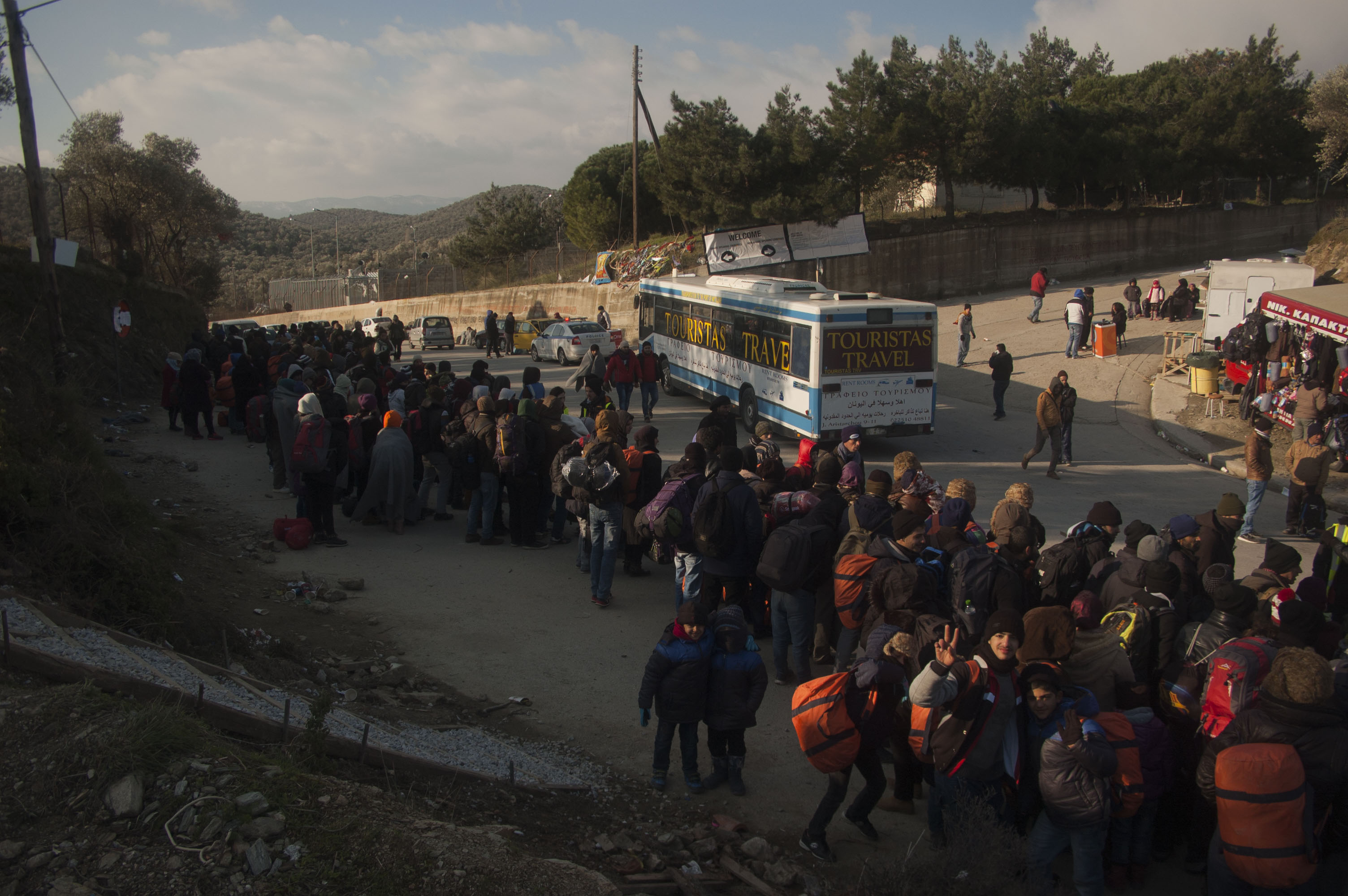
Photo by Bailey Tom Bailey

Photo by Hendrik Faller

Photo by Hendrik Faller
Conditions for refugees on Lesvos have improved greatly since October 2015, as proper resources have been brought to bear. However, there is still an enormous more to be done to meet the challenge of the refugee crisis – and Europe needs to fundamentally rethink its approach, Merel argues.
“The biggest humanitarian issue I believe, and has always been since the beginning, is the fact that refugees are being regarded by the politicians as numbers and by many people in Europe as if they are ‘different’,” Merel explains. “There is a sense of segregation, a sense of fear, a sense of entitlement over land and wealth and rights and freedom: privileges reserved only for us Europeans simply because we happened to be so lucky to have been born here, privileges we do not really want to share with anyone.”

Photo by Bailey Tom Bailey

Photo by Bailey Tom Bailey

Photo by Bailey Tom Bailey
So, what would she like to see as the official response? “I want to see some compassion from the EU,” she explains. “Maybe a hint that we have learned something from history.”
Merel points to her recent blog post: “For months we have been pulling desperate people out of sinking dinghies, we have treated children with hypothermia, we have fed malnourished families, we have shovelled shit in the Calais “Jungle”, clothed people, been teargassed among them, listened to their unimaginable stories and raised money to try and lessen their suffering,” Merel writes. “But most important of all, we have met people as real as you and I who are coming to Europe in search for a better life, not because they are looking for a handout, but because they have little choice. The refugees seem to be painted as though they are an entirely different species, not entitled to the same humanity or privileges we enjoy.”
Find out more about Better Days For Moria.
Enjoyed this article? Like Huck on Facebook or follow us on Twitter.
You might like
Activists slam “pervert glasses” in new guerrilla campaign
Everyone Hates Elon — Stickers have appeared on the London Underground network, criticising the wearable technology’s covert filming capabilities.
Written by: Isaac Muk

New exhibition highlights British radical living over 200 years
Earthly Paradise — Taking place at the William Morris Gallery, it explores the homes and lives of artists, writers, musicians and more, as well as the conditions that allowed them to thrive.
Written by: Isaac Muk

Pink Floyd’s Roger Waters joins team of new Palestinian resistance documentary
Freedom Theatre — Directed by Rishi Pelham, the film spotlights a theatre operating in the Jenin refugee camp.
Written by: Ella Glossop

Just Stop Oil holds first protest in 17 months
No new drilling — Having previously said that it was “hanging up the hi-vis”, the climate activist group has blocked a road outside Parliament to protest Andy Burnham opening the door for new oil and gas extraction licenses in the North Sea.
Written by: Ella Glossop

In photos: The enduring resistance of Notting Hill Carnival
Carnival of Resistance — A new photobook by Wayne Campbell and Wayne Crichlow reflects on the protest beginnings of Europe’s biggest street festival, along with the traditions keeping its original spirit alive today.
Written by: Isaac Muk

Tens of thousands gather to remember Jason Arday at London vigil
Stand Up to Racism — It took place in Trafalgar Square, with speakers paying tribute to the former Cambridge professor’s life and achievements, while calling for accountability over the reporting he faced from the mainstream press.
Written by: Ella Glossop


