
Striking portraits of side-saddled, Mexican rodeo women in the USA
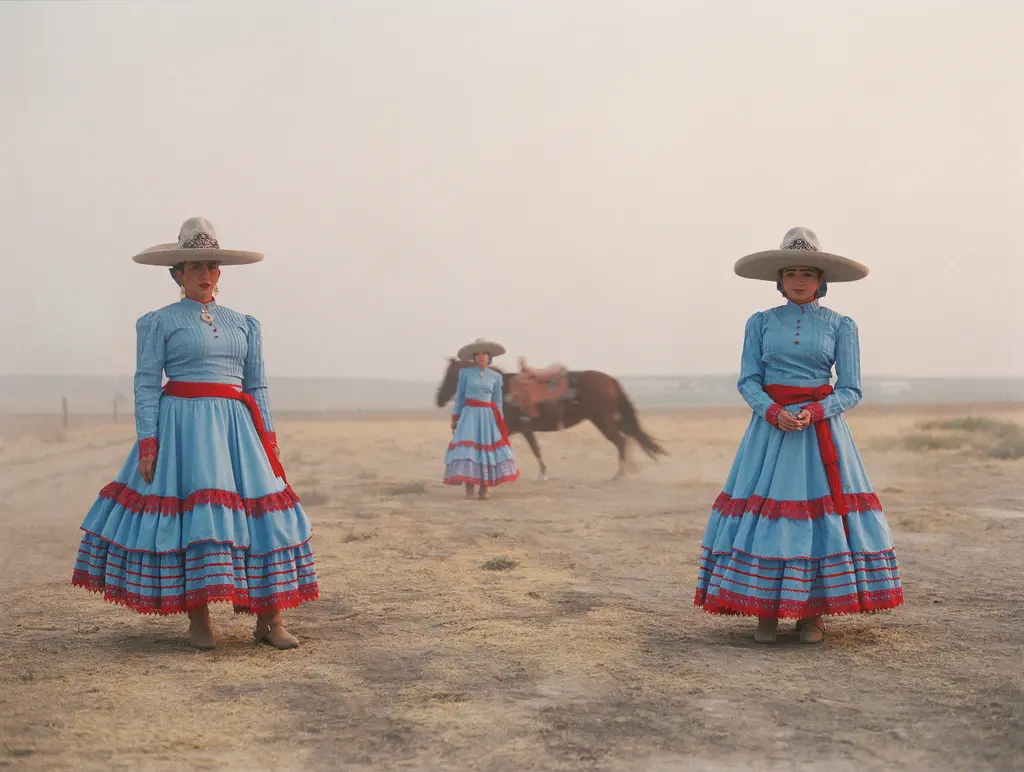
Escaramuza — Photographer and competitive horse rider Constance Jaeggi travelled across America to meet and document the women taking part in charrería – Mexico’s national sport – uncovering stories of migration, culture and identity in the process.
In Mexico, a charrería rodeo meet is a vibrant celebration of tradition and culture. Riders dressed in bold attire take on an array of challenges that include the lasso test Piales en Lienzo (Roping of the Feet) and equestrian competition Cala de Caballo (Test of the Horses). Meanwhile Mariachi and Banda music starts the party around the event’s dust ring centre, and a diverse array of local foods is cooked up for attendees.
Evolving from 16th century ranching traditions, charrería such a treasured part of national culture and identity that it lands on UNESCO’s Representative List of the Intangible Cultural Heritage of Humanity. It’s also the national sport of Mexico. But until 1953, it was a men-only sport, with women not being allowed to take part in the charrería, and even after that they only participated as half-time entertainers. They would only be recognised as proper competitors in 1992.
Yet over these years, the women, known as escaramuza, have become key parts of charrería meets. Riding side saddle and dressed in traditional outfits that include sombreros and long dresses, they perform daring, synchronised moves on the horses. It’s a display of skill and bond with horses, with riding side-ways, with both legs on a single side of the horse meaning that they only really have full control over half of the animal.


But what does escaramuza look like across the border, in the United States? It’s what Constance Jaeggi set out to find out when she began her project Escaramuza, which has now been published as a full photobook. The photographer has been a longtime lover of horses, ever since she first got into horse riding as a teenager in her native Switzerland, and even participated in equestrian sports herself.
“There just happened to be a place that did Western style riding close to where I lived,” she recalls. “I became fascinated with Western culture – I would spend all my weekends at the barn, and at lunch time we would watch Western movies and listen to country music, so I got into all these romantic notions of the American West, and started dreaming of living in the US and having a competitive riding career.”
It set her on a path that ultimately led her to Texas, where she attended college while also competing. While travelling to small towns across the USA to take part in the competitions, Jaeggi picked up a camera, and began taking pictures of horses and riding culture. “Photography became my connection with horses, which is very important and has shaped my life in a lot of ways,” she continues. “The camera was another way for me to explore my relationship with them.”

She first became truly engaged with escaramuza at the Forth Worth rodeo, where she began diving into the culture and photographing its characters and athletes, travelling across the USA to meet different escaramuzas and their communities. “I was immediately really interested, initially because of the aesthetics of it – it’s a really beautiful culture and tradition,” Jaeggi explains. “Then I started reading about it and found a few papers that talked about the gender boundaries within the sport and the connection to the soldaderas – women who fought in the Mexican Revolution – and how the image of these women changed over time to become more mythological and romanticised. I was really fascinated by all these layers.”
Much of charrería’s appeal is built on history and legend, with the sport acting as a source of national pride and identity in the wake of the Mexican Revolution. The same applies to escaramuza, with the word itself translating to “skirmish”, referencing those soldaderas. “The myth behind it was that they would be sent into battle before the men and kick up dust to distract the opposing side – I was fascinated by the historical connection, but also what it meant for women in Mexico and how in contributed to their emancipation. They were defying social norms and going into battle.”
That identity building and sense of national pride perhaps becomes even more pertinent across the border in the USA, as a means for people to engage with their national and cultural identities. A sense of pride is captured throughout Jaeggi’s photobook, from their intricately designed, well cared for outfits, to their close bonds with the horses that shine through in the photographs, while their voices are amplified through poetry by ire’né lara silva and Angelina Sáenz, who used interviews that Jaeggi recorded to bring their stories to life.
- Read next: Saddling up with Texas’ Creole trail riders


“A lot of the women I was photographing are mostly second, third, fourth generation migrants,” Jaeggi says. “One of the big things that kept coming up was that many of them didn’t feel American in the US, and when they went back to Mexico, they didn’t feel Mexican enough either. And this sport gives them a place, and a way of connecting with their home.”
With charrería still dominated by men, who also make up the majority of representatives on its sporting associations, there’s still a way to go for the escaramuza, but its rich culture and history provide a sense of place and belonging, especially in a USA that has been targeting Latine folks through targeted ICE arrests and deportations. “Several themes came out of my conversations, and immigration was definitely one of them, and a touchy subject,” she says. “You could say that charrería is the Mexican version of rodeo, but actually, it’s a precursor to American rodeo.”


Escaramuza by Constance Jaeggi is published by GOST Books.
Isaac Muk is Huck’s digital editor. Follow him on Bluesky.
Buy your copy of Huck 82 here.
Enjoyed this article? Follow Huck on Instagram and sign up to our newsletter for more from the cutting edge of sport, music and counterculture.
Support stories like this by becoming a member of Club Huck.
You might like

'Hyper-American' photos of life in rural Texas
Edward Thompson's portraits of Texas Hill Country during the George W. Bush years are both timeless and deeply personal.

The lasting community legacy of a legendary Californian boxing gym
Moretón — Since opening in the ’80s, the Coachella Valley Boxing Club has trained multiple world champions, while providing a vital hub for local youth. In his new photobook, Darren Vargas documents its tight-knit, Chicano-led community, while also weaving a deeply personal story.

In Portugal, a DIY longboarding festival is keeping surfing’s radical roots alive
Gliding Barnacles — Set in Figueira da Foz, the five day get together was born out of the local scene’s desire to protect the local environment and their coastal breaks. Ellie Howard traces its growth and all round celebration of creativity.

Inside the grunge golden age with Hole’s former bassist
My ’90s Rock Photographs — Melissa Auf der Maur’s new photobook is a sprawling visual memoir of her time at the heart of the US scene, from Tinker to The Smashing Pumpkins.

Introducing ‘The Chaos Isles’, a new photozine by Huck and Yushy
Normal Island — From unlicensed raves to the solstice at Stonehenge, furries to giant vegetable growers, Yushy is one of the UK’s best lensmen of its wild side. ‘The Chaos Isles’ will be sent out exclusively to Club Huck+ members.

Signs of solidarity as London marks three years of genocide in Palestine
Never forget — 250,000 people gathered on Saturday as Israeli attacks have continued in Gaza and the West Bank. Daisy Schofield photographed the diverse people and placards in attendance.


