A secret history of cross-dressing, in photos
- Text by Miss Rosen
- Photography by Sebastian Lifshitz / The Photographers’ Gallery

At the tender age of 10, Sébastien Lifshitz began collecting found photographs of men and women who refused to conform to the strictures of gender roles that demanded dressing according to an arbitrary set of rules. Here, in the privacy of their own space, they were free to don whatever clothing they wished and created a picture that stood as evidence to who they knew themselves to be.
Over the years, Lifshitz haunted flea markets, garage sales, junk shops, and eBay, amassing an impressive collection of amateur photographs of mostly anonymous men and women from Europe and the United States that date between 1880 and 1980. A selection of these works is on view in Under Cover: A Secret History of Cross-Dressers at The Photographer’s Gallery (February 23 – June 3, 2018).
“The subject of gender non-conformity and trans identity is something that feels very urgent right now: in our press, our social consciousness,” observes Karen McQuaid, Senior Curator at The Photographers’ Gallery. “We live with socially cultivated assumptions that men are one way and women are another when it comes to our dress, our actions, our accessories, our ambitions even – and historically there hasn’t been a lot of freedom in how we respond to these things. The more these issues are discussed openly, the more we educate each other and see gender as a spectrum.”

Five performers on a platform. Handwritten on verso ‘Haris Fifi, Zerneck Joe, Gaby Zerkovitz, Stasik Ficzin Mehelyi Mimi’. Albumen print, Hungary, circa 1900.
This sophistication is seen throughout Lifshitz’s collection, which reveals a wide range of styles and attitudes toward gender, costume, and identity. The more we look, the more we understand how limiting and disempowering it is to put gender inside a box and trap people within the confines of someone else’s definitions.
“One of the important things is to keep in mind is that the motivation for any of these individuals presenting as they do in front of the camera cannot be defined with any certainty,’ McQuaid explains. “There is a whole range of gender non-conforming presentations here, and one of the joys of the show is to dwell on those differences. We might come out of it with a broader understanding of how people deal with gender, dress, and identity. Because most people are unidentified we cannot say with certainty whether they were playing around in front of the camera or if this was a more serious part of their life, their identity and their practice.”

French prisoners of war in the German camp Königsbrück. Written on verso ‘Kriegsgefangenen- Sendung’. Germany, circa 1915.
The beauty of the photographs has a deeper resonance when you consider them as artefacts of a much deeper truth. “You have the documentary evidence of people who are purely resisting dominant and prescribed ways of being and that in itself is liberating to know – that it was persistent across all of these decades, communities, and societies,” McQuaid reveals. “You also have that much more private photographs, if someone does not want to present a certain way full time, and a lot of cross-dressers don’t; they say this is something I want to do part-time or sadly some people just don’t feel safe enough to, photography provides this amazing visual arbiter, proof that you have succeeded in achieving a look that you were aiming for.”
In this way, the photograph becomes a declaration of self, an object that exists as a testament to a secret that must be shared. “Sébastien was deeply affected by their lives, as he describes, ‘existence’s lived against the grain,’” McQuaid adds. “He was really struck by how courageous these people have to be to overcome the prejudices to be who they wanted to be.”

Behind the scenes at the cabaret, Kodachrome, United States, circa 1960.
![Guilda, [one of a triptych]. New York, United States, circa 1950.](https://www.tcocdn.com/wp-content/uploads/2018/02/03_Press-Images-l-Under-Cover-l-Guilda-1950.jpg)
Guilda, [one of a triptych]. New York, United States, circa 1950.

Mock wedding, United States, circa 1900.
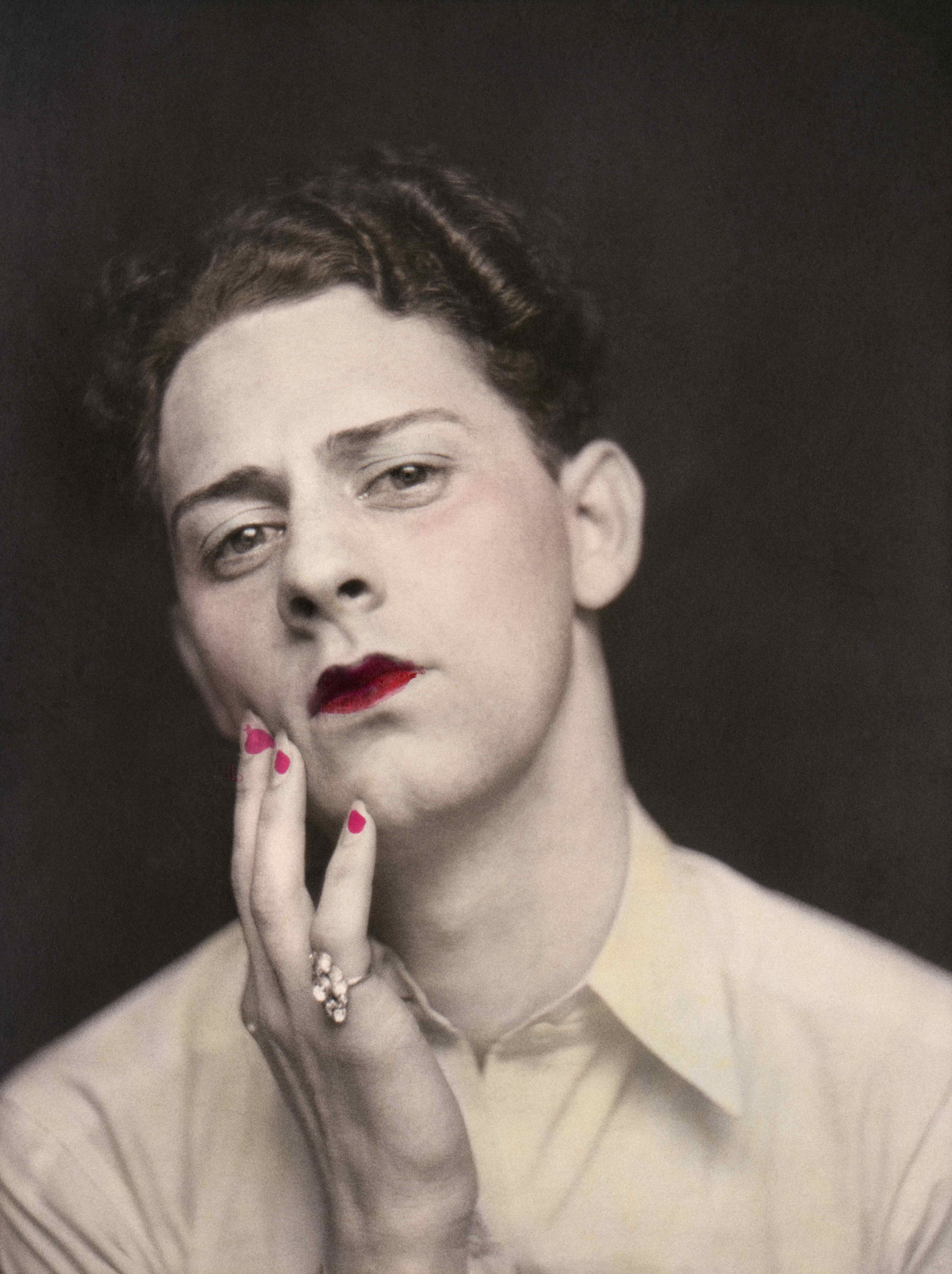
Man in makeup wearing ring. Photograph from a photo booth, with highlights of colour. United States, circa 1920.

English prisoners of war in the German camp,
Frankfurt. Handwritten on verso ‘Artists, Jude “& J. Lewis, second lieutenant, Welsh Regiment, 1st the King’s own”. Albumen
print, Hungary, circa 1900.

Man dressed as a woman, Mannheim, Germany, circa 1960.

René Boivin photographer, Paris, France, circa 1930.

Man in his garden, France, circa 1910.
Under Cover: A Secret History of Cross-Dressers runs at London’s The Photographer’s Gallery from February 23 to June 3, 2018.
Follow Miss Rosen on Twitter.
Enjoyed this article? Like Huck on Facebook or follow us on Twitter.
You might like

In photos: Black Texas life since emancipation
Kinship & Community — A new photobook and exhibition showcases the rich culture, history and community of African American folks in the Lone Star State, whose existence in the region predates colonial Britain.
Written by: Miss Rosen

Inside Parkuir: the art project queering sport, space and our bodies
Lie and play — Founded by Maria Laudes and Guiu Gimeno, it provides a framework for engaging, subverting, and celebrating the small details that make people unique – and queer.
Written by: Molly Lipson

Youthful joy & end-of-era poignancy at a London school prom
Leavers — For several years, Lewis Khan documented young people as they celebrated the last of their school days and the completion of their exams. The series is now collated in a new self-published photobook and short film.
Written by: Zoe Whitfield

Harry Gruyaert’s vintage, kaleidoscopic scenes of New York
A Sense of Place — For 50 years, the Belgian photographer and Magnum Photos member has been capturing NYC’s colourful chaos. A new photobook and exhibition showcase his unique, technicolour view of the city.
Written by: Miss Rosen

In the pit at one of the UK’s last stock car & banger speedways
Stock Car Racing Isn’t Dead — Photographer Liam McCarthy spent time in and around the Arlington Raceway’s circuit, capturing the diehard community that keeps the sport alive.
Written by: Isaac Muk

Inside Lower Duck Pond, the nicest town on the internet
/r/HaveWeMet — With a population of 2,500 and no fixed location, the subreddit is a space for roleplaying citizens to solve mysteries, host fictional events and ultimately connect. In an internet that’s often divided and toxic, Vicky Jessop hangs out in one of its most wholesome corners.
Written by: Vicky Jessop


