The sobering splendour of the hottest place on Earth
- Text by Paden Vaughan
- Photography by Patrick Fraser
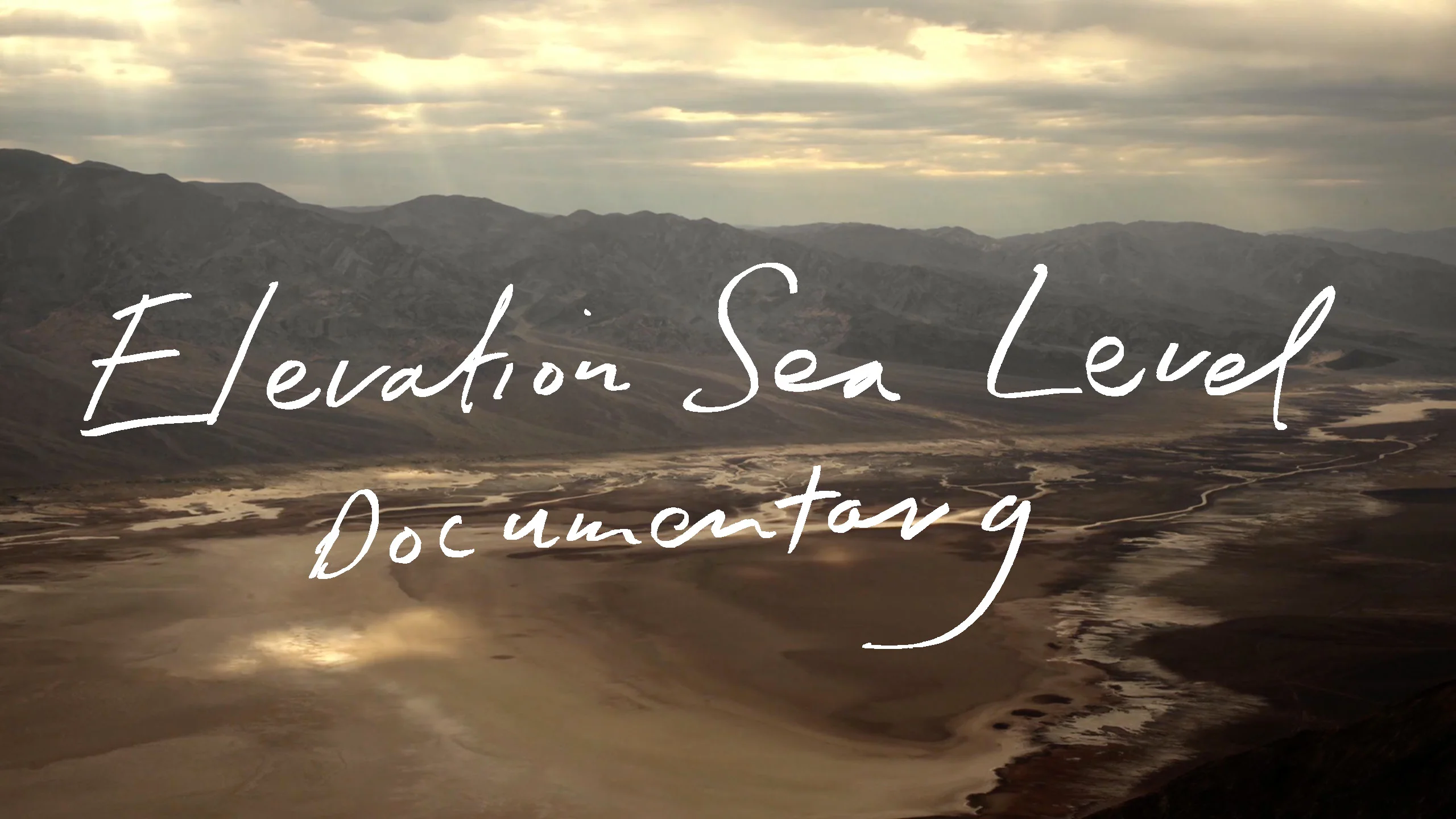
On 10 July 1913, at Furnace Creek in Eastern California’s Death Valley, meteorologists captured the world’s highest ever recorded temperature; a staggering 134 °F (56 °C). Over a century on, this desolate, almost Martian valley is not the sort of place that locals care to stay in for too long. But for a growing number of European tourists, this vast wasteland entrances and amazes, reinforcing our captivation with Earth’s extremities.


It was this obsession with our planet’s most hostile environments, that drew photographer and filmmaker Patrick Fraser to the valley, acting as inspiration for his latest short film Elevation Sea Level.
Patrick has been in the U.S. for over 15 years now, swapping sleepy Norwich for the great expanse of the American West Coast, his love of the outdoors providing a never-ending source of inspiration. Patrick’s latest beautifully shot short film meets the Europeans who, for the anniversary of Death Valley’s record-breaking temperature, made the pilgrimage to the desert’s lowest point at Furnace Creek, undergoing an almost epiphanic transformation on arriving.


What initially drew you to Death Valley?
I’ve always been fascinated by the desert in the US; I’ve been living out here for 18 years and I’d go to Death Valley and Joshua Tree a lot. I noticed over the years that a lot of Europeans visit the valley for the anniversary of the hottest ever recorded temperature on the 10th of July, so thought it would be interesting to capture their experiences.
We collectively seem to be fascinated by ‘extremes’, wouldn’t you agree?
Thats right, we’re definitely drawn to these extremes. I think they were curious to see what these places are like and that curiosity was part of it. There was something about the tourists I met there that really intrigued me; the local people don’t really visit Death Valley but the Europeans seem enthralled by it. As a European myself, I can see how America seems like a huge adventure.


What surprised you when speaking to the film’s subjects?
Well I guess I was surprised there were so many people there. A lot of them came from the real high points of Yosemite, and then dropped down to the lowest point. That change was something they loved; this high to low adventure. But I think it was just them experiencing that extremity of heat and their sheer loss for words at being there. It’s an amazing place, there’s nothing like it in Europe, so they’re seeing something that seems almost alien.
Take for instance the French woman I interviewed; she was taking her son and daughter to this out of the world experience. But they’re from this small town outside of Paris and they’re seeing something so huge and overwhelming.
As a European, did you feel you could relate to these tourists when filming in the valley?
Definitely, there was a lot of that. People from the U.S. don’t go to Death Valley for vacations; they go to Hawaii or even to Europe, but I get why the Europeans go there. There’s no american interviews, so you’re just getting a snapshot of this incredible place through the European mind.


Obviously the heat can be a killer, did you find it an issue filming there?
Sometimes; its crazy, you have to make sure your car is working otherwise you’re gonna be stranded, and each of us had to have at least a gallon of water a day. One day my cameraman had to sit in the car with the camera blasting the AC because it was that bad.
Did you find it reinforced the love you felt for the desert?
I love that these places exist, no matter how many times I go the national parks I’m always blown away; there’s always something new and quirky. Thats partly why I came to America because of the huge open spaces here. Sometimes I need to just go out into the middle of the desert; living in LA can be stressful, so it’s great to have these remote natural places to go and recharge your batteries. And in the film there’s no mention of cities, just these astonishing natural places.
I guess it’s almost like a poem to the desert, or a snapshot, in keeping with my photographic ethos.
Enjoyed this article? Like Huck on Facebook or follow us on Twitter.
You might like

In photos: Black Texas life since emancipation
Kinship & Community — A new photobook and exhibition showcases the rich culture, history and community of African American folks in the Lone Star State, whose existence in the region predates colonial Britain.
Written by: Miss Rosen

Youthful joy & end-of-era poignancy at a London school prom
Leavers — For several years, Lewis Khan documented young people as they celebrated the last of their school days and the completion of their exams. The series is now collated in a new self-published photobook and short film.
Written by: Zoe Whitfield

Harry Gruyaert’s vintage, kaleidoscopic scenes of New York
A Sense of Place — For 50 years, the Belgian photographer and Magnum Photos member has been capturing NYC’s colourful chaos. A new photobook and exhibition showcase his unique, technicolour view of the city.
Written by: Miss Rosen

Inside Lower Duck Pond, the nicest town on the internet
/r/HaveWeMet — With a population of 2,500 and no fixed location, the subreddit is a space for roleplaying citizens to solve mysteries, host fictional events and ultimately connect. In an internet that’s often divided and toxic, Vicky Jessop hangs out in one of its most wholesome corners.
Written by: Vicky Jessop

A major Nan Goldin exhibition is coming to London
You Never Did Anything Wrong — Opening at the Hayward Gallery in November, the show will debut a new film from the artist and activist, alongside a slate of recent work.
Written by: Jack Dennison-Thompson

Tender portraits of women serving life sentences in America
Looking Inside — While working as a public defender attorney in New York State, Sara Bennett found dilapidated prisons and forgotten people. Her new photobook harnesses the power of images and shines a humanising light on those imprisoned for serious crimes and their reintegration into society, while asking questions of the USA’s incarceration system.
Written by: Miss Rosen


